Key Insights
- Harmony’s Bitcoin Bridge was sunset in Q4 2022, now requiring manual processing. However, they relaunched cross-chain bridging by partnering with LayerZero on October 27, 2022.
- Through efforts of the Recovery One Foundation and its partners, over $4.4 million in devalued bridge assets have been removed from circulation as of year-end.
- Harmony released their 2023 technical roadmap to develop light clients and account abstraction.
- The FBI confirmed Lazarus Group was responsible for Harmony’s Horizon Bridge theft.
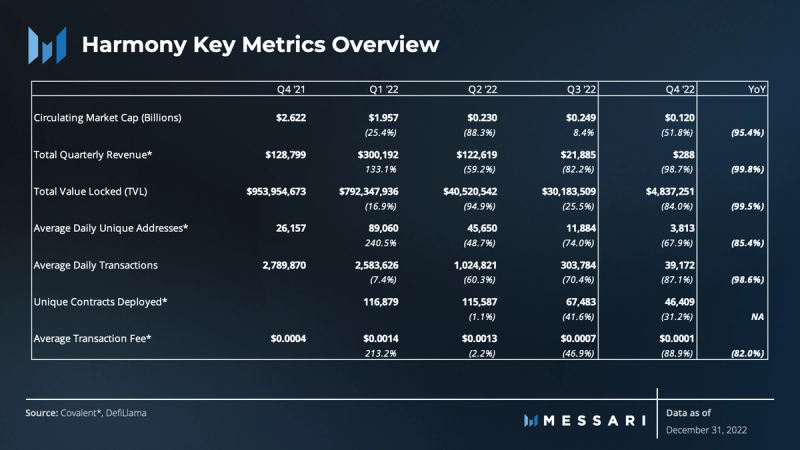
- Network usage declined substantially in Q4 as quarterly revenue and average daily transactions fell by 99% and 87%, respectively.
Primer on Harmony
Harmony is an Ethereum Virtual Machine (EVM)-compatible, Effective Proof-of-Stake (EPoS) smart contract platform for decentralized applications. It uses the Fast Byzantine Fault Tolerance (FBFT) consensus mechanism and a random state sharding technique that separates a chain into segments. Each segment processes transactions and stores data in parallel, thus increasing transaction throughput and speed. Harmony also utilizes a Verifiable Random Function (VRF) and Verifiable Delay Function (VDF) to ensure secured randomness when validators are assigned to shards, preventing the possibility of a “single shard attack.” Harmony achieves 2-second transaction finality across four shards.
Key Metrics
Performance Analysis
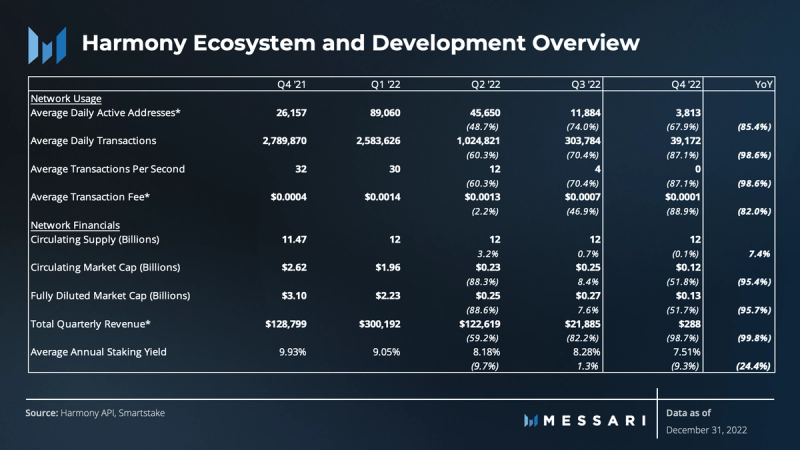
Harmony’s network usage, defined by daily active addresses and transactions, has trended downward each quarter since it hit all-time highs in Q4 2021. The decline in network usage wasn’t isolated to Harmony, as the macroeconomic climate, UST collapse, and failure of FTX impacted many L1s throughout the year. However, Harmony experienced additional downward pressure on its network activity after the departure of DFK and the Horizon Bridge hack.
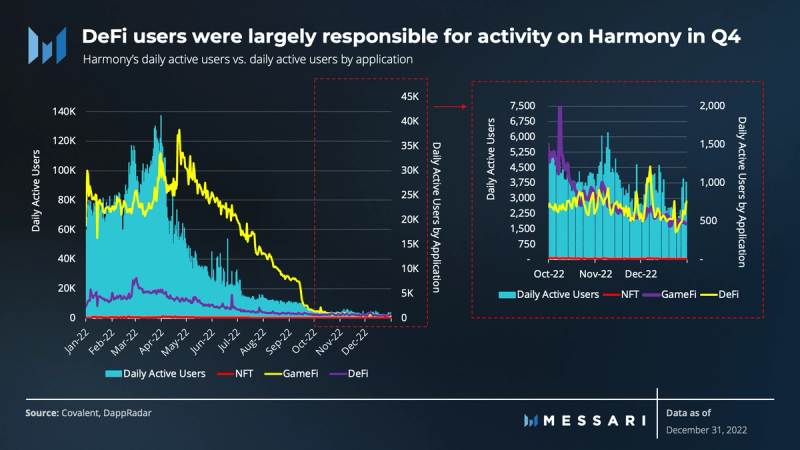
On average, there were 3,800 daily active users in Q4, or 68% less than the 12,000 users in Q3. This starkly contrasts with the nearly 26,000 average daily active users during Harmony’s peak at the end of 2021. Since DFK’s departure in late April, the number of active users has steadily declined.
In Q3, the recovery plan and Harmony’s commitment to 0% minting established that treasury funds would be deployed over four years to strategic partners. Partnerships with Recovery One Foundation, Tranquil Finance, and Modulo were formed to facilitate a burning mechanism, ultimately using those funds to burn devalued assets and remove them from circulation.
As of late, Harmony’s DeFi users have helped sustain the existing active user base during the quarter, likely due to users burning assets with these DeFi partners.
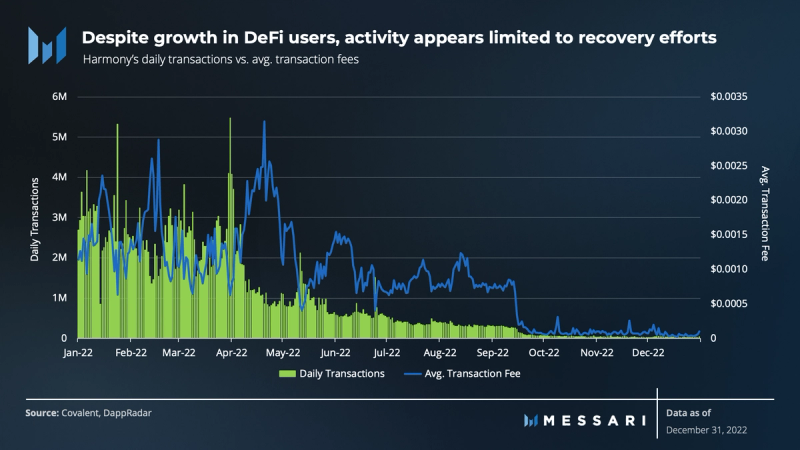
There were nearly 2.8 million average daily transactions in Q1 2022. Fast forward to Q4, Harmony’s average daily transactions fell by 87% to approximately 40,000. After dropping from 304,000 in the prior period, it constituted a 98% decline YoY. In addition to the decline in transactions, average transaction fees fell to their lowest as network activity fell drastically, and the price of Harmony’s token ONE reached two-year lows.
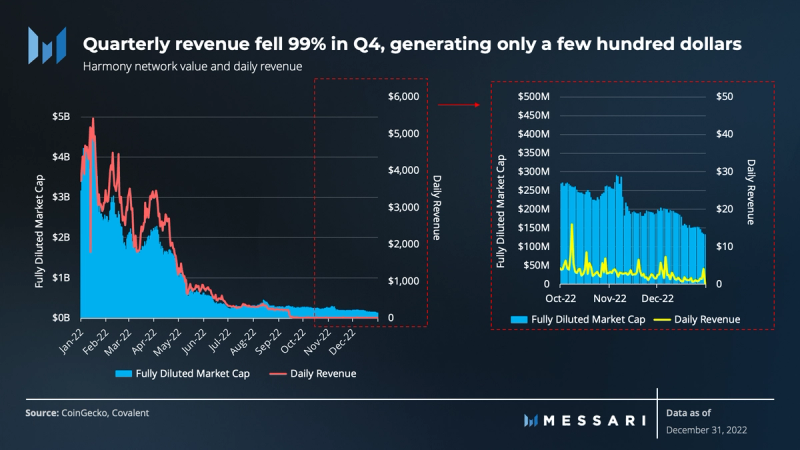
During the days of heightened activity with DFK earlier in the year, Harmony was generating, on average, $3,300 in daily revenue in Q1. The second quarter saw average daily revenues fall 59% to $1,300. By the second half of 2022, average daily revenues were less than a few hundred dollars daily. The decline in network activity in H2 2022, compounded with consistent price depreciation, put significant downward pressure on revenue generation.
In October 2022, the Harmony community/team put forward discussions for the Harmony Improvement Proposal (HIP) – 28, which was still open heading into 2023. It proposed a hard fork to route all protocol revenues to the treasury. The proposal aimed to provide a reserve cushion to help sustain infrastructure expenditures to maintain normal protocol operations. These expenses include Harmony’s Elastic RPC, Oracle, multisig, block explorer, and more.
Ecosystem and Development Overview
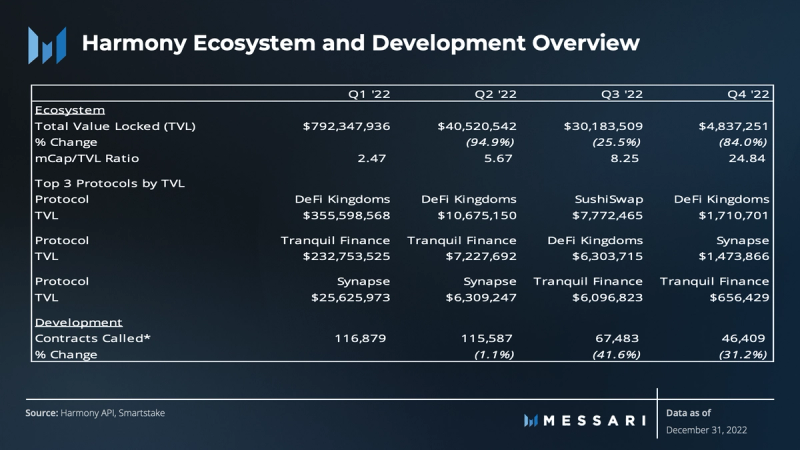
Harmony’s ecosystem has experienced ongoing challenges following the departure of DeFi Kingdoms in April. The total value locked (TVL) fell to new lows at $4.8 million in Q4, an 84% decline from Q3.
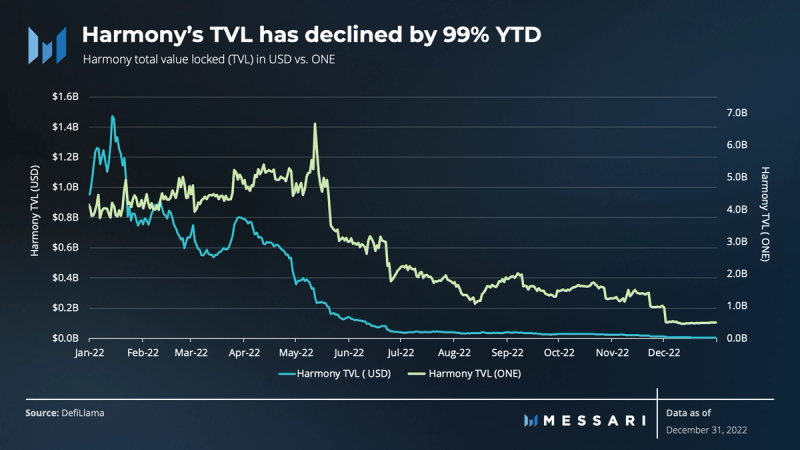
The Horizon Bridge hack in May amplified the effects of DFK’s departure and the overshadowing bear market. Harmony’s TVL saw its steepest decline in 2022 as its once-robust user base started diminishing. After FTX collapsed in early November, Harmony’s TVL declined by ~80% through the end of the year.
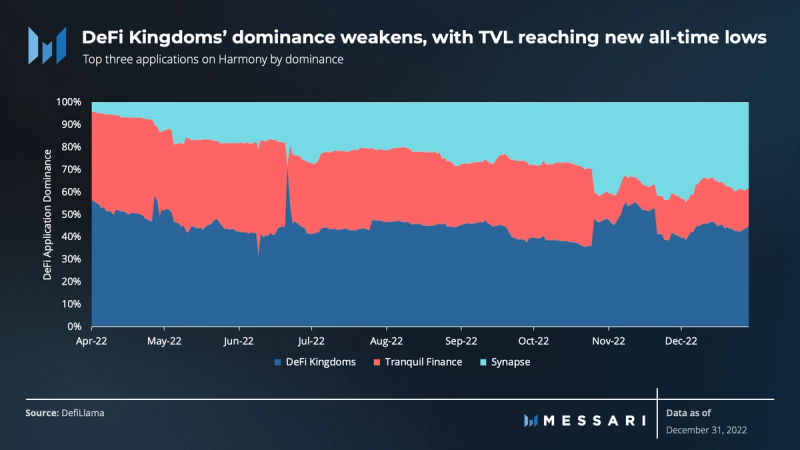
In Q4, there was a substantial shift in user behavior on Harmony’s platform. According to Harmony’s top applications on DappRadar, Q4 data shows that unique active wallets (UAW) within GameFi accounted for roughly 52% of UAW compared to 46% for DeFi. However, in Q3, UAW in GameFi grew to 90%, whereas DeFi was less than 10%.
This user base shift from GameFi into DeFi appears strongly correlated to participation in Recovery One’s burning program. Applications like Tranquil Finance, Fuzz Finance, and Modulo were nominated as burn partners to help facilitate the burning/repegging of assets affected by the Horizon Bridge.
Staking and Decentralization Overview
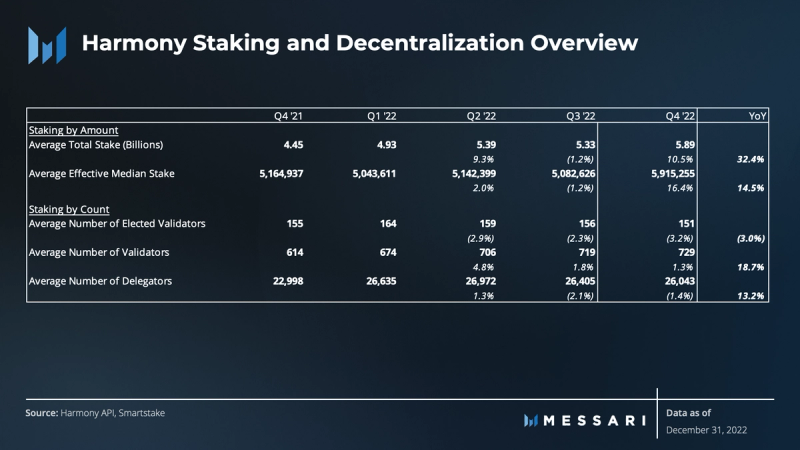
Harmony uses a unique staking mechanism called Effective Proof-of-Stake (EPoS). Staking rewards are based on the effective median stake of validators. The validators’ rewards are capped by this mechanism, incentivizing them to spin up a new validator to maximize rewards. The mechanism is designed to promote further decentralization and to prevent “overstaking.” In turn, delegators are encouraged to delegate to validators below the median stake to capture optimal rewards.
Validators are required to stake the effective median amount to be eligible for election. In Q4, the effective median amount staked grew by 16%, from 5.0 million to 5.9 million ONE. This would require validators to increase their effective median stake to be eligible for election. The additional 900,000 ONE needed would equate to roughly ~$14,000 for a validator who is short of stake.
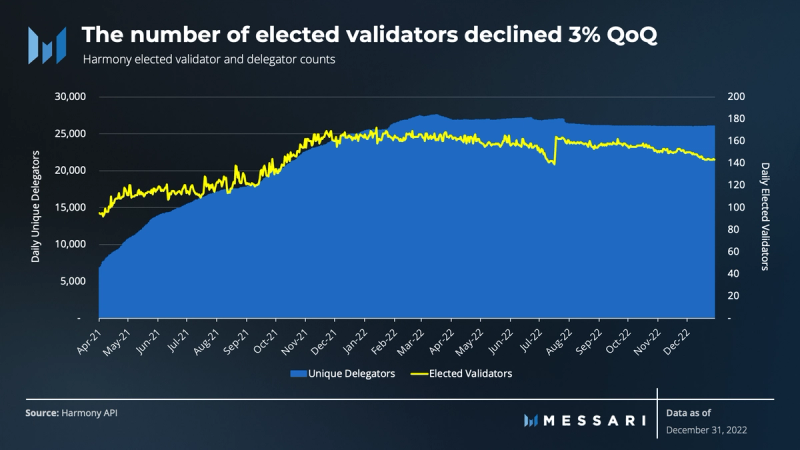
The Q4 decline in elected validators from 156 to 151, or a 3% decline, is likely a result of validators becoming ineligible due to median staking requirements or validators shutting down operations. The average total stake denominated in ONE has remained steady throughout 2022, growing by 11% QoQ.
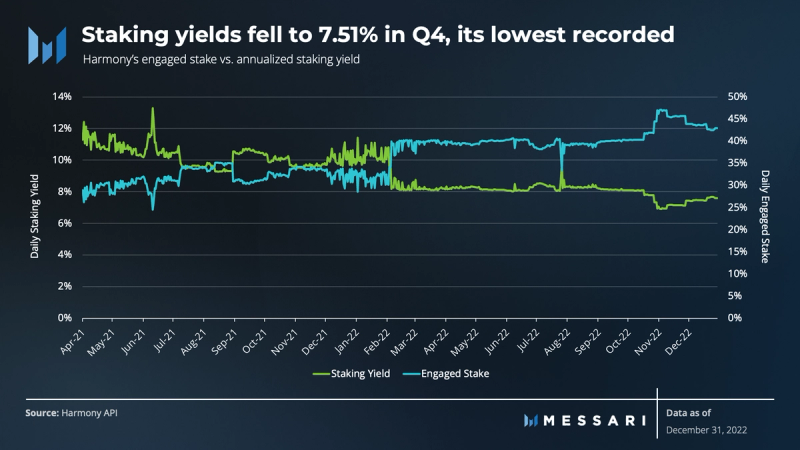
The average total staked grew by 11% in Q4, whereas the average effective median stake grew by 16%. In addition to shrinking the number of elected validators, the large increase in the effective median stake applied downward pressure on average staking yields. Harmony’s staking yields fell from 8.28% in Q3 to their lowest, 7.51%, in Q4.
Qualitative Analysis
Key Events
Infrastructure Updates
- Harmony’s V4.3.13 — This mainnet release was a non-mandatory upgrade for all Harmony validators. It included minor changes to improve consensus, RPC, node, and CLI commands.
- LayerZero Bridge — On October 27, Harmony announced a relaunch of cross-chain bridging by partnering with LayerZero and utilizing its multisig validation layer. The partnership reduced the need to maintain any backend infrastructure around the bridge and should help instill new confidence in Harmony’s bridging solution.
Horizon Bridge Post-Mortem
Recovery One Foundation
Since the foundation was established in Q3, four “burn partners” have been chosen. This includes Recovery One Foundation (R1), Tranquil Finance, Modulo, and recently added Fuzz Finance. The Harmony team committed to 0% minting and strategically deploying reserves from its treasury to help with ongoing Horizon Bridge recovery efforts.
By the end of Q4, three rounds of funding from the treasury had taken place. Its first round of funding took place on October 20 with $150,000 USDS, successfully burning approximately ~$1.6 million in devalued bridged ONE assets. In early November, another $150,000 in USDS was deployed, taking roughly $1.5 million in devalued assets out of circulation. Towards the end of Q4, another $150,000 was deployed for a third round of funding, burning an additional $1.4 million in assets.
Each partner offers different ways in which assets are burned. For example, Modulo utilizes a Dutch auction burn mechanism, whereas Tranquil uses a direct market mechanism. Through the efforts of partners and users, participants have successfully burned over $4.4 million in depegged assets, with $450,000 deployed from Harmony’s treasury.
Bridge Hack Fund Movement and Involvement (Subsequent Events)
On January 16, 2023, Binance CEO CZ announced his team had detected the movement of funds stolen in the Horizon Bridge incident. Through a collaboration with Huobi, funds were frozen, recovering an estimated 124 BTC. One week following the announcement, the Federal Bureau of Investigation (FBI) released a formal statement confirming that the Lazarus Group was responsible for stealing bridge funds.
Strategic Partnerships
Harmony has taken notable strides in partnering with platforms that will help spearhead its footing in the GameFi and Web3 space. Four key partnerships were established in Q4.
- Game Space is a GameFi-as-a-Service (GaaS) platform that will integrate with Harmony and help reduce the friction in onboarding Web2 games into Web3. Using an embedded software development kit (SDK), builders can deploy custom in-game marketplaces and NFTs.
- Blockcoders announced the launch of the first public NFT marketplace SDK on Harmony.
- Grindery announced its launch and deployment of Grindery Gateway on Harmony. Grindery Gateway is a no-code Web3 API allowing users to mint NFTs and create new workflows, merging Web2 and Web3 applications. Grinery makes this possible by syncing with Zapier, using an email address.
- Lossless will add a layer of defense using Aegis for the newly launched LayerZero bridge. Aegis is an automated threat monitoring system for Web3 projects looking for preventative measures to avoid exploits.
Governance
In Q4, the Harmony Improvement Proposal (HIP) – 28 Fee Collection has been a contentious one. At a high level, HIP 28 proposed the collection of network transaction fees to fund vital infrastructure services and partnerships. However, this change would eliminate the current fee-burning mechanism, route transaction fees into a multisig wallet, and, most importantly, result in a hard fork. Broadly speaking, this would have large implications for tokenomics and validator rewards.
(Subsequent Events: HIP-28 has since failed, which is a win for the overall governance community. HIP-28v2 is now in progress to split the transaction fees 50/50 between vital infrastructure and burning.)
Roadmap
On January 5, Harmony detailed the main priorities for 2023. The team will focus on State Pruning, Cross Shard transactions, Light Clients, Leader Rotation, and more efficient State Syncing.
- State Pruning
- If nodes could safely delete old block data while maintaining the trustless validity of the chain state, then the large storage space requirements would be relieved. State Pruning would require less data to validate, shorten sync time, reduce costs, and improve network efficiency and output.
- Cross Shard Transactions
- To improve scalability, Harmony plans to bring significant changes to transaction processing and consensus algorithms to allow transactions to be processed across multiple shards.
- Light Clients
- The team plans to grant users the ability to interact with local RPCs instead of a full node, which would reduce friction and lower network load and costs
- Leader Rotation
- Harmony will likely implement a hybrid leader rotation approach using variable random functions to elect leaders. This leadership model would improve security and decentralization
- State Syncing
- This solution would ensure full nodes can synchronize their state efficiently, improving speed and efficiency.
In addition to these priorities, Harmony will continue pursuing GameFi and Web3 as they see abundant opportunities within digital identities, domains (e.g., ENS), marketplaces, and gaming.
Closing Summary
Between the collapse of Terra UST and FTX and the attacks on various bridges, it’s safe to say the entire industry has endured obstacles throughout the year. However, Harmony faced another layer of challenges with the departure of DeFi Kingdoms and the Horizon Bridge. The considerable decline in network usage and participation within the ecosystem this year is troubling and has negatively impacted community morale.
Harmony must leverage its recent partnerships to onboard new games, NFT markets, and developers to bring more activity to the platform. Additionally, the protocol should seek to achieve the milestones on its roadmap to realize its long-term vision.
The road to success is never easy, but Harmony’s persistence, timely execution, and absolute transparency will be paramount to sustaining the community’s support in 2023.