Key Insights
- Since its December 2024 launch, Sonic has seen impressive growth, with TVL increasing 21-fold to $565 million and DEX volume surpassing $2.3 billion.
- Sonic’s transaction activity remains robust, with a cumulative total of 26 million transactions and a daily average of 399,882. Shadow Exchange, a native DEX, accounts for 30% of this activity.
- Sonic’s technical features, including high transaction throughput, sub-second finality, and the optimized SonicVM, offer a competitive platform for application development.
- The S token airdrop (valued at $160 million), featuring a vesting schedule and burn mechanism, is designed to encourage long-term network participation.
- Daily active addresses on Sonic average 25,650, with a cumulative total of 743,323 unique wallets interacting with the blockchain since its launch
Primer
Sonic (S), a new Layer-1 blockchain developed by the team behind Fantom Opera, aims to provide a high-performance platform for decentralized applications. Leveraging experience from Fantom’s Opera chain, Sonic emphasizes improved speed and scalability. Technically, Sonic achieves 10,000 transactions per second with sub-second finality, a noteworthy improvement over existing EVM-compatible chains. This performance is intended to support high-volume transaction throughput. EVM compatibility, along with Solidity/Vyper support, facilitates the migration of existing Ethereum-based applications. The native token, S, functions for transaction fees, staking, validator operations, and governance. A 1:1 token upgrade mechanism is available for FTM holders on Fantom Opera.
Sonic’s architecture is designed around several key features. A fee monetization model allows developers to earn up to 90% of the transaction fees generated by their applications. An Innovator Fund, with up to 200 million S tokens allocated, aims to attract new projects to the ecosystem. A corresponding airdrop of approximately 200 million S tokens is planned for users of both Fantom Opera and Sonic. The Sonic Gateway provides a bridge from Ethereum, permitting asset transfer and access to liquidity. This bridge incorporates a fail-safe mechanism for asset protection.
Sonic’s goal is to provide a robust platform for DeFi development. The emphasis is on achieving high throughput and low latency while maintaining EVM compatibility. Further details regarding the underlying architecture and specific technical implementations can be found here.
Website / X (Twitter) / Discord
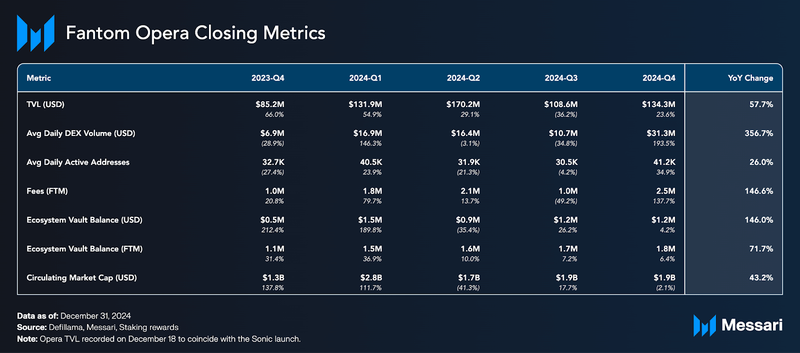
Fantom Closing Metrics
Opera Closing Overview
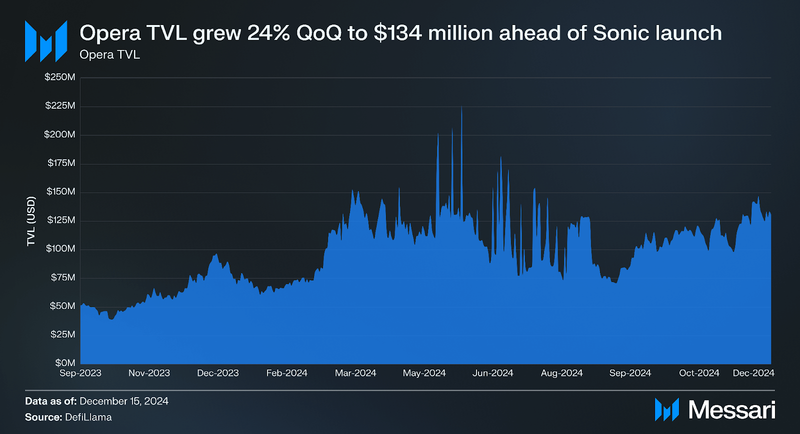
Anticipation for the Q4 2024 Sonic launch drove growth on the Opera network. TVL increased by 24% QoQ, rising from $108 million to $134 million, led by protocols like SpookySwap ($14 million TVL), Beethoven X ($8 million TVL), and WigoSwap ($7 million TVL).
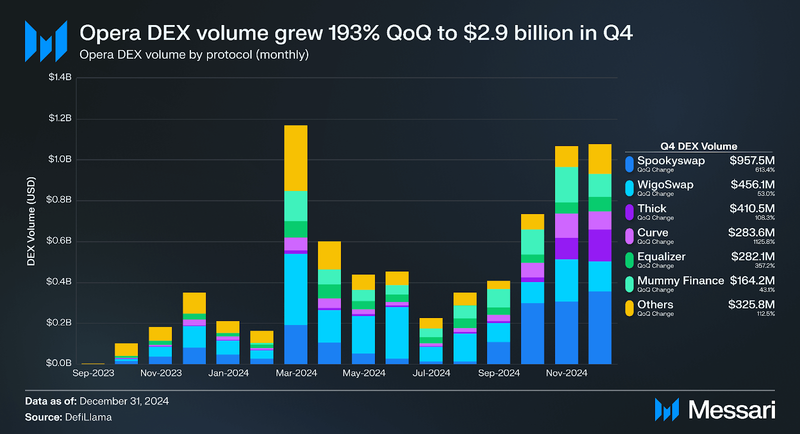
This surge in activity extended to DEX trading volume. The Opera network DEX trading volume saw a remarkable 193% QoQ increase, jumping from $982 million to $2.9 billion. Key contributors included SpookySwap ($958 million in volume), WigoSwap ($456 million), and Thick ($411 million).
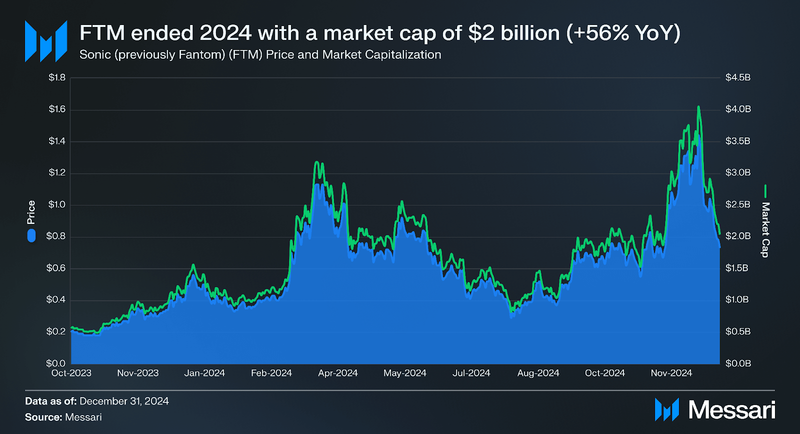
Market enthusiasm surrounding the Sonic launch was evident. The FTM token price peaked at $1.44, reaching a $4 billion market capitalization, before settling at $0.73 with a $2 billion market cap by the end of Q4. This final market capitalization represented a 56% YoY increase.
Hello Sonic
Launched in 2019, Fantom’s Opera network provided a foundational smart contract platform, but upgrading a live blockchain presented inherent challenges. To address these limitations, Fantom developed Sonic, a new high-throughput chain, announced in March 2024 and followed by a rebranding to Sonic Labs in August. Q3 2024 saw the unveiling of key technical features and initiatives, culminating in a September testnet launch. Sonic officially launched on December 18, 2024. With this successful launch and the strong onchain metrics demonstrated by the Opera network in anticipation of Sonic, the focus now shifts to the performance and adoption of the new Sonic chain.
TVL
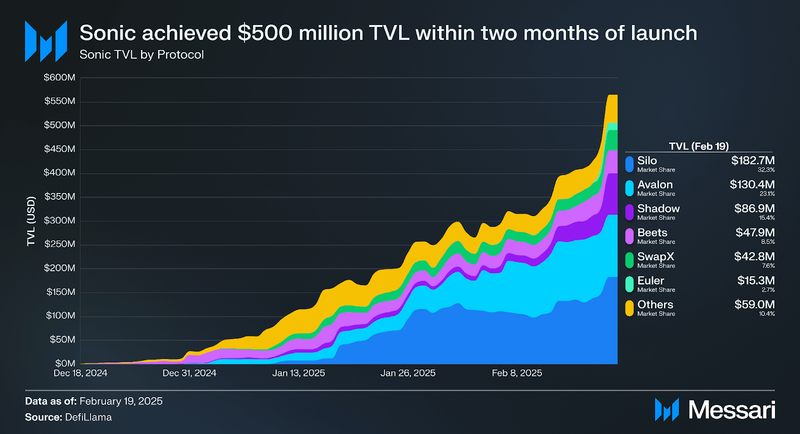
Sonic has demonstrated impressive growth since its launch, with TVL reaching a record high of $565 million as of February 19, 2025. This represents a remarkable 21-fold increase since the beginning of 2025. Leading protocols include lending platforms Silo ($183 million TVL) and Avalon Labs ($130 million TVL), followed by Shadow Exchange ($87 million TVL), Beets ($48 million TVL), and SwapX ($43 million TVL).
Volume
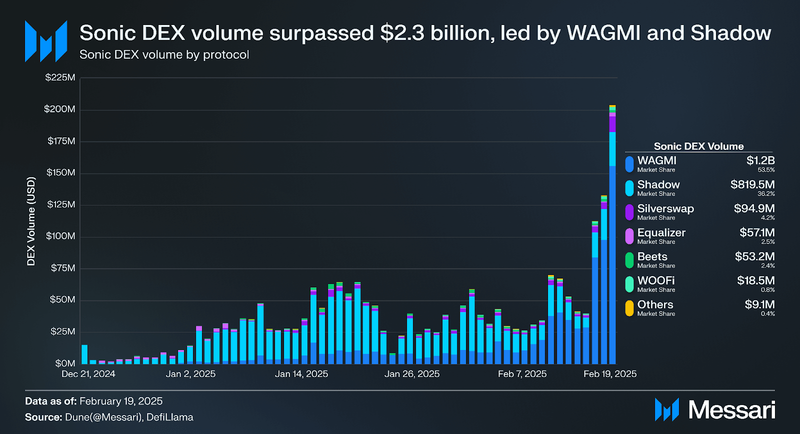
Since its launch, the Sonic network has facilitated significant DEX activity, generating a total trading volume of $2.3 billion. This volume is dominated by WAGMI, capturing a 54% market share with $1.2 billion traded. Shadow follows closely behind at 36% market share, accounting for $819 million in volume. Other notable DEXs on Sonic include Silverswap, Equalizer, and Beets, which have captured 4%, 2.5%, and 2% of the market share, respectively.
Daily Active Addresses
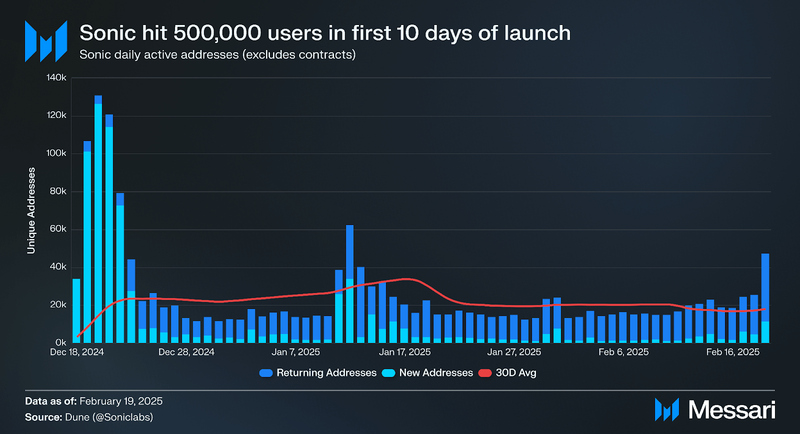
Daily Active Addresses (DAA), which track unique wallet interactions (excluding contracts), also saw substantial growth. Sonic attracted 500,000 unique wallets within its first 10 days, and has since accumulated 743,323 unique wallet interactions. Currently, Sonic averages 25,650 daily active addresses.
Stablecoins
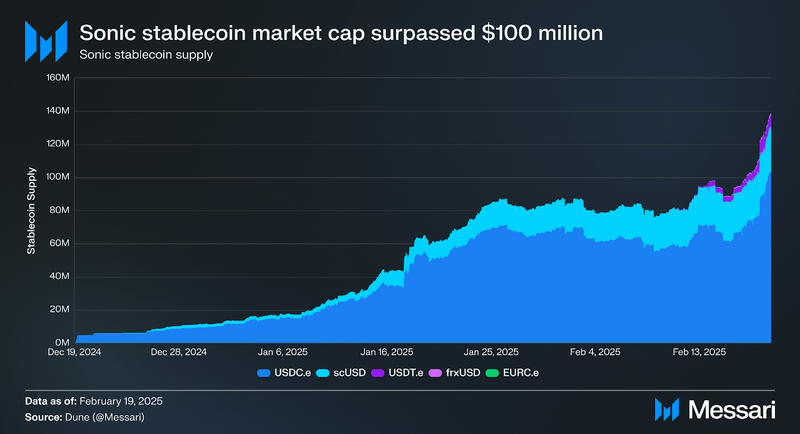
Sonic’s stablecoin market has expanded significantly, reaching a total market capitalization of $139 million. This market is dominated by USDC.e (75%), followed by scUSD (20%) and USDT.e (5%). USDC.e and USDT.e are the officially bridged stablecoins via Sonic’s failsafe bridge, Sonic Gateway, while scUSD is a stablecoin created by Rings, a bridge and yield protocol.
Transactions
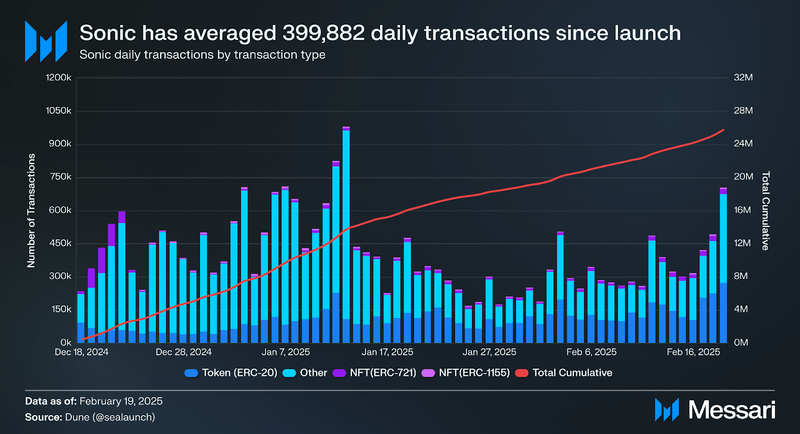
Transaction activity has remained consistently high, with a cumulative total of 26 million transactions. Sonic averages 399,882 daily transactions, comprised of 26% ERC-20 token transfers, 5% NFT transactions, and 69% general transactions. Shadow Exchange, a native DEX, accounts for 30% of all transactions and fees. Beyond DeFi, gaming is also gaining traction, with Sacra contributing 8% of onchain activity. Sonic’s highest transaction day to date was January 13, 2025, with 980,182 transactions.
Sonic Technical Features and Incentives
Some of the key technical features of Sonic include:
- TPS and TTF: Sonic theoretically achieves 396,000 ERC-20 transfer transactions per second with sub-second time to finality.
- SonicVM: An optimized virtual machine designed to improve smart contract execution efficiency, potentially reducing gas costs and enhancing overall network performance.
- SonicDB: A database with live pruning, a unique feature that automatically removes historical data, reducing validator storage requirements as the chain grows.
In addition to the key technical features, Sonic is debuting six core initiatives:
- Fee Monetization: Rewards builders with up to 90% of the fees generated by their applications.
- Sonic Gateway: A secure bridge for transferring assets between Ethereum and Sonic.
- S Airdrop: Designed to incentivize early adopters and kickstart economic activity on the network.
- Dynamic Fee Functionality: Allows builders to customize gas fees for users interacting with their contracts.
- Innovator Fund: Allocates 200,000,000 S tokens from the Sonic Lab treasury to support infrastructure development and strategic partnerships.
- Sonic and Sodas: A series of developer-focused networking events hosted worldwide, funded by Sonic Labs.
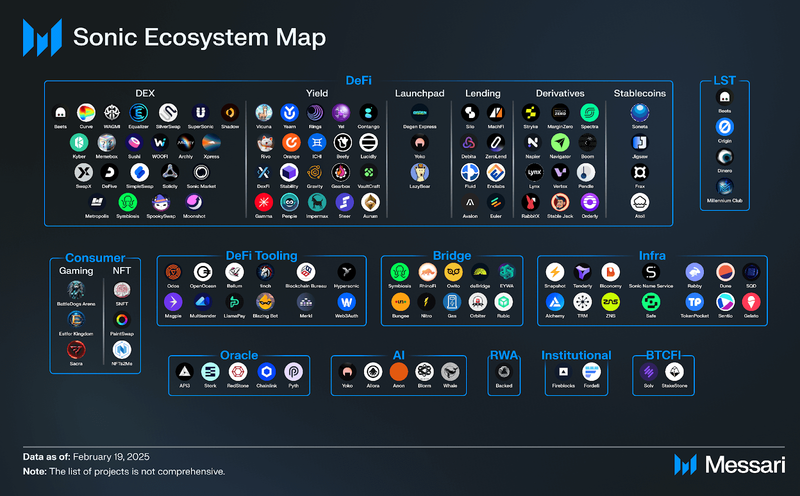
Some of these initiatives were already underway, while the full rollout coincided with the launch of infrastructure and support from data providers such as Chainlink, Pyth, Dune, Alchemy, Safe, and others. With its diverse infrastructure and builder-first incentives, Sonic positions itself as a leading blockchain for developers.
Fee Monetization Program
A distinguishing feature of Sonic is the Fee Monetization Program (FeeM). This program allows developers to earn up to 90% of the gas fees generated by their applications. The approach is similar to that of platforms like YouTube or X, where creators receive a share of the revenue they generate. By sharing gas fee revenue, Sonic incentivizes developers and retains builders through a sustainable income stream.
The program addresses a critical challenge in the crypto industry: fragmented liquidity caused by appchain adoption. Developers sometimes migrate their applications to dedicated chains to capture gas fee revenue or optimize costs. However, this migration can lead to losing valuable applications and talent for the host chain, while appchains lose composability and liquidity from the original chain. Unichain is a current example of this dynamic. By rewarding developers for building high-usage smart contracts, FeeM aims to prevent this loss and retain talent and liquidity within Sonic.
Transactions on Sonic will follow one of two fee distribution flows under the monetization program. For applications not participating in the program, 50% of the transaction fee will be burned, while the remaining 50% will be split between validators and the ecosystem vault. For participating applications, up to 90% of the transaction fee will go to the app’s developer(s), with the remaining 10% tipped to validators.
Innovator Fund
In addition to the Fee Monetization Program, Sonic Labs revealed the Innovator Fund. The fund includes an allocation of 200 million S tokens (worth over $170 million as of February 20, 2025) to incentivize partner migration and attract infrastructure providers. Key consumer app integrations include Curve, Pendle, and Equalizer, while major infrastructure providers include Chainlink, Dune, and Safe.
Sonic Gateway
Over the past two years, bridge exploits have resulted in losses exceeding $2.5 billion. Recognizing the security risks associated with cross-chain applications, Sonic introduced a secure bridge between Ethereum and Sonic, called Sonic Gateway.
Sonic Gateway is designed to enable efficient token transfers between the two networks without compromising decentralization or security. Transfers from Ethereum to Sonic take up to 10 minutes, while transfers from Sonic to Ethereum may take up to one hour. Validators operating nodes on both networks will secure the bridge, ensuring that no centralized entity can access funds in transit. This design establishes a secure, decentralized connection.
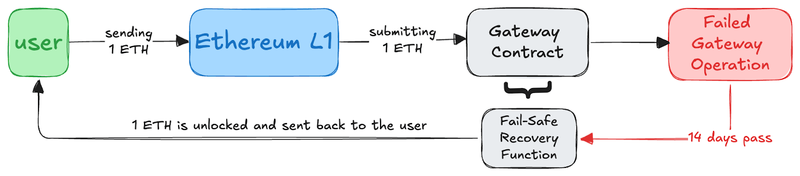
To further bolster system security and user confidence, Sonic Gateway includes a fail-safe mechanism. This feature allows users to withdraw their funds on Ethereum if the bridge or chain experiences a failure. If issues persist for more than 14 days, users can unlock the native assets they bridged over from Ethereum. This mechanism acts as a form of insurance for bridge users and could unlock additional liquidity for the ecosystem.
S Token
The S token serves as Sonic’s native token, which is used for paying transaction fees, staking, validator operations, and governance participation. Upon Sonic’s launch, FTM holders were able to exchange their tokens 1:1 for S. The total supply of S tokens, set at 3.175 billion, mirrors the existing total supply of FTM. Six months after launch, 6% of the 3.175 billion S will be minted for the airdrop program.
Sonic Token Airdrop
Sonic Labs plans to airdrop 190,500,000 S tokens to incentivize developers, early Sonic users, and loyal Opera users. The airdrop implements a linear vesting schedule and burn mechanism to encourage long-term holding. On the first day of the airdrop, 25% of the tokens will be unlocked, while the remaining 75% will vest over nine months as ERC-1155 NFT positions.
Users may claim the remaining tokens before the nine-month vesting period ends but will incur a burn penalty. The table below illustrates the number of tokens burned based on when users claim their tokens.
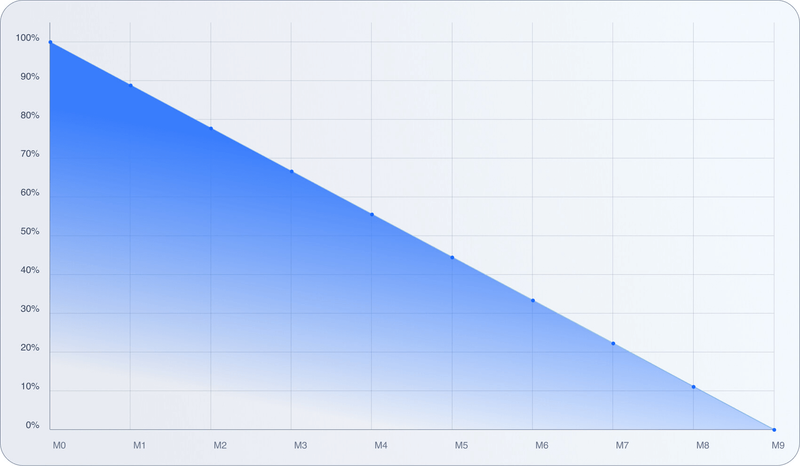
This airdrop design aims to prevent immediate selling pressure and encourages long-term use of the new chain.
Sonic Boom and Sonic Arcade
On August 20, 2024, Sonic Labs launched the first phase of its airdrop program, Sonic Boom. Sonic Boom is aimed at developers and incentivizes teams to earn Sonic Gems (points) by building applications. The bounty program concluded in Q4 and rewarded thirty projects, with the top three being Silo, Yearn, and Vicuna.
The program’s second phase, Sonic Arcade, was announced at the end of Q3 2024. Built on the Sonic testnet, Sonic Arcade includes three play-to-earn games: Plinko, Mines, and Wheel. Users can play these games to earn airdrop points while experiencing Sonic’s speed.
Closing Summary
The Sonic network launch ushered in a new era for the ecosystem. Pre-launch anticipation fueled growth on the Opera network, with TVL and DEX volume surging by 24% and 193%, respectively, in Q4 2024. This momentum, along with a 56% YoY increase in FTM market capitalization, showed market confidence in the shift to Sonic. Sonic has quickly gained traction, demonstrating growth in TVL, daily active addresses, stablecoin market capitalization, and transaction volume since its December 2024 launch.
Beyond financial incentives, Sonic’s technical advancements, such as high transaction throughput, sub-second finality, and the optimized SonicVM, position it as a competitive platform for applications. The secure Sonic Gateway bridge and its fail-safe mechanism address critical security concerns in the cross-chain arena. Furthermore, the strategic S token distribution, including the airdrop program with its vesting and burn mechanism, is designed to encourage long-term network participation.