Key Insights
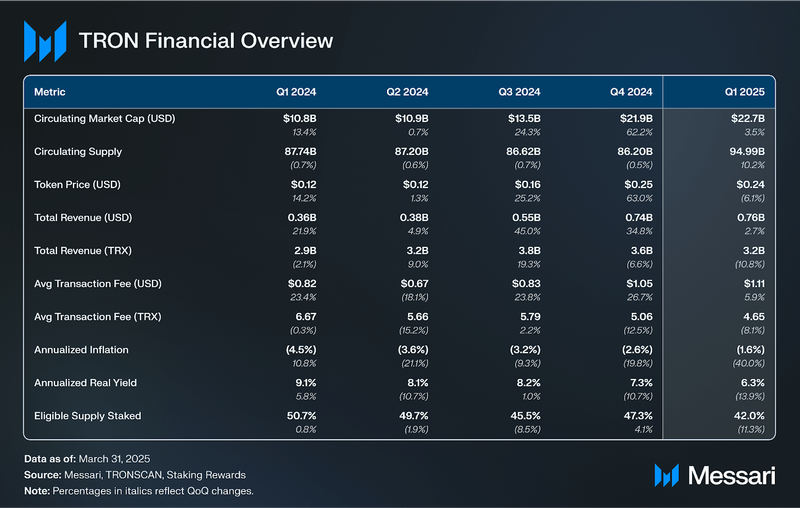
- TRON experienced positive growth across many key metrics in Q1, including a 3.5% QoQ increase in market cap, reaching $22.7 billion, and a 2.7% QoQ increase in revenue to $760.2 million, an all-time high for the network.
- Collaborations with Wintermute, T3 FCU, Kiln, and Nansen showcased ecosystem growth in Q1. The launch of USDD 2.0 on TRON also expanded the network’s stablecoin offerings.
- DeFi activity on TRON showed mixed results in Q1, with DeFi TVL in USD decreasing by 36.7% to $4.7 billion, dropping TRON to being the fifth-largest network by TVL. Daily DEX volume grew by 14.2% QoQ, with SUN V3 accounting for 89.4% of all volume.
- Technical upgrades from the TRON developer community in Q1 included one proposal, the announcement of gas-free transactions, and smart wallets. TRON also continued its decentralization efforts, reaching 397 Super Representative Candidates (-26 QoQ) with 8,008 nodes distributed across 84 locations (+2 QoQ).
- Stablecoin usage remained strong, with USDT on TRON representing 99.3% of the total stablecoin market cap, or $65.7 billion (+13.9% QoQ). The average daily USDT transfer volume increased by 3.3% QoQ, reaching $19 billion.
Primer
TRON (TRX) is a public, open-source blockchain network that relies on a Delegated Proof-of-Stake (DPoS) consensus mechanism. An election process is used to determine which validators participate in consensus. All TRX stakers vote onchain for the candidates they want to become Super Representatives (SRs). In each epoch, the top 27 most voted-for candidates become SRs within the active set and take turns producing blocks. A new election occurs every six hours.
The TRON Virtual Machine (TVM) powers applications on the network and uses “Energy” and “Bandwidth” instead of gas, like its Ethereum Virtual Machine (EVM) counterpart. Bandwidth is gas spent on transactions, whereas Energy is gas spent on smart contract calls. Energy and Bandwidth can be acquired by staking TRX or burning TRX to pay for the Energy/Bandwidth required to execute a smart contract call or transaction. The TVM is EVM-compatible and offers developers affordable and fast smart contract execution.
TRON Portal / Website / X (Twitter) / Discord
Key Metrics
Financial Analysis
Market Cap and Revenue
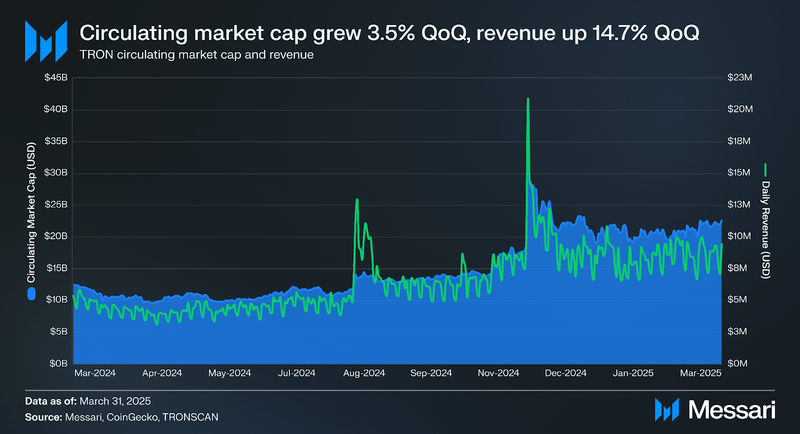
TRX’s circulating market cap increased for the ninth consecutive quarter in Q1, up 3.5% QoQ from $21.9 billion to $22.7 billion. Furthermore, TRX performed similarly to other large-cap cryptocurrencies as its market cap ranking amongst all tokens (excluding stablecoins) dropped one spot from 9 to 10. Notably, TRX has been a deflationary token for many quarters. In Q1, there was a 10% increase in the circulation supply of TRX, making it inflationary for the quarter.
TRON utilizes a resource model to execute transactions onchain. To summarize, the resource model is based on distributing Bandwidth and Energy to stakers. As long as stakers have acquired enough resources, they can use those resources to transfer tokens and execute smart contracts for free. Users must cover transaction fees with TRX if they utilize more computing power than their resources allow, all of which is burned. As such, revenues for TRON are derived from the TRX token burns coming from transaction fees. To track these numbers in real time, see the TRON Portal.
TRON had another solid quarter for USD revenue. Total Revenue in USD was up 2.7% QoQ from $740.3 million to $760.2 million, and daily revenue was up 14.7% QoQ. Due to the 6.1% decrease in token price in Q1, Total Revenue in TRX was down for the second consecutive quarter by 10.8% from $3.6 billion to $3.2 billion.
Supply Dynamics
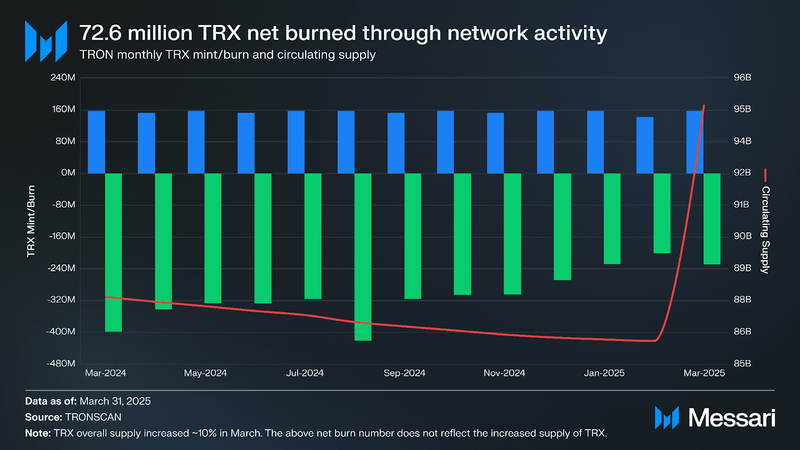
The circulating supply of TRX is primarily affected by two parameters: (i) tokens minted to reward stakers and block producers, and (ii) tokens burned due to network transaction fees. TRX rewards equate to 5.06 million tokens being minted per day. As such, the circulating token supply will decrease over time if more than 5.06 million TRX are burned daily, on average.
In Q1, the circulating supply of TRX increased from 86.6 billion to 95.0 billion. This is the first quarter where the circulating supply of TRX increased due to the migration of USDDOLD to USDD 2.0. The increase in TRX’s circulating supply is due to the deprecation of USDDOLD and the migration to USDD 2.0, which released previously locked TRX collateral back into circulation. While this change affects circulating supply, it does not increase TRX’s total supply and instead reflects a shift in accounting methodology.
Annualized, this equates to an inflation rate of approximately -1.6%. Annualized inflation was down QoQ, decreasing 40% from -2.6%.
TRON incentivizes participation in its staking mechanism through a combination of the following:
- Block Reward – Super Representatives earn 16 TRX for each block produced (subject to change through onchain governance). After producing a block, the Super Representative’s chosen commission ratio is kept, while the remaining TRX is distributed amongst the representative’s associated voters.
- Vote Reward – The 28th to 127th most voted-for Super Representatives become Super Representative Partners for the next epoch. While partners do not participate in block production, they still receive voting rewards, as well as the TRX stakers that voted for said partners. For every block produced, 160 TRX is rewarded to Super Representatives and Super Representative Partners in proportion to their respective TRX stakers’ votes.
The annualized real yield for staking decreased in Q1, down 14% QoQ from 7.3% to 6.3%. This decrease was due to the inflation of the TRX token supply in Q1.
Network Analysis
Usage

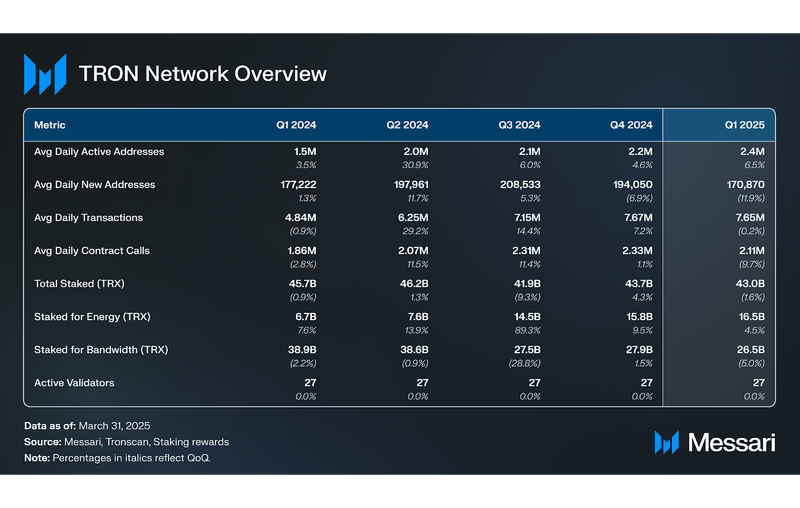
Q1 usage was mixed for TRON, with increases in some onchain activity metrics like daily active addresses and CeFi transactions, while others, like average daily new addresses and daily transactions, decreased. Average daily transactions decreased 0.2% QoQ from 7.7 million to 7.7 million, and daily active addresses grew 6.5% QoQ from 2.2 million to 2.4 million.
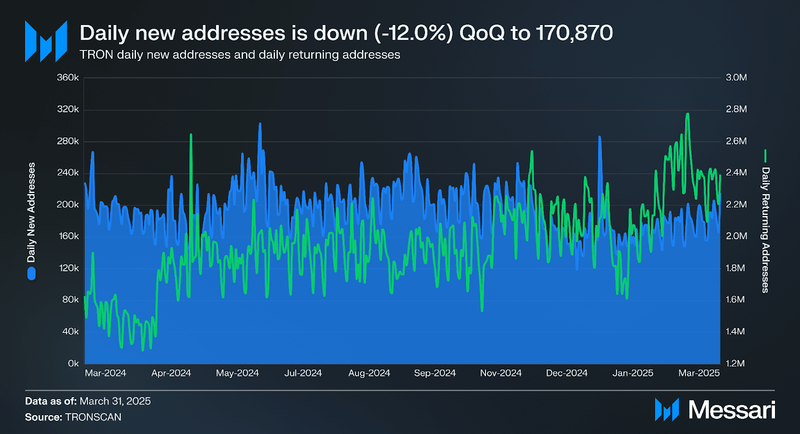
Average daily new addresses decreased for the second consecutive quarter, down 12% QoQ from 194,050 to 170,870. Of Q1’s average daily active addresses, 7.2% were new addresses.
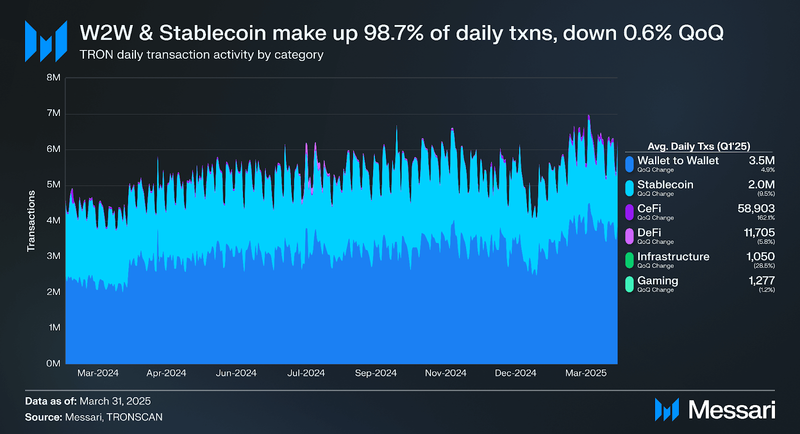
Most transactions on TRON continue to come from wallet transfers and stablecoins. Wallet transfers were up 4.1% QoQ from 3.3 million to 3.5 million, and stablecoin transfers were down 9.5% QoQ from 2.2 million to 2.0 million. Collectively, wallet transfers and stablecoin transactions represented 98.7% of Q1 transactions, down 0.6% QoQ from 99.3%.
The most impacted area in terms of market share was CeFi transactions. This category’s transactions went up 162.1% QoQ from 22,470 to 58,902. Infrastructure-related transactions had a significant QoQ decrease, down 28.5% from 1,469 to 1,049.
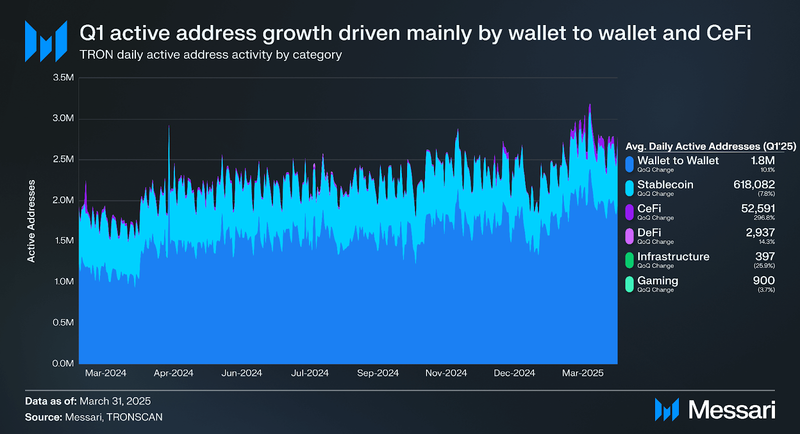
Wallet transfers and stablecoins have historically dominated average daily active address activity on TRON. Q1 was no different, as an average of 1.8 million addresses conducted a daily wallet transfer, up 10.1% QoQ. Stablecoin transactions saw a decrease of 7.8% QoQ to 618,081, which aligns with the decrease in overall stablecoin transactions. Active addresses interacting with CeFi increased by 296.8% QoQ to 52,591, while Infrastructure interactions decreased by 25.9% QoQ to 397, almost erasing the strong growth in Q4.
Security and Decentralization
TRON uses a Delegated Proof-of-Stake (DPoS) consensus mechanism and the Practical Byzantine Fault Tolerance (PBFT) consensus algorithm to secure the network. A DPoS election occurs every six hours, in which 27 Super Representatives (SRs) take turns producing blocks. Those wishing to run a TRON node can pay 9,999 TRX to become an SR candidate.
While there may be centralization concerns regarding only 27 SRs participating in securing the network, at the end of Q1, over 395 SR candidates (down from 423 in Q4) received votes. This diversity of candidates helps mitigate centralization concerns and promotes a more distributed governance model, enhancing the network’s resilience and security. The growing number of SR candidates should challenge the voting population to distribute votes. Additionally, no singular entity received over 10% of all votes. The entity with the most votes was Binance Staking, which received 2.9 billion (7.3%) of the 40 billion votes in the most recent election.
Although there may be some benefits to a democratic voting system for block production and a growing set of SR candidates, neither feature fully does away with centralization risks. Metrics such as the geographic diversity of nodes may also factor into a network’s level of centralization. At the end of Q1, there were 8,008 TRON nodes (down from 8,149 in Q4) distributed across 84 different geographic locations around the globe, with the highest concentration in the United States (20%). Too many nodes in the same location could jeopardize the health of a network due to geopolitical risks, regulations, and acts of nature, among other reasons.
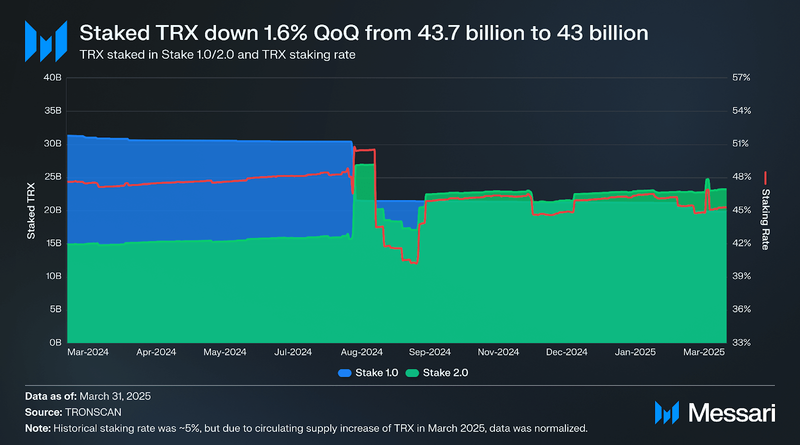
Since the introduction of the new staking mechanism, Stake 2.0 (TIP-467), in April 2023, it has become the default for all new staking activity. Any TRX staked after April 2023 is automatically assigned to Stake 2.0, while TRX previously staked under Stake 1.0 remains valid and unaffected. Stake 2.0 implemented a new layer to separate low-frequency staking operations and high-frequency resource delegating operations. It also introduced resource re-delegating without unstaking and improved resource utilization.
Across both options, the staking ratio (the proportion of TRX’s total supply actively staked) fell, decreasing to 45.3% in Q1. This decrease is mainly due to the large increase in the circulating supply of TRX made in March 2025. The historical staking rates were 5% higher. Additionally, more users continued to switch to Stake 2.0 over 1.0 in Q1. Stake 2.0 ended the quarter with 23.2 billion TRX staked (+3.1% QoQ), whereas Stake 1.0 finished with 19.8 billion TRX staked (-6.5% QoQ). In sum, 43 billion TRX were staked at the end of Q1, a decrease of 1.6% QoQ. Due to a decrease in TRX’s price, the total stake in USD was down 7.5% QoQ from $11.1 billion to $10.3 billion. Compared to other PoS networks, TRON had the sixth-highest dollar value of funds staked by the end of Q1, maintaining its position from the prior quarter.
It is worth noting that to take over the network through a two-thirds attack, a malicious actor would need to control 18 of the 27 SRs. At the end of Q1, this threshold was 32.3 billion TRX ($7.7 billion).
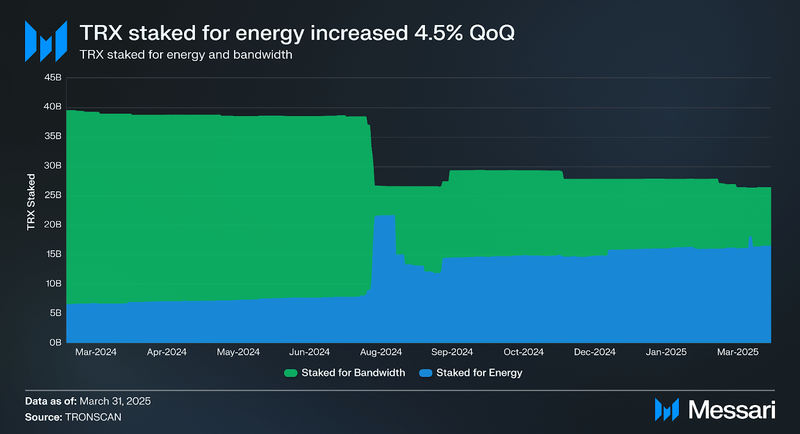
Bandwidth is the gas spent on transactions, while energy is the gas spent on contract calls. Users can stake TRX to acquire either resource accordingly:
- The amount of bandwidth obtained from an account’s stake = (the amount of TRX staked for obtaining bandwidth / the total amount of TRX staked for obtaining bandwidth in the whole network * 43.2 billion)
- The amount of energy obtained from an account’s stake = (the amount of TRX staked for obtaining energy / the total amount of TRX staked for obtaining energy in the whole network * 90 billion)
Notably, the amount staked for bandwidth is down 5% QoQ from 27.9 billion to 26.5 billion. As for energy, staking increased 4.5% QoQ from 15.8 billion to 16.6 billion, in part due to overall higher gas fees. The amount staked for each resource is correlated with consumption.
Technical Developments
In Q1, TRON passed one proposal to migrate operations to create cross-platform computational consistency, and gas-free transactions were announced.
- Proposal 101 (Jan. 20, 2025) – To migrate operations from java.lang.Math to java.lang.StrictMath for cross-platform computational consistency. This was approved by 23 of the 27 Super Representatives.
- Gas-Free Transactions – Gas-free USDT transfers on TRON are “coming soon.”
- TRON Tailored Smart Wallets (March 31, 2025) – TRON accounts support multi-signature functionality by default, but Smart Wallets add advanced features like energy sharing, zero account activation costs, and simplified resource management. TRON offers three Smart Wallet types: Simple, SWTRXC, and SWFEAT. Each is designed for specific needs, ranging from basic custodial wallets to advanced non-custodial management solutions.
Ecosystem Analysis
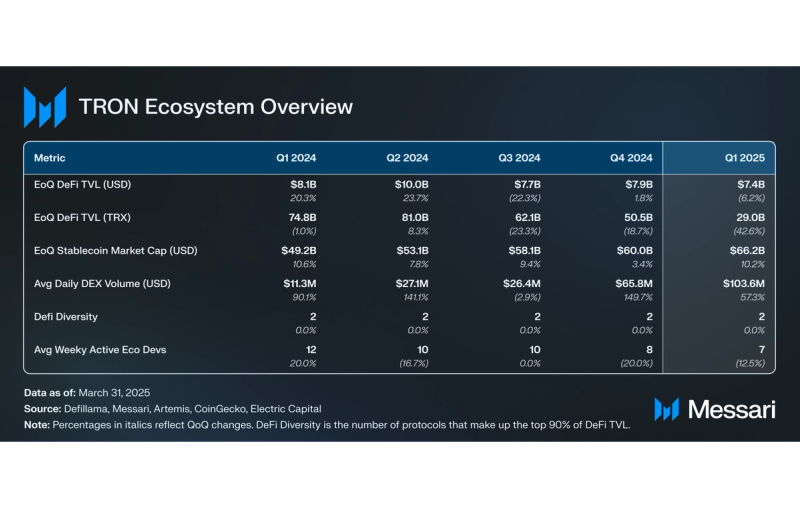
DeFi
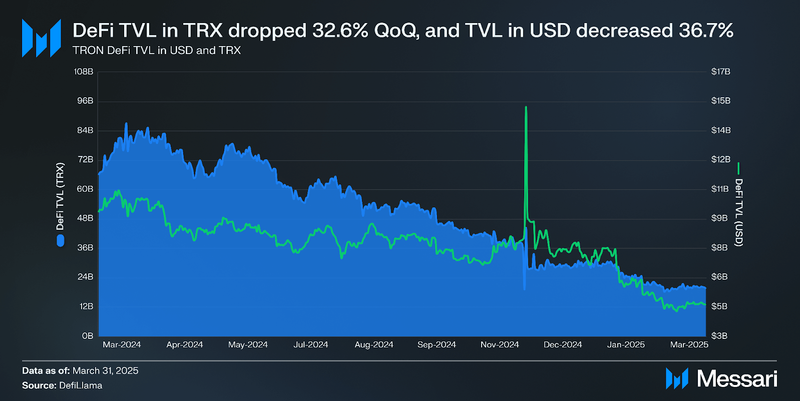
DeFi TVL on TRON denominated in TRX fell 32.6% QoQ from 29 billion to 19.5 billion. The TVL denominated in USD also decreased, following TRX’s price, down 36.7% QoQ from $7.4 billion to $4.7 billion. Compared to other networks, TRON dropped from third to fifth-highest network by TVL at $4.9 billion, getting beat by third-place Bitcoin ($5.3 billion) and fourth-place BNB Smart Chain ($5.8 billion). Notably, the large spike in DeFi TVL in terms of USD in Q4’24 was due to a sudden rise in TRX’s price and subsequent drop in Q1’25.
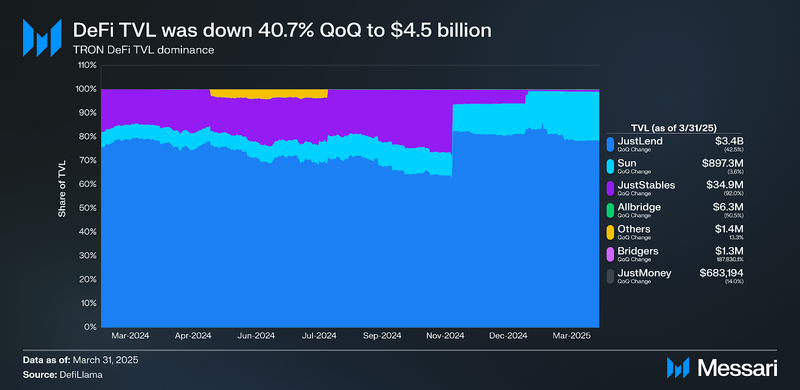
The top three protocols by TVL on TRON are JustLend, SUN, and JustStables.
JustLend, the largest protocol by TVL, saw its TVL decrease 42.5% QoQ from $6.0 billion to $3.4 billion. Total borrow volume on JustLend increased from $134.6 million to $171.7 million (+27.5% QoQ), perhaps signaling a greater appetite for leverage on TRON.
SUN saw a slight decrease in its TVL, down 3.6% QoQ from $930.8 million to $897.3 million. SUN consists of three different AMMs (V1, V2, and V3). By the end of Q1, V1 TVL was $451.8 million (50.3% of TVL), V2 TVL was $232.8 million (25.9% of TVL), and V3 TVL was $212.7 million (23.7% of TVL). JustStables saw the largest decrease of 92% QoQ, and Bridgers saw the most significant increase of over 187,000%.
In sum, JustLend and SUN represented 99% of DeFi TVL on TRON.
DEX Volume
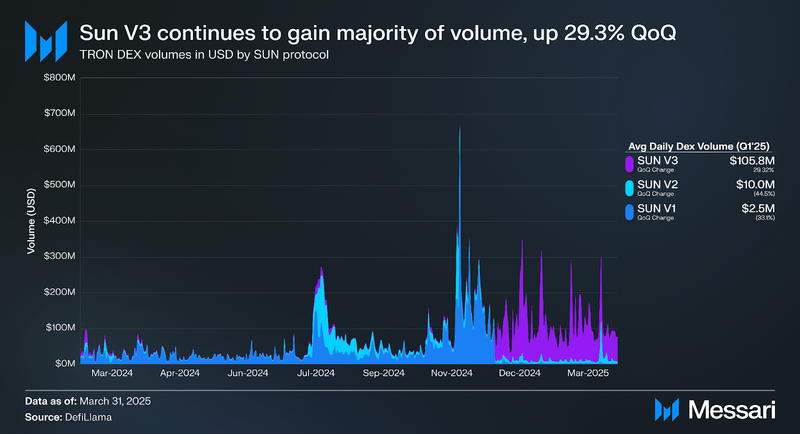
Overall DEX activity on TRON normalized in Q1, with average daily DEX volumes increasing 29.3% QoQ. Zooming in on SunPump, its slowdown is most evident through the decrease in volume routed through SUN V2, which hosts liquidity pools for bonded memecoins from SunPump. The average daily DEX volume on SUN V2 was down 44.4% QoQ.
Essentially, all DEX volumes on TRON occur on SUN. In June 2023, SUN introduced a concentrated liquidity (CL) AMM to its product suite (SunSwap V3). Q1’24 marked the first time since SunSwap V3’s introduction that the majority of volume on SUN was routed through the V3 AMM. SUN V3 accounts for 89.4% of all volume on TRON.
Stablecoins
The stablecoin market cap on TRON has been steadily trending up over the past year, reaching an all-time high in Q1. Stablecoin market cap increased by 12.8% QoQ from $58.7 billion to $66.2 billion. USDT accounts for the vast majority of stablecoins on TRON, boasting a market share of 99.3% (+1% QoQ). The market cap of USDT on TRON ended the quarter at $65.7 billion (-13.9% QoQ). Additionally, 45.9% of all USDT in circulation is on TRON.
No other stablecoins on TRON had QoQ increases in Q1. The second largest stablecoin on TRON, USDD, was down 66.2% QoQ from $747.4 million to $252.8 million. USDD reached a milestone of over 140,000 accounts that hold the stablecoin.
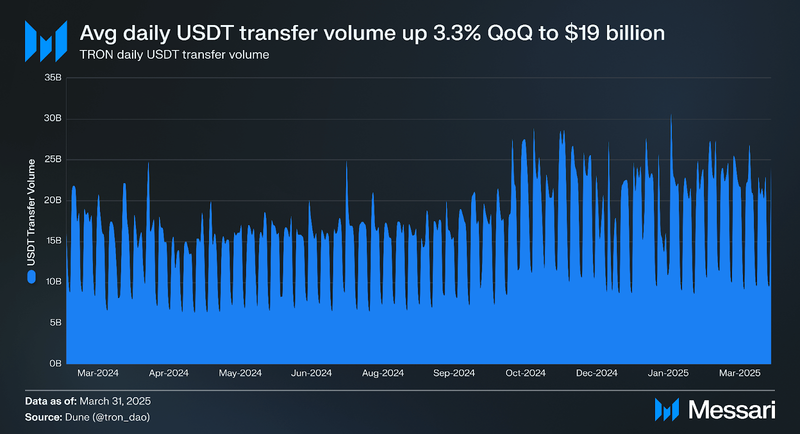
Another useful metric for evaluating stablecoins is transfer volume. This metric measures the dollar value of stablecoins moving onchain, not just when interacting with DEX-based smart contracts. The average daily USDT onchain transfer volume maintained its upward growth in Q1, increasing by 3.3% QoQ from $18.4 billion to $19 billion.
Ecosystem Growth
TRON continues to partner with leading companies in the blockchain space. A few notable partnerships and ecosystem upgrades that were announced in Q1 included:
- The T3 Financial Crime Unit (T3 FCU), a joint effort by TRON, Tether, and TRM Labs, has frozen over $126 million in criminal assets since its launch in August 2024, targeting illicit activities such as money laundering, scams, and terrorism financing. Its most notable success involved a $26.4 million freeze tied to a European money laundering ring, showcasing the power of public-private partnerships and blockchain analytics.
- USDD 2.0 launched in January 2025. This upgraded version aims to maintain a 1:1 peg with the U.S. Dollar (USD) through mechanisms such as over-collateralization and a Peg Stability Module (PSM). In February, the USDD team announced that the T1 Threshold for USDD 20% APY Staking Campaign will be raised to $300 million.
- Two new Super Representatives were added: Kiln and Nansen.
- Kiln will assist with validating transactions, producing blocks, and maintaining network security.
- Nansen will bring its blockchain analytics tools to the TRON ecosystem, offering developers, institutional investors, and the broader community insights through their products that track smart contracts, wallet activity, and onchain movements.
- JustLend DAO has introduced a flexible, low-priced Energy rental service for all users. This service consistently allows participants to rent 100,000 Energy units.
- Uquid, a Web3 shopping platform, allows users to purchase items with USDT on TRON. Over 40% of the users have used this option.
- TRON DAO and Wintermute announced a strategic collaboration to enhance liquidity, reduce volatility, and improve trading efficiency for TRX across centralized and decentralized exchanges. By combining Wintermute’s global expertise in algorithmic trading and OTC services with TRON’s growing DeFi ecosystem, the collaboration aims to strengthen market stability and expand global reach. Wintermute will provide comprehensive market coverage, conduct in-depth analysis, and serve as an OTC partner for TRX, USDT, USDD, and other tokens, providing competitive spreads and enhancing overall ecosystem stability.
- TRON DAO and Pump.fun have partnered to launch PumpSwap, a new DEX designed to enhance SOL/TRX cross-chain liquidity and provide seamless Web3 access through improved interoperability.
- Tap Protocol launched a bridge between TRON and the Bitcoin network.
- Pentagon Games XP, a web3 gaming hub, has announced that users can now connect their TRON wallets and manage their assets directly onchain for all in-game experiences.
- Eternal AI and TRON DAO have collaborated to bring AI agents to the TRON ecosystem.
TRON continues implementing strategies to grow its ecosystem beyond stablecoins, with initiatives such as the TRON Builders League, an incubator program, with a $10M fund, designed to support builders on TRON.In Q1, the TRON Eco Star program was announced, where many prizes will be awarded to those who meet certain criteria outlined in the program overview document.
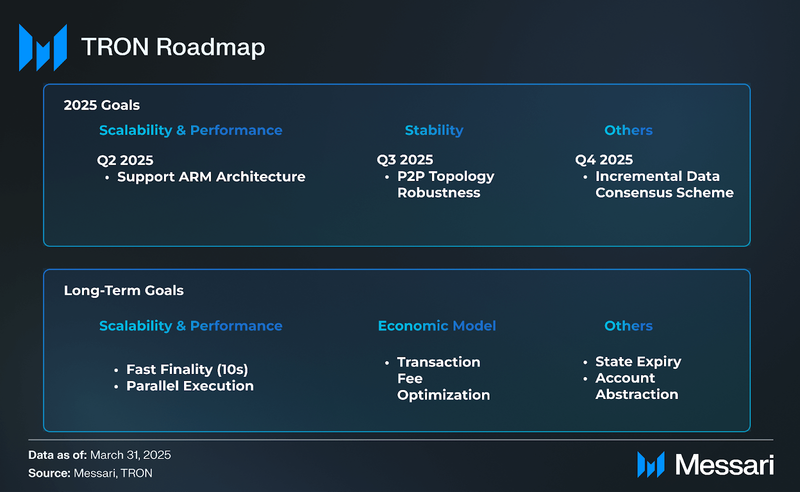
In 2025, TRON will focus on enhancing network performance and scalability through initiatives like support for ARM architecture and parallel transaction execution. Economic model improvements, such as dynamic transaction fee adjustments, aim to strengthen the ecosystem’s sustainability. In the long term, TRON plans to explore other areas like account abstraction and state data expiration to ensure robust infrastructure and future adaptability.
Closing Summary
In Q1 2025, TRON maintained steady growth across key metrics, with continued increases in market cap, total revenue, and ecosystem engagement. Despite a temporary rise in TRX’s circulating supply, the network’s financials and user activity remained strong, bolstered by stablecoin dominance, DeFi participation, and improved infrastructure. Stablecoin activity remained a cornerstone of TRON’s ecosystem, with USDT accounting for 99.3% of stablecoin supply and average daily USDT transfer volumes up 3.3% QoQ to $19 billion. TRON further expanded its ecosystem through strategic partnerships with T3 FCU, Wintermute, Eternal AI, Kiln, Nansen, Tap Protocol, Pentagons Games XP, and the launch of USDD 2.0.
Looking ahead, TRON’s 2025 roadmap, coupled with initiatives like the $100 million AI development fund and the many technical upgrades, positions the network for sustained innovation and ecosystem expansion. To stay up-to-date with all things TRON, visit the TRON Portal.