Key Insights
- MapleStory Universe is a virtual worlds ecosystem designed to host applications built from the MapleStory IP. The ecosystem serves as a hub for creativity, collaboration, and community engagement, supported by integral components that form a comprehensive ecosystem.
- MapleStory Universe’s Web3 initiative brings Synergy Apps, the MapleStory Universe SDK, and MapleStory N, a PC-based MMORPG that integrates blockchain into the MapleStory IP.
- Nexon, the company behind MapleStory Universe, has invested over $100 million in creating this new ecosystem.
- MapleStory Universe will introduce NXPC as its primary utility token with a fixed supply of 1.0 billion. NESO, a gameplay-oriented token derived from NXPC, will be earned through in-game activities and used for interactions within the ecosystem.
- MapleStory Universe introduces RX 2.0, a new in-game reward experience. RX 2.0 is designed to create a sustainable and player-driven item ecosystem. Items have a fixed supply, with demand-driven pricing mechanisms, ensuring rarity and utility.
Introduction
The blockchain gaming sector has often struggled to reconcile the volatility of token economies with the demands of sustainable, long-term gameplay. Many early attempts prioritized token issuance over gameplay quality, resulting in inflationary systems with poor retention metrics. MapleStory Universe (MSU), a blockchain-integrated expansion of Nexon’s flagship IP, attempts to provide an alternative model, anchoring its economy in gameplay utility, player engagement, and long-standing IP value.
At the center of MSU is Nexpace, the branch of Nexon designated with building out the MapleStory Universe. The central core to MSU’s design is NXPC, a utility-first token engineered to support content creation, transaction processing, and item issuance. Its core innovation lies in a dual-mechanism asset flow—NFT minting through NXPC “Fission” and redemption via NXPC “Fusion”—designed to introduce supply-side constraints and incentivize arbitrage-based market balancing, enabling a real-time feedback loop between item demand and token utility.
MSU’s ecosystem includes the core game (MapleStory N), a modular development framework (MapleStory Universe SDK), and player-built experiences (Synergy Apps)—all interconnected through NXPC and NESO, a wrapped utility token designed for in-game use.
Research Contents
Background
Launched in 2003 by South Korean game developer Nexon, MapleStory became one of the first globally successful 2D MMORPGs. Its distinctive side-scrolling mechanics, expansive world-building, and highly social gameplay positioned it as a pioneer in the live-service gaming model, allowing it to sustain engagement through continuous content updates. Over its 21-year history, MapleStory has attracted over 250 million registered users globally, generating over $5.0 billion in lifetime revenue.
Building on this legacy, Nexon introduced MapleStory Universe, an ambitious initiative to integrate blockchain technology with the existing MapleStory IP. Unlike traditional MMORPG economies—where in-game assets remain locked within publisher-controlled environments—MapleStory Universe seeks to leverage blockchain’s asset ownership model to create a player-driven, tradeable economy. Nexon has backed this initiative with $100.0 million in internal investment capital, underscoring its strategic commitment to exploring crypto gaming applications.
The project is led by Sunyoung Hwang (CEO), Dominic Jang (CBO), and Keith Kim (Head of Strategy)—a team with deep expertise in game development, blockchain integration, and strategic market expansion. By combining Nexon’s long-standing success in live-service gaming with emerging blockchain innovations, MapleStory Universe is focused on bridging the gap between traditional gamers and crypto-native audiences, serving as one of the most prominent legacy gaming IPs to explore blockchain integration at scale.
Technology
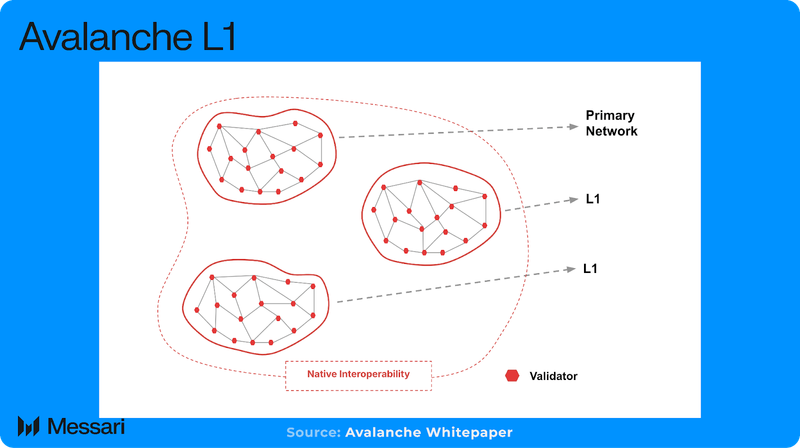
MapleStory Universe originally planned to build on Polygon, but on Mar. 11, 2024, Nexon announced a strategic shift to developing its own Avalanche Layer-1 (L1) blockchain using AvaCloud. Nexon cited technical challenges during early development, particularly around customization, gas fee configurations, and infrastructure predictability, as reasons for transitioning to AvaCloud. AvaCloud is Avalanche’s managed Subnet service that allows enterprises to launch custom blockchains without managing infrastructure or validator networks.
The Role of Avalanche L1’s in MapleStory Universe
Avalanche L1s function as independent, application-specific blockchains validated by their own node sets and governed by customizable rules. This configuration enables high throughput and reduced latency without interference from other applications on shared chains. AvaCloud enabled Nexon to customize its own blockchain, with control over core parameters such as gas fee structures and transaction throughput. This architecture is designed to improve gameplay responsiveness and support a stable in-game economy, both important considerations for MMO infrastructure.
The Avalanche L1 approach facilitates asset interoperability with the broader Avalanche ecosystem, allowing players to move NFTs, tokens, and other assets between MapleStory Universe and external applications. Nexon further benefits from Avalanche’s Subnet architecture, which offers a modular and permissioned blockchain environment without requiring the team to manage Avalanche infrastructure themselves. AvaCloud abstracts complex backend operations such as validator setup and network orchestration, allowing Nexon to focus on gameplay mechanics and economic design.
Chainlink VRF and Provable Fairness
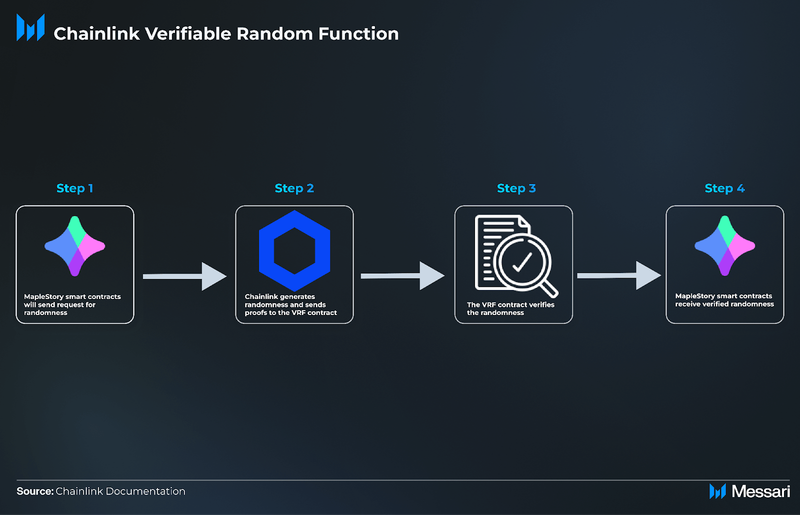
MapleStory Universe has partnered with Chainlink to integrate Chainlink Verifiable Random Function (VRF), a secure and tamper-proof randomness solution that ensures onchain verifiability for in-game random events. By leveraging Chainlink VRF, MapleStory Universe introduces transparent and cryptographically secure randomness, allowing players to verify the fairness of in-game mechanics.
In traditional gaming, randomness is controlled by opaque, centralized algorithms, often leaving players skeptical about the fairness of rare item drops, gear upgrades, and event rewards. With Chainlink VRF, each random outcome, whether obtaining a rare item or enhancing an in-game asset, is generated using a publicly verifiable cryptographic process, ensuring provable fairness across the ecosystem.
Data Management and Transparency
MapleStory Universe combines onchain and offchain systems to ensure transparency, trust, and seamless gameplay. While blockchain’s decentralized infrastructure enhances data ownership and security, its slower processing speed challenges maintaining the real-time responsiveness expected in MMORPGs. MapleStory Universe employs a hybrid approach, integrating centralized offchain data with blockchain-based systems to address this.
Key Solutions for offchain data:
MapleStory Universe ensures data integrity through a hybrid model combining event sourcing, hash validation, and onchain publication.
- Event Sourcing logs every user action as an immutable event, creating a full history of each item’s lifecycle. This is paired with state storage, which records an item’s current attributes (e.g., owner, stats, level) for fast reference during gameplay.
- To validate this data, MSU uses two layers of cryptographic hashing:
- Event Hashing chains each recorded event together, forming an unbreakable sequence. Any attempt to alter past data would break the hash chain and be flagged as tampering.
- State Hashing links an item’s current state to its historical record by generating a hash that combines the latest state and its final event. This ensures the current data is both accurate and traceable.
- MSU publishes these hashes onchain at regular intervals, enabling external verification by players and auditors through their real-time hash validation.
- Additionally, real-time hash validation monitors all offchain updates (e.g., item upgrades or trades). Any inconsistencies trigger automatic rejection or rollback, preserving data integrity at every step.
RX 2.0
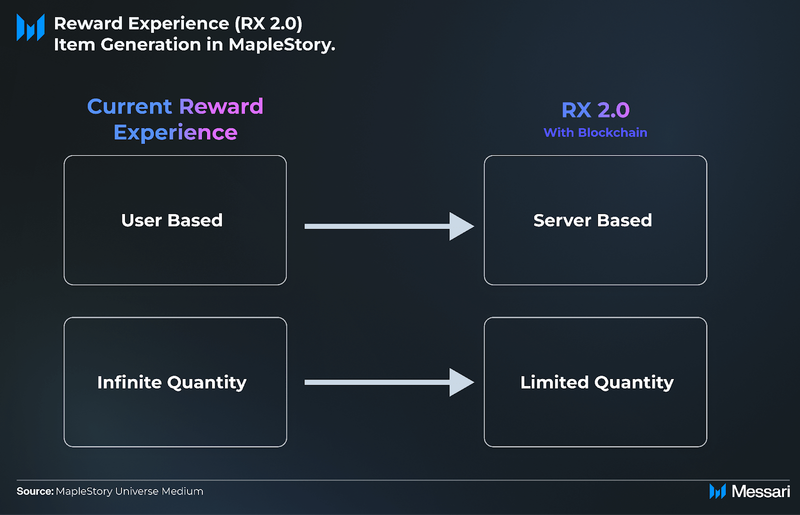
MapleStory Universe introduces Reward Experience (RX) 2.0, a player-driven item economy designed to address the challenges of inflationary item supply and obsolescence that plague traditional MMORPGs. In conventional live-service models, developers continuously introduce new content, often leading to asset devaluation and redundancy as older items become obsolete. RX 2.0 offers a sustainable alternative, built around two core pillars: utility and rarity, ensuring that in-game assets maintain long-term value and strategic significance.
RX 2.0 enhances item utility by enabling NFT-based assets that transcend individual games within the MapleStory Universe, allowing for seamless cross-game functionality. Unlike traditional game assets, which remain locked within a single title, NFT integration expands item utility beyond static in-game mechanics, enabling player-driven customization, trading, and content creation.
RX 2.0 implements a fixed-supply model to preserve long-term item value via the Nexpace item pool, ensuring that asset issuance is demand-driven rather than unlimited. Unlike traditional MMORPG economies where items are infinitely minted, RX 2.0 introduces strategic asset management, requiring players to consider item utility and scarcity.
Redefining the Player Experience
MapleStory Universe reimagines player participation by shifting from passive content consumption to active ecosystem contribution. Through NFT ownership, creator incentives, and modular developer tools, players gain direct agency over the assets, experiences, and narratives that define the game world. This positions MSU as more than a game—it becomes an interactive IP platform co-authored by its community.
UGC Built on Canonical IP Assets
Unlike traditional user-generated content (UGC) systems where players build with generic or custom-made tools, MSU UGC is grounded in official, tokenized MapleStory assets. Each NFT represents a legacy item with fixed metadata (e.g., rarity, stats, item type) within a globally tracked supply pool. Players can access these NFTs via the MapleStory SDK to build:
- Standalone applications and mini-games
- Social or narrative overlays using legacy equipment
- Marketplace extensions and peer-to-peer services
This structure ensures that UGC remains integrated with the MSU economy and lore, enabling creative expression while preserving assets’ underlying value and scarcity.
IP Expansion Through Participation
MSU reframes the relationship between player and publisher. Instead of content being developed solely by Nexon, every player interaction—whether through app development, NFT remixing, or world-building—feeds back into the evolving state of the MapleStory Universe. NFTs function as tokenized assets with gameplay and economic utility, which players can use to co-author experiences within the MSU ecosystem.
This model allows players to:
- Expand the game’s universe without fragmenting its economy
- Participate in ecosystem value accrual via NFT-driven content
- Create persistent gameplay loops that extend beyond MapleStory N
UGC and RX 2.0: The Experience Layer
RX 2.0 introduces scarcity and utility to item design; UGC provides the application layer that activates those assets. Items derive additional value from their in-game stats or rarity and how they are used across MSU applications. For example:
- A rare item used in multiple high-traffic Synergy Apps may gain social or marketplace value beyond its core game utility.
- Custom dungeons or mini-games built around specific items could drive localized demand for certain NFTs.
This feedback loop creates a multidimensional reward structure where rarity, usefulness, and cultural relevance reinforce one another—strengthening the long-term retention of both users and assets.
Tokenomics
MapleStory plans to launch two tokens, NXPC and NESO. NXPC is the primary utility token for the ecosystem, acting as both a reward for ecosystem contributors and a medium of exchange. It will have a fixed total supply of 1.0 billion tokens, ensuring controlled issuance and long-term sustainability. Meanwhile, NESO can be viewed as an in-game token that allows players to interact with various apps within the Universe and in the NFT marketplace. The breakdown of NXPC tokenomics is as follows:
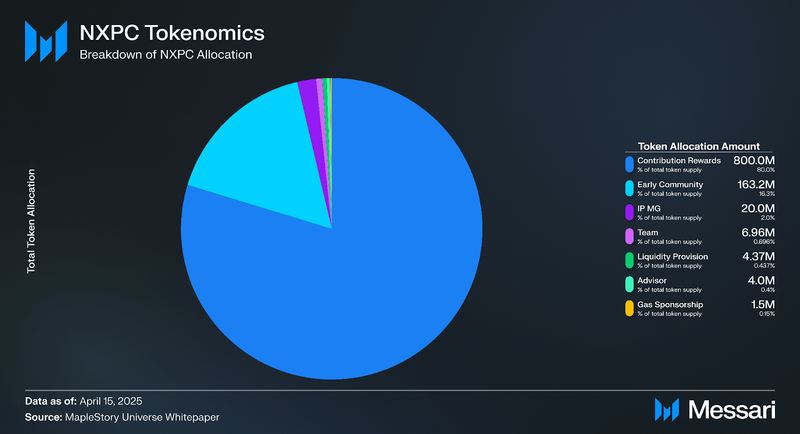
- 80.0% as Contribution Rewards (800.0 million NXPC) – At the Token Generation Event (TGE), tokens will be locked initially, with unlocking commencing within the first year. Distributed to contributors each cycle (seven days) with no lock-up periods. The release schedule will follow the equation below:
Cumulative Distribution of NXPC in the 𝑛 th cycle = 800,000,000 × (1 −𝑒−0.002666 × 𝑛). - 16.3% to early community (163.17 million NXPC) – Fully unlocked on token generation event (TGE).
- 0.69% as Team allocation (6.96 million NXPC) – A 9-month cliff period, followed by quarterly unlocks over the next three years.
- 2.0% to the IP MG (20.0 million NXPC) – A 9-month cliff period, followed by quarterly unlocks over the next three years.
- 0.437% to Liquidity provision (4.37 million NXPC) – Fully unlocked on TGE.
- 0.4% to Advisors(4.0 million NXPC) – A 12-month cliff period, followed by milestone-based vesting.
- 0.15% to Gas Sponsorship (1.5 million NXPC) – Fully unlocked on TGE.
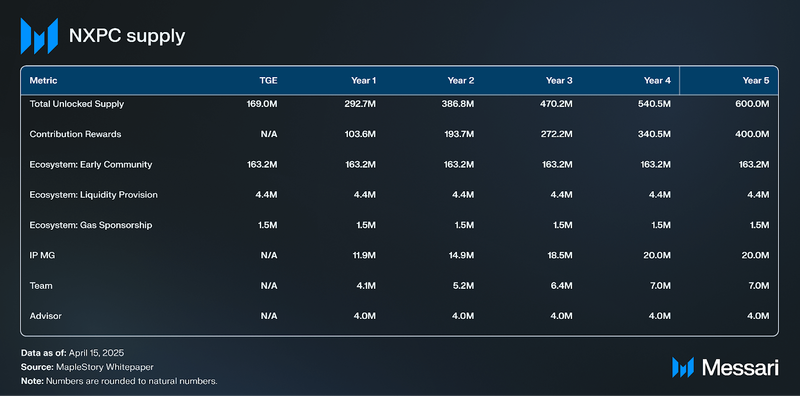
The NXPC supply model follows a halving-style mechanism, where token distribution gradually decreases over time but never reaches zero. This controlled issuance structure ensures long-term sustainability, gradually reducing new NXPC entering circulation while maintaining a continuously diminishing supply flow.
NXPC: A Self-Regulating Token Economy
The MapleStory Universe (MSU) economy is underpinned by NXPC, a utility-first token that facilitates sustainable value creation across a multi-layered ecosystem. NXPC supports gameplay incentives, NFT issuance, smart contract interactions, and contributor rewards. It is paired with NESO, a secondary in-game token convertible at a fixed rate, used to reward gameplay actions and facilitate marketplace interactions.
NXPC is not optimized for short-term liquidity or speculative trading. Its design introduces a dual mechanism—Fission and Fusion—that enables ETF-style arbitrage between token value and in-game asset demand. This model incentivizes active participants to balance the supply of NFTs with circulating NXPC, creating a structural feedback loop between utility and price.
Token Flow and Utility
NXPC intends to function as the utility token powering MapleStory Universe. It will serve the following functions:
- Paying Transaction Fees: Once MapleStory mainnet is live, the NXPC tokens will be used to pay transaction fees when users send transactions or interact with smart contracts on the network.
- Convert to NESO: Users can convert their NXPC into NESO to interact with game features. NESO can act as the medium of exchange within the game and synergy apps, such as buying items in the NFT marketplace for MapleStory N.
- NFT Minting (Fission): Players can exchange NXPC for a collection of NFTs called a “set,” which issues items from a fixed-supply pool with controlled rarity.
- NFT Redemption (Fusion): Users may return a basket to the Item Pool to reclaim NXPC. These NFTs are removed from circulation, returned to the Item Pool, and can become available again for Fission. The redemption value for the baskets is determined by the market price (calculated by the median of the weighted average bid prices, known as the reference price).
- Rewards: NXPC will be used as an incentivizing mechanism for creators and developers who contribute to the MapleStory Universe by creating content and applications. MapleStory Universe intends to roll this out in two phases:
- Phase one will be bootstrapped by the MapleStory Universe team and will actively search for contributors and onboard them to its creator program. Only eligible and approved creators will initially be able to receive NXPC as a reward. The criteria for this program will be made public at a later date.
- The second phase will focus on a permissionless approach. This phase will no longer require an eligibility process for users to be rewarded for their contributions. Instead, MapleStory Universe will have an automated system that will determine the reward distribution based on benchmarks and measurements that will be refined based on the first phase and made publicly available.
ETF-Like Design: Arbitrage and Supply Mechanics
NXPC’s Fission and Fusion system introduces price-responsive token flows that resemble the creation/redemption mechanisms of exchange-traded funds (ETFs). The core architecture intends to enable arbitrage-based balancing between NXPC and in-game item demand:
- When NFT demand increases, players are incentivized to redeem NXPC to exchange items at a fixed cost, capturing the upside from item scarcity.
- When NXPC appreciates, players may choose to redeem NFTs via Fusion to reclaim NXPC, particularly when NFT prices fall below the implicit token value.
This mechanism creates a self-regulating supply circuit, mitigating inflation risk while reinforcing utility-based valuation. Over time, as item issuance reduces the circulating NXPC supply and NFTs are redeemed, market participants dynamically adjust the token-to-item equilibrium through usage-based arbitrage.
NXPC differs from typical gaming tokens we’ve seen in the past because it’s built into a globally recognized gaming IP and designed to grow with real player activity, not short-term speculation. Its unique redeem and exchange mechanics help balance supply and demand, while the decision to skip early VC funding avoids the usual token sell pressure. As MapleStory Universe expands and more Nexon titles join the ecosystem, NXPC has the potential to become the core token behind a multi-game economy, giving it room to grow alongside the entire ecosystem.
NXPC Fission:
While Nexon will be in charge of issuing new items, any holder of NXPC has the authority to create NFTs and bring them into the MapleStory N game. In a process known as NXPC Fission, holders will exchange NXPC for a basket of items to generate these limited NFTs to be used in-game. The exchangeable NXPC for items formula is as follows:
NFT/NXPC Exchange Ratet = Number of Items in Item poolt/Total Supply of NXPCt
NFT/NXPC Exchange Ratet : The NXPC/NFT exchange rate is the number of NFTs that are created using one NXPC at a time t.
t represents each cycle of NXPC’s distribution schedule.
Number of items in item pool: This value reflects the total number of items in the Item Pool at any given time t.
Total supply of NXPCt: This value represents the maximum supply cap minus the cumulative net NXPC spent on item creation at any given time t.
Total Exchangeable NXPCt represents the total NXPC exchanged with the basket at time t. When NXPC is exchanged for NFTs, the number of NFTs in the Item Pool (numerator) decreases by the number of newly created items. In contrast, the total NXPC supply (denominator) decreases by the amount of NXPC spent.
As new items are added to the Item Pool, the number of NFTs available for minting through NXPC Fission increases. Since only the numerator in the exchange rate formula (Number of items in the item pool) grows, while the denominator (NXPC supply) stays the same, the NFT/NXPC Exchange Rate rises over time. It’s important to note that items in the Item Pool aren’t considered circulating until they are minted through Fission.
NXPC Fusion:
MapleStory Universe allows players to return NFTs to the ecosystem’s item pool in exchange for NXPC rewards through Fusion. Rewards are automatically distributed based on each participant’s contribution to the Fusion basket, measured by the reference prices of the NFTs they submit. For example, if a player contributes 50% of the basket’s total value, they receive 50% of the NXPC distributed, regardless of the number or rarity of NFTs. This value-based system ensures that Fusion rewards are proportional, transparent, and aligned with the economic worth of each player’s contribution. The equation to determine this value is as follows:
Participation Rate=∑(Reference Price of NFTs in the basketUser X Number of NFTs in the basketUser)/Total reference price of all NFTs in the basket
The Participation Rate is calculated by dividing the total reference value of a player’s deposited NFTs by the total value of all NFTs in the basket. For example, if Alice deposits two Item A’s worth 50 each, and the basket is worth 1,000, her share would be 10% (2 × 50 / 1,000).
NFTs exchanged for NXPC via Fusion are bundled into predefined units called “Baskets.” Each Basket contains a fixed percentage of every item type in the Item Pool, proportional to its maximum supply. For instance, a Basket composed of 1% of each item’s cap in a pool with Items A (100), B (200), and C (300) would include 1 A, 2 B, and 3 C. This standardized composition enables predictable supply dynamics, preserving scarcity for high-rarity items while ensuring accessibility for more common assets.
activity and demand, while keeping valuable items scarce and low-tier items accessible.
NESO
NESO can be viewed as an in-game token allowing players to interact with various apps within the Universe. It will serve the following functions:
- Convertible: NESO can be seen as a wrapped version of NXPC. Players can convert their NESO to NXPC if they so choose, with the value of NESO being directly tied to NXPC. NESO will have a fixed conversion rate to NXPC.
- Payment: NESO will be used to buy NFTs from the Universe marketplace.
- Game Reward: NESO will be used to reward players for completing in-game actions. Players who slay monsters, complete quests, and defeat bosses will receive NESO.
- Applications: NESO will be used to interact with other applications built by contributors to the MapleStory Universe.
- User rewards: As more contributors participate in building applications in the MapleStory Universe. Contributors may integrate NESO within their apps as user rewards, making their apps more attractive and encouraging user participation. Additionally, contributors can establish various utility models using NESO, further expanding its usefulness within the community.
Ecosystem
MapleStory Universe (MSU) is structured as a modular ecosystem, enabling diverse player interaction and application development forms. It comprises three core components: MapleStory N, Synergy Apps, and the MapleStory SDK. These are designed to operate under a unified token and item economy powered by NXPC.
MapleStory N
MapleStory N is the flagship game of MSU—a PC-based MMORPG that adapts the core elements of the original MapleStory franchise with blockchain-integrated systems. Players earn NFTs through gameplay, trade items in onchain marketplaces, and engage in persistent economies that reflect real player activity.
While MapleStory N serves as the initial onramp for traditional gamers, it is not the endpoint. The game is designed to act as a base layer for economic primitives, from which players can build roles as merchants, guild leaders, narrative designers, or application developers. NXPC enables these roles by acting as both currency and a coordination mechanism across different layers of interaction.
Synergy Apps
Synergy Apps are third-party applications built on top of the MSU infrastructure. These include custom game modes, social spaces, and utility services designed around official NFTs. By allowing contributors to reuse and extend canonical MapleStory assets, Synergy Apps creates new layers of value without disrupting the item economy.
This approach contrasts with typical UGC systems, which often fragment gameplay or introduce asset bloat. MSU’s app runs on the same item pool, ensuring composability and maintaining economic alignment between core and community-built experiences.
MapleStory SDK
The MapleStory SDK enables developers to interact with MSU’s infrastructure, build onchain applications, and create novel gameplay mechanics using tokenized assets. Developers can pull live metadata from NFTs, enforce custom rarity-based rules, or develop new front-ends to represent legacy game content.
The SDK formalizes MSU’s transition from a closed IP to a permissioned composable network, giving builders access to IP-protected primitives while ensuring content integrity through curated standards.
NXPC in the broader Nexpace vision
NXPC is positioned as more than a game token—it is intended to serve as the foundational asset for Nexon’s broader blockchain strategy under the Nexpace brand. According to internal messaging and developer posts, additional Nexon IPs may be onboarded into the MSU framework over time.
NXPC’s long-term value is further underpinned by MapleStory’s sustained global success. In 2024, MapleStory Global revenue rose 24% YoY, now accounting for 35% of the franchise’s total revenue. With record Q4 performance across Japan, North America, and Europe—and continued strength in China—NXPC stands to benefit from a cross-regional user base engaging with the IP.
As Nexon expands MSU’s reach to these markets, NXPC may be among the few crypto-native tokens backed by a globally scaled brand with a long-standing player base.
This cross-IP integration would allow NXPC to serve as the reserve asset for multiple game economies, expanding its surface area for utility, liquidity, and network effects. Similar to how V-Bucks function across Fortnite’s ecosystem, NXPC could enable users to:
- Interact with future blockchain-integrated Nexon games
- Bridge assets across IPs via NFT wrappers or item pools
- Participate in unified governance and creator incentive programs
The significance of this expansion is twofold:
- Diversification of utility: NXPC demand would be driven by multiple product lines rather than a single game.
- Platform Stickiness: Players and creators are incentivized to stay within the Nexpace ecosystem due to shared infrastructure and transferable value.
Roadmap
While MapleStory Universe has not released a formal public roadmap, recent milestones signal steady progress across product development and community activation.
- First Pioneer Test (July 24 – Aug. 2, 2024): A closed test with 1,000 participants, yielding strong performance: 92% average DAU, 82% retention, and over 45,000 hours of playtime.
- Second Pioneer Test (Nov. 20 – Nov. 29, 2024): Open to the public, this test saw new user counts surge from 3,243 to 119,767. The “Make Special Name” campaign let users reserve in-game names via NFT letter collection. A 5.0 million NXPC reward pool was allocated for participation, to be distributed post-token launch.
- Gear Up NOW! Event (Nov. 29 – Dec. 23, 2024): This follow-up event maintained engagement between tests, recording daily transaction volumes of over 150,000.
These events served as critical infrastructure stress tests and early user acquisition campaigns, setting the foundation for the anticipated mainnet launch.
Q1 2025:
- The Live World Leap event launched on Feb. 12, 2025, and ran until Mar. 12, 2025. It allowed players who had completed various tasks in the test phases to migrate their characters to be playable once the mainnet is live.
- Yapper Launchpad: On Feb. 26, 2025, MapleStory Universe participated in Kaito’s Yapper Launchpad, a platform that allows KAITO holders to vote and be directly involved in the projects that Kaito plans to help launch. KAITO holders lock KAITO and receive sKaito, which they can use to vote on various projects featured on the Yapper Launchpad. MapleStory amassed over 45.0 million votes, becoming the most-voted project in Yapper Launchpad history.
- The Alphabet Fusion event (Mar. 17–24, 2025) was a collaborative NFT challenge in MapleStory Universe. Players submitted Alphabet, Number, or Name Length NFTs to fill a 39-slot Collection Board, earning 1 NXPC per NFT once the board was completed. All NFTs were burned upon completion. NXPC rewards will be distributed during the upcoming airdrop period.
- Henesys network: On Mar. 27, 2025, MapleStory Universe announced that users could now track their Avalanche L1 called Henesys.
Although MapleStory Universe has yet to publish a formal public roadmap, all current development efforts point toward the ecosystem’s next major milestone: the official launch of its live game. Following a series of testnet activations designed to stress-test infrastructure, refine gameplay mechanics, and onboard early adopters, MapleStory Universe is steadily transitioning from experimental phases into preparing a fully functional, blockchain-integrated MMORPG.
Closing Summary
MapleStory Universe distinguishes itself from early Web3 gaming models by focusing on entertainment-first principles and long-term utility. Rather than prioritizing speculative token models, it is built around three core principles: entertainment first, utility-driven tokenomics, and long-term sustainability.
Backed by over two decades of live-service game development and anchored by one of the most recognizable gaming IPs in the world, MSU combines traditional game design expertise with years of blockchain and tokenomics research. It introduces a transparent, composable economy where digital ownership, item scarcity, and user-generated content are foundational pillars.
With MapleStory N leading the ecosystem rollout, MSU is laying the groundwork for a broader virtual economy. Beyond combat and questing, players will form guilds, operate shops, craft items, and trade digital assets. Over time, they may even contribute to the evolving lore and structure of the universe. This vision marks a departure from the traditional developer-controlled model—MSU is building a decentralized world where incentives, value, and creativity flow from the community.
In this ecosystem, no single authority dictates the rules. Every player, creator, and developer holds a stake in shaping the experience. Powered by transparent mechanics and true asset ownership, MapleStory Universe signals a fundamental shift toward player agency and ecosystem-driven evolution.