Key Insights
- Reserve is positioned to become the onchain BlackRock as the leading provider of Decentralized Token Folios (DTFs). DTFs function as onchain ETFs that provide transparent, real-time access to diversified crypto investments.
- Reserve’s dual-protocol approach features the Yield and Index Protocols. This structure enables investors to efficiently capture yield or gain thematic market exposure, which significantly lowers barriers previously limited to institutional investors.
- Yield DTFs reflect strong product-market fit at a market cap of $210 million. The newly launched Index DTFs currently hold $1.7 million in market cap and show rapid adoption potential.
- Reserve’s decentralized governance structure aligns incentives between token holders and DTF creators, which drives user engagement and ecosystem growth.
- Reserve aims to enable the creation of universally accessible, asset-backed currencies resilient to inflation by combining diversified asset portfolios with decentralized governance.
Introduction
The global Exchange Traded Fund (ETF) market has reached $14.6 trillion in assets since its inception in 1993, with 27% of this increase occurring in 2024 alone. The ETF market is projected to grow further, potentially hitting $30 trillion by 2029. Despite this rapid expansion, traditional ETFs remain centralized and opaque, controlled by large institutions such as BlackRock. These centralized structures restrict innovation, transparency, and investor participation, creating barriers to dynamic market responsiveness.
Reserve offers a decentralized alternative through Decentralized Token Folios (DTFs), commonly referred to as “onchain ETFs.” Unlike legacy ETFs, DTFs operate entirely onchain, which introduces unprecedented transparency, real-time data, and global accessibility. Investors can easily track underlying assets, transaction histories, and portfolio compositions around the clock. Furthermore, DTFs empower users to create investment folios, enabling targeted exposure to rapidly emerging sectors such as DeFi, gaming, and artificial intelligence.
Reserve has emerged as a leader in the DTF space, currently managing the largest TVL within the sector at $204 million. The DTF model represents a shift toward democratizing investment by removing gatekeepers and offering permissionless creation and redemption. Investors can now capture strategic exposure to evolving crypto narratives swiftly and transparently, significantly lowering the barriers that once limited financial innovation to large institutions. This positions Reserve as a critical evolution in asset management.
Background
Nevin Freeman and Matt Elder co-founded Reserve in 2017, aiming to provide stable monetary solutions to individuals and entities in countries facing high inflation or limited access to stable currencies, such as the USD. Initially designed for exchanging and transacting with stablecoins, the project evolved with the launch of the Reserve Yield Protocol in October 2022. This protocol enables users on Ethereum, Base, and Arbitrum to create stablecoins (RTokens) backed by diversified baskets of ERC-20 collateral tokens.
Today, the Reserve ecosystem includes multiple companies, prominently supported by ABC Labs, a globally distributed team of around 25 employees focused on the Reserve protocols’ ongoing development. Key team members include Nevin Freeman, Co-founder of Reserve and President of Confusion Capital; Thomas Mattimore, CEO of ABC Labs; and Taylor Brent, Lead Protocol Engineer.
Reserve Technology
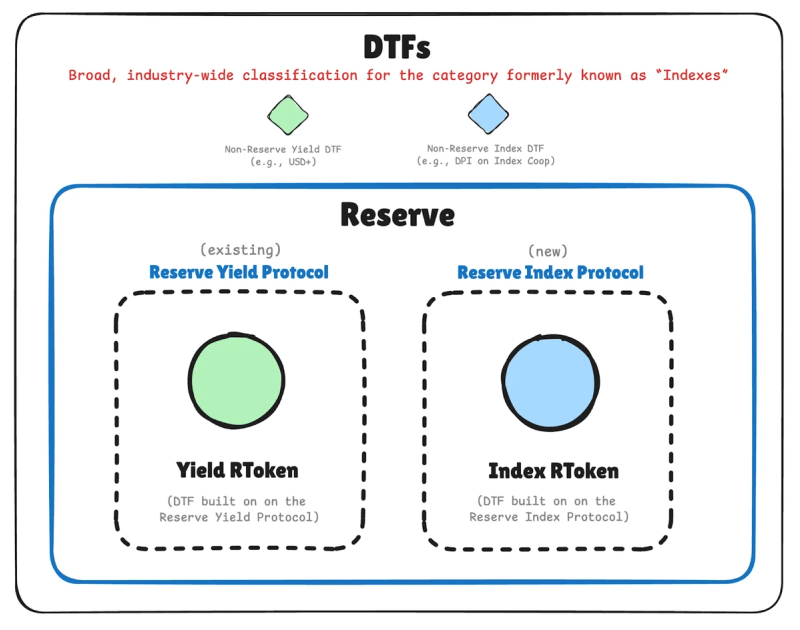
Reserve consists of two distinct protocols, both enable the creation of Decentralized Token Folios (DTFs) but are designed to serve different purposes. A DTF is a token redeemable at a 1:1 ratio for a basket of other tokens. This concept extends beyond Reserve, serving as an ETF equivalent specifically tailored for DeFi.
The first protocol, the Reserve Yield Protocol, builds Yield DTFs (Yield RTokens), which are designed primarily to capture yield from underlying tokens. An established example is the Web 3 Dollar (USD3), a yield-focused token on Reserve backed by three yield-bearing assets: Compound USDC V3, Morpho Steakhouse USDC, and Savings DAI. Reserve has offered yield-oriented products, such as USD3, since early 2023.
The second, newer protocol is the Reserve Index Protocol, explicitly designed to support the next evolutionary phase of DTFs in crypto. The Reserve Index Protocol facilitates the creation of Index DTFs (Index Rtokens), which provides investors targeted and thematic exposure within the digital asset market. This latest development highlights its potential impact on the broader adoption of decentralized finance products.
Onchain ETFs
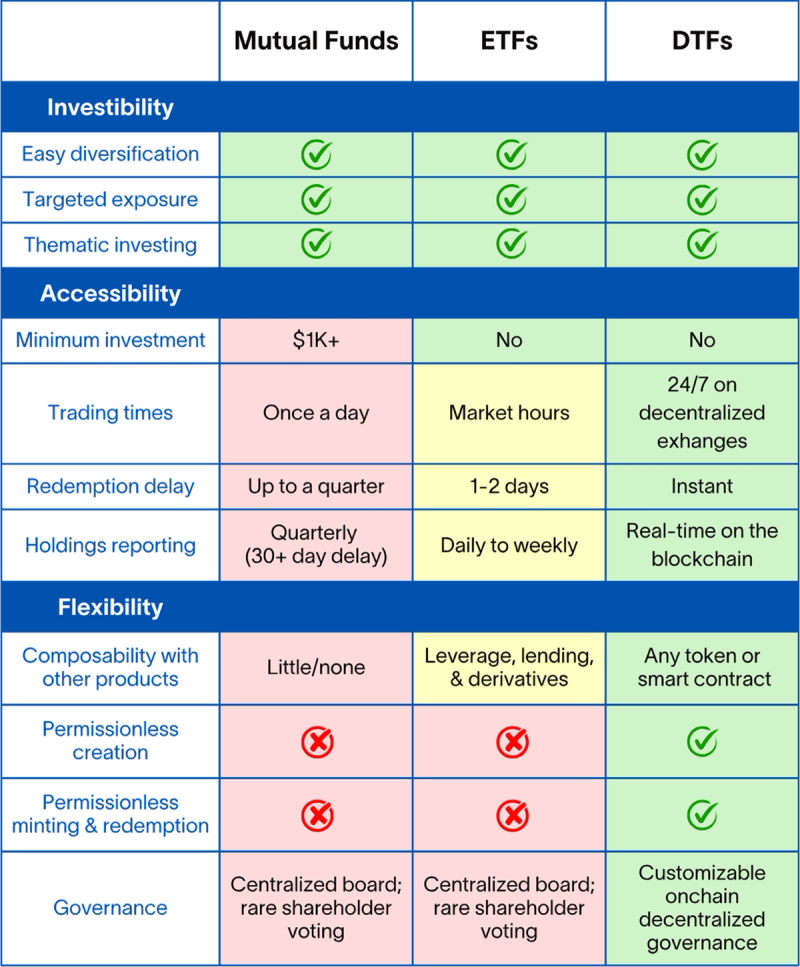
The crypto market hosts over five million tokens trading onchain, with more than 50,000 new tokens emerging daily. This makes manual tracking and investment management impractical for average investors. Decentralized Token Folios (DTFs), similar to ETFs but tailored for DeFi, simplify this complexity by allowing investors to efficiently assess performance and trade thematic crypto portfolios. DTFs provide accessible exposure to evolving crypto narratives without requiring investors to individually manage each asset.
DTFs function similarly to traditional ETFs, with each DTF redeemable 1:1 for its basket of underlying tokens. Unlike traditional financial products managed by investment companies or market makers, DTF redemptions are executed through smart contracts, allowing anyone — not just specific market participants — to redeem assets directly. This decentralized approach enables DTFs to securely hold very large baskets of tokens, with the Reserve Index Protocol supporting indexes with up to 50 tokens on Ethereum and approximately 100 tokens on Base. Importantly, all underlying assets are stored securely within smart contracts. This ensures custody is handled by transparent, autonomous code rather than by centralized entities.
DTFs offer flexible exposure to diverse crypto investment strategies, with numerous practical applications. Investors seeking broad market exposure can use DTFs tracking indexes such as the Bloomberg Galaxy Crypto Index (BGCI) or the MarketVector Digital Assets 25 Index (MVDA25) directly onchain. With permissionless DTF creation coming soon, anyone will be able to launch customized indexes focused on thematic investments, from baskets of memecoins to sector-specific portfolios targeting AI, DeFi, GameFi, DeSci, or DePIN. DTFs also provide straightforward exposure to entire ecosystems — for instance, holding multiple tokens within the Solana ecosystem without individually selecting each asset. Additionally, DTFs can incorporate complex DeFi positions, combining yield-generation strategies with diversified risk management, all packaged within a single, easily tradable asset.
Index RToken Governance and Fees
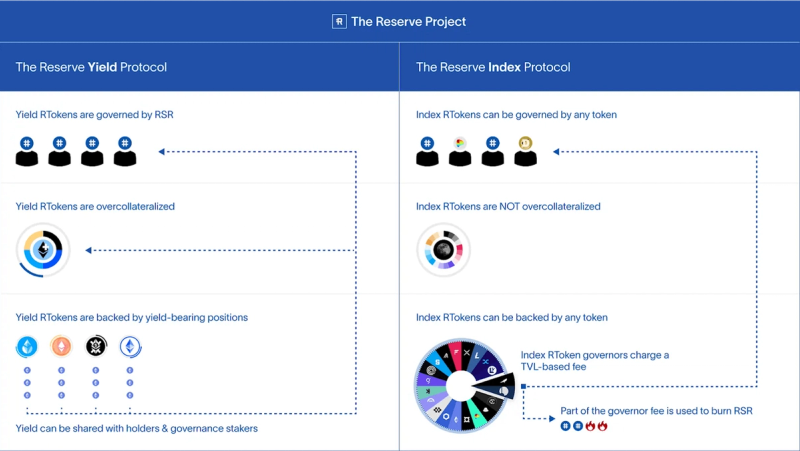
Reserve Index RTokens incorporate decentralized governance. Each DTF is governed by a specific governance token. This token can be Reserve’s native RSR or any other existing or newly minted token chosen by the DTF creator. Newly created governance tokens offer significant flexibility. They can be allocated to team members, partners, or investors during the launch phase. Creators can also stream these tokens to early users and liquidity providers to boost initial adoption and market liquidity.
This governance model makes Reserve highly attractive to institutions and independent creators alike. Institutions can leverage Reserve’s established, secure, and tested software instead of developing their own infrastructure. They can deploy DTFs with their customized governance tokens. Governance token holders directly influence crucial aspects of the DTF, including decisions about token composition and fee structures. This creates robust incentives for ongoing engagement and growth within the Reserve ecosystem.
Similar to traditional ETFs, Index RTokens charge a fee based on the total assets under management (AUM), also referred to as total value locked (TVL). For example, if an Index RToken charges a 1% annual fee, investors holding $100 in that RToken will pay $1 in fees over the year. These fees directly correlate with the growth and size of the RToken, which makes it advantageous for governance token holders as the Index RToken expands.
These fees are divided into two distinct components: the Governance Fee and the Platform Fee. The Governance Fee portion is distributed to holders of the governance token. This structure incentivizes governance holders to actively promote and manage their respective DTFs, as their earnings are directly tied to the RToken’s success and adoption.
The Platform Fee is allocated to RSR holders, either through direct burning of RSR tokens or through liquidity pool token burns. In the future, this fee may also be directed to an RSR-governed treasury if holders opt for this structure. This fee distribution model ensures that RSR holders benefit from the overall growth and usage of Index RTokens. Below is a visual representation showing how Reserve Index RTokens are governed compared to Yield RTokens:
Reserve RTokens
Currently, the total market cap across all RTokens stands at $212 million. Yield RTokens, launched in 2023, dominate with $210 million of the total market cap, demonstrating strong product-market fit. Index RTokens, introduced more recently on February 25, 2025, currently have a combined market cap of $1.7 million across Ethereum and Base, with a total of 14 Index RTokens deployed.
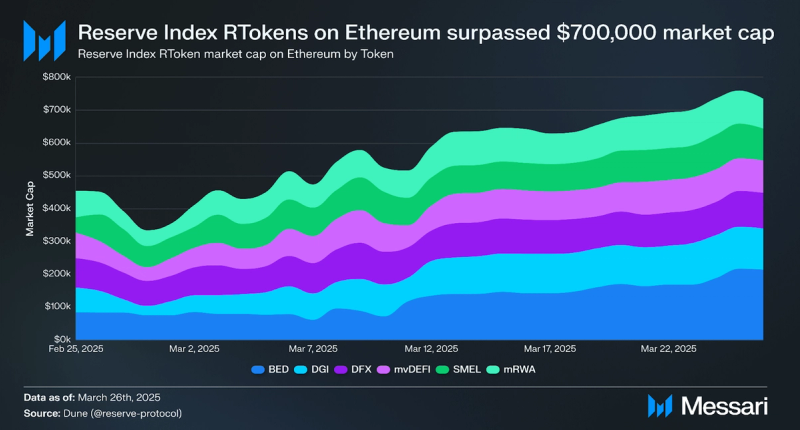
Ethereum-based Index RTokens collectively account for a market cap of $734,568 distributed among six tokens. The largest is the BTC ETH DCA Index (BED), currently valued at $209,001. BED is backed by WBTC, WETH, and USDC, aiming to dollar-cost average into Bitcoin and Ethereum through monthly rebalancing, while simultaneously earning additional yield from lending collateral to money markets. The DeFi Growth Index (DGI), valued at $124,913, tracks early-stage DeFi projects with promising user growth, trading volume, and TVL, holding tokens such as MORPHO, FLUID, and COW. The CoinDesk DeFi Select Index (DF), at a market cap of $107,224, follows the CoinDesk DeFi Select Index (DFX), comprising large-cap, highly liquid DeFi tokens like UNI, AAVE, and MKR.
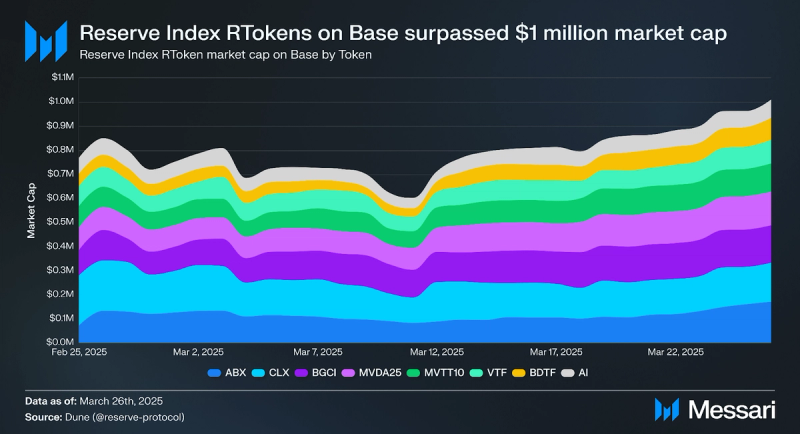
On Base, Index RTokens recently surpassed the $1 million market cap milestone across eight tokens. The largest, Alpha Base Index (ABX), holds a market cap of $160,238. ABX is DAO-governed and focuses on emerging Base ecosystem projects identified as having high risk-adjusted growth potential. Its top holdings include TIBBIR, DRB, and RSR. Next, the Bloomberg Galaxy Crypto Index (BGCI), with a market cap of $153,987, mirrors the Bloomberg Galaxy Crypto Index, capturing the performance of major crypto assets like cbBTC and bsdETH. The Clanker Index (CLX), valued at $150,987, provides exposure to leading assets within the Clanker ecosystem, prominently featuring tokens like CLANKER and Fartcoin.
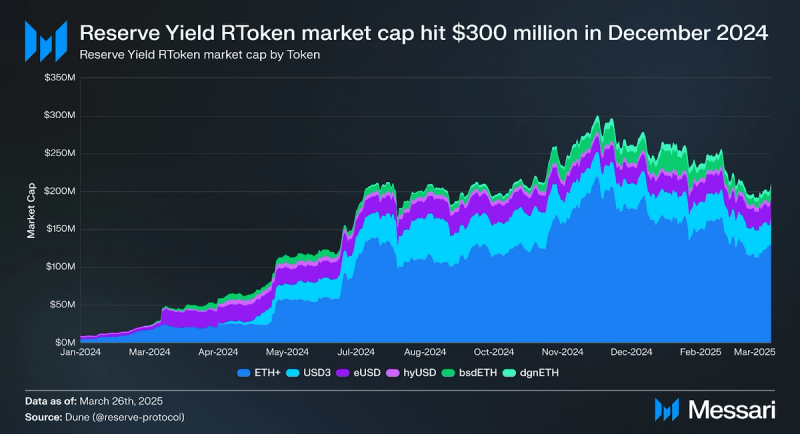
Yield RTokens have successfully achieved product-market fit, holding a total market cap of $212 million distributed across six tokens. The largest, ETH+, has a market cap of $127 million and is collateralized by Ethereum-pegged yield-generating tokens: Stader ETHx, Staked Frax ETH, Wrapped Staked ETH, and Rocket Pool ETH. The second-largest Yield RToken, USD3, holds a market cap of $35 million and is backed by yield-bearing, USD-pegged collaterals, including Compound USDC V3, Morpho Steakhouse USDC, and Savings DAI.
Tokenomics
The RSR token grants holders influence over Reserve protocols and RTokens through three main governance roles:
- Yield RTokens Governance: RSR governs and overcollateralize Yield RTokens, maintaining responsibility for ensuring collateral quality and managing risk. Stakers participate actively in governance decisions and benefit directly from the success and increased adoption of these RTokens.
- Index RTokens Governance: RSR holders may choose to govern newly deployed Index RTokens, which influence token composition and fee structures. Even Index RTokens governed by tokens other than RSR contribute to RSR’s value through platform fees. This benefits all RSR holders collectively.
- Meta-level Governance: The Reserve ecosystem aims to establish a meta-level DAO governed by RSR holders. This DAO will manage critical decisions, which includes directing protocol fees toward burning RSR or supporting treasury growth, managing protocol upgrades, and controlling RSR token emissions.
By default, the entire proposal-to-execution cycle spans approximately eight days, facilitating active participation while ensuring thorough evaluation.
Governance Process
Reserve’s default governance implementation, Governor Anastasius, provides a structured, transparent framework for community-led decision-making. RSR holders propose, discuss, and vote on protocol updates, collateral changes, and economic parameters. Voting power is proportional to the amount of RSR held or delegated, with configurable governance parameters such as proposal thresholds, quorum requirements, voting periods, and execution delays.
The governance process follows three primary stages:
- Proposal: Community members holding sufficient RSR propose changes or improvements.
- Voting: RSR holders cast votes directly or through delegated representatives.
- Execution: Approved proposals enter a timelock delay before execution, allowing additional review and community input.
By default, the entire proposal-to-execution cycle spans approximately eight days, facilitating active participation while ensuring thorough evaluation.
Protocol Safety Mechanisms
Reserve employs additional security measures, which grants specific emergency roles — Pauser, Short Freezer, Long Freezer, and Guardian — to Ethereum addresses designated by governance. These roles can temporarily pause or freeze system operations in the event of exploits or unexpected vulnerabilities. This safeguards user funds and protocol stability.
RSR Emission Schedule
RSR Token Unlocks
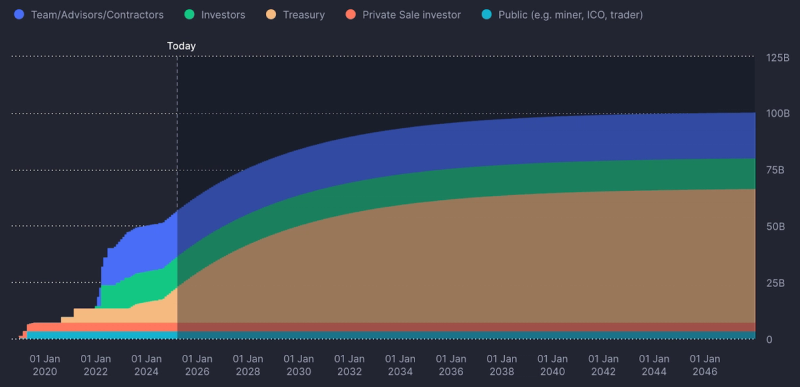
RSR has a fixed total supply of 100 billion tokens. Currently, 56 billion RSR tokens are in circulation, with the remaining 44 billion allocated to two controlled wallets known as the Slow Wallet and the Slower Wallet. These wallets fund initiatives to accelerate RToken adoption and ecosystem expansion, each with specific rules governing token withdrawals.
The Slow Wallet, controlled directly by the Reserve project team, releases tokens with a hard-coded four-week withdrawal delay after initiating any transaction. Tokens from the Slow Wallet primarily fund ecosystem entities such as Confusion Capital, which manages the Slower Wallet. Confusion Capital oversees funding allocations to key ecosystem contributors, including Best Friend Finance and ABC Labs, which leads core protocol development.
The Slower Wallet imposes additional constraints on withdrawals to further decentralize trust and enhance transparency. It maintains the same four-week withdrawal delay but adds a limit that restricts withdrawals to a maximum of 1% of the total RSR supply (1 billion RSR) in any rolling four-week period. For example, if 1 billion RSR is withdrawn, the wallet’s withdrawal limit resets gradually — after two weeks, half the limit (500 million RSR) becomes available again. This throttling mechanism ensures controlled token distribution into the ecosystem.
RSR’s future emissions follow a predetermined schedule designed to emulate Bitcoin’s well-established emissions curve, progressively reducing new supply over time. Token allocations from these emissions directly support critical activities that foster ecosystem growth, including:
- Core protocol and smart contract development
- User interface and frontend development, particularly for RToken applications
- Protocol research, security audits, and iterative improvements
- Marketing campaigns and educational initiatives
- Integration with essential DeFi infrastructure, such as price oracles
- Legal analysis and compliance strategies, especially for security-focused RTokens
Total Token Allocation Breakdown:
- Team, Advisors, Contractors: 20.34%
- Investors: 13.58%
- Treasury (Ecosystem Funding): 59.23%
- Private Sale Investors: 3.85%
- Public Allocation (ICO, Traders, Miners): 3.00%
This structured token emission model ensures predictable token flows, transparent governance, and sustainable long-term growth within the Reserve ecosystem.
Roadmap
Reserve is advancing its DTFs, with immediate plans to expand the Reserve Index Protocol beyond Ethereum and Base onto Solana. This expansion allows individuals and institutions to access diversified investment indexes seamlessly, positioning Reserve as a decentralized alternative to centralized giants like BlackRock. Also, Reserve plans to introduce permissionless DTF creation, which gives investors the capability to launch customized indexes. By empowering a broad set of creators to deploy and manage DTFs, Reserve leverages market-driven competition to identify optimal asset combinations across crypto sectors.
This decentralized indexing framework aligns directly with Reserve’s broader mission of developing a universally accessible, asset-backed currency resistant to inflation and systemic risks. Traditional fiat currencies, including the US dollar, face inherent vulnerabilities due to centralized control and monetary policies. Reserve believes stable, asset-backed tokens — diversified across asset classes such as equities, bonds, real estate, gold, and digital assets — can provide a more resilient long-term store of value.
By enabling anyone globally to create, transact, and settle with these decentralized token folios, Reserve aims to create the financial infrastructure necessary for widespread adoption of asset-backed currency. This infrastructure not only offers immediate benefits to users seeking stability but also provides a robust alternative financial system capable of supporting the global economy should traditional currencies ever face significant disruption.
Closing Summary
Reserve, founded in 2017 by Nevin Freeman and Matt Elder, initially aimed to offer stable monetary solutions for users facing inflation and unstable currencies. Today, Reserve has evolved into a sophisticated ecosystem offering DTFs, crypto’s decentralized equivalent to traditional ETFs. Through two specialized protocols — Yield and Index — Reserve provides investors with accessible yield opportunities and thematic crypto portfolios, governed transparently by community-chosen governance tokens.
Yield RTokens have rapidly achieved product-market fit, capturing significant market share, while Index RTokens, launched in early 2025, are quickly expanding. Reserve’s strategic roadmap focuses on extending its decentralized Index Protocol onto blockchains like Solana, further widening investor access. Beyond decentralized investing, Reserve’s mission is to develop an asset-backed currency that provides global stability and resilience. By combining diversified asset portfolios with decentralized governance, Reserve seeks to offer a secure, transparent, and inclusive monetary alternative for users worldwide.