Key Insights
- Despite market headwinds, affiliate volume increased 29.7% QoQ, rising from $2.25 billion to $3.21 billion, with Asgardex leading all affiliates at $1.22 billion.
- THORChain’s USD-denominated DeFi TVL declined 50.5% QoQ, falling from $368.6 million to $181.1 million, while native RUNE-denominated TVL rose 93.2%, from 82.2M to 158.8M RUNE.
- RUNE fell 74.5% QoQ, dropping from $4.48 to $1.14, significantly underperforming BTC and ETH over the same period.
- Swap activity decreased 24.4% QoQ, with average daily volume falling from $91.0 million to $68.8 million. March 2 marked a protocol-record high of $1.05 billion in daily volume due to laundering activity post-Bybit exploit.
- THORFi’s lending and savers programs were paused mid-quarter with approximately $200 million in protocol liabilities. Proposal 6 was approved to unwind THORFi without inflating RUNE supply, using trading fees and node rewards to repay debt over time.
Primer
THORChain (RUNE) is a Layer-1 network designed to facilitate cross-chain DEX swaps without the need for wrapped assets. The blockchain is developed on the Cosmos SDK and uses the BFT Tendermint consensus engine. Native assets are managed directly in onchain vaults and funds are secured by node’s bonding or staking RUNE.
The network employs Threshold Signature Schemes (TSS) requiring a two-thirds majority of nodes for the movement of funds to and from vaults. Each vault must have a RUNE stake worth more than 1.5 times the value of the vault’s funds to ensure nodes do not collude to steal funds.
THORChain uses continuous liquidity pools (CLP) where all pools are paired with RUNE and provide consistent liquidity to all assets in the network. Furthermore, fees are adjusted according to the liquidity depth of the pool. Additionally, THORChain’s Savings Product for yield on synthetic assets (synths) and Lending Product for overcollateralized, 0% interest loans with no liquidations or expiration, were sunset in Q1 2025..
Website / X (Twitter) / Telegram
Key Metrics
Financial and Ecosystem Analysis
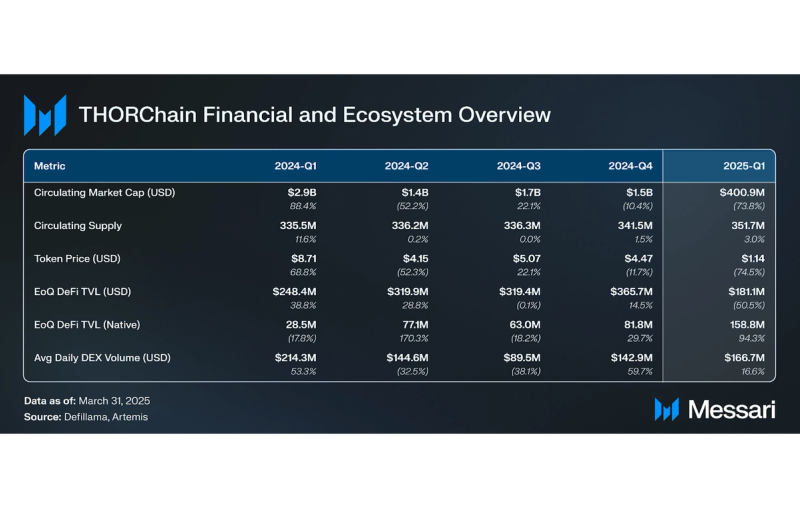
Following a volatile close to 2024, THORChain’s native asset, RUNE, saw a sharp correction in Q1 2025. RUNE ended the quarter at $1.14, down 74.5% quarter-over-quarter (QoQ), underperforming both BTC and ETH, which posted more stable price action declining 12.6% and 45.5% respectively. The token’s market capitalization declined 73.8% QoQ, falling from $1.5 billion to $400.9 million—its lowest point since mid-2022. THORChain’s rank among digital assets dropped accordingly from 69th to 119th, reflecting weakened sentiment and broader de-risking across the altcoin market.
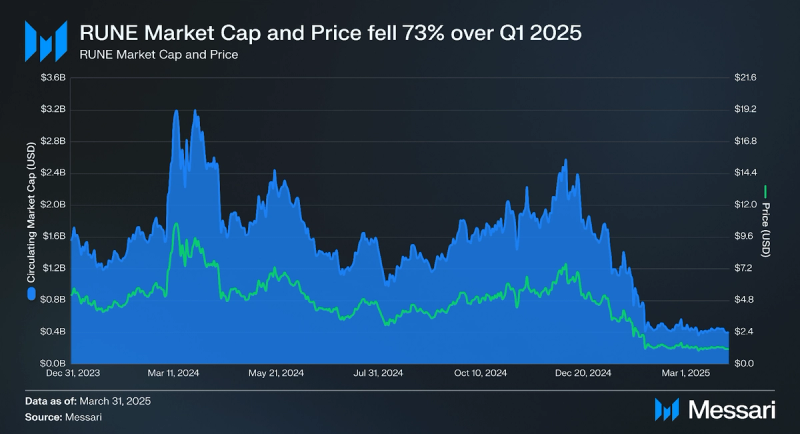
Despite price weakness, RUNE token emissions remained modest, with circulating supply increasing by 3.0%, rising from 341.5 million to 351.7 million RUNE over the quarter.
DeFi
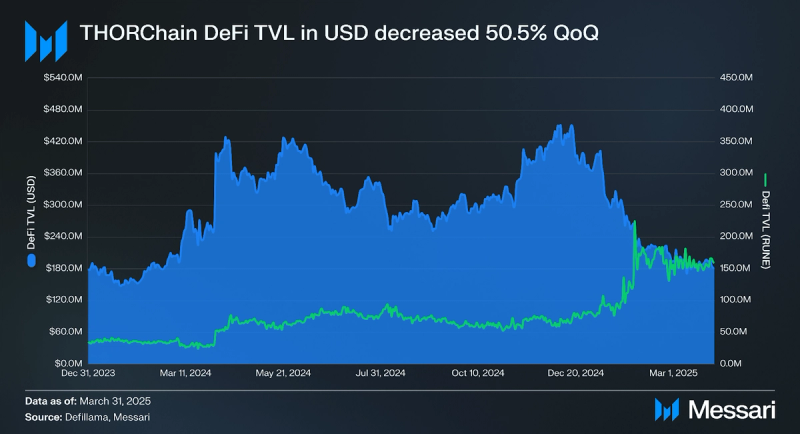
THORChain DeFi Total Value Locked (TVL) declined sharply in Q1 2025, finishing the quarter at $181.1 million, down 50.5% from $368.6 million in Q4. The drop in USD-denominated TVL was largely driven by RUNE’s 74.5% price correction, which significantly impacted the value of pooled assets. TVL peaked early in the quarter at $367.7 million on January 2 before trending downward in parallel with RUNE’s market performance.
In native terms, however, THORChain’s DeFi TVL rose substantially. Total RUNE-denominated TVL increased 93.2% QoQ, growing from 82.2 million to 158.8 million RUNE. This divergence highlights sustained and growing participation in THORChain’s liquidity pools, even as price volatility drove USD values lower.
THORChain’s ability to expand native asset deposits in the face of a broader market pullback suggests rising user engagement and a continued appetite for multichain liquidity infrastructure. The growth in RUNE-denominated TVL amid declining token prices points to long-term confidence in protocol fundamentals and the utility of THORChain’s cross-chain capabilities.
Swap Volume
In February 2025, the cryptocurrency exchange Bybit suffered a significant security breach, resulting in the theft of approximately $1.4 billion worth of ETH. The perpetrators, identified as the North Korean-affiliated Lazarus Group, sought to launder the stolen assets by converting them into other cryptocurrencies.
According to reports, the hackers utilized THORChain to swap substantial amounts of the stolen ETH for BTC. This illicit activity contributed to THORChain processing a record $4.66 billion in swaps during the week ending March 2, 2025. Notably, over $1 billion was processed on March 2 alone.
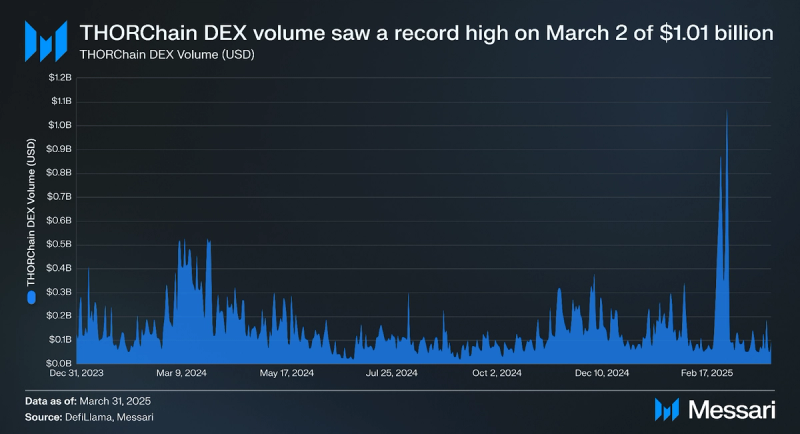
Swap activity on THORChain declined in Q1 2025, with average daily volume falling 24.4% quarter-over-quarter to $68.8 million, down from $91.0 million in Q4 2024. This decline reversed the gains from the previous quarter and marked a continued cooldown from the $218.4 million daily average seen at the beginning of Q1.
Despite the lower average volume, Q1 included a record spike in throughput driven by abnormal activity following the Bybit exploit. On March 2, THORChain processed a single-day high of $1.05 billion in swaps as hackers used the protocol to convert stolen ETH into BTC. This surge distorted weekly metrics but did not offset the overall downtrend in organic swap usage.
Onchain data indicates that while average daily swappers decreased by 14.5% QoQ to 1.78K users, core usage remained distributed across a wide range of affiliates and wallet integrations. The sustained participation reflects the protocol’s continued role as a backend settlement layer for multichain swaps, even as broader market volatility and RUNE’s price drawdown weighed on user activity.
Affiliate Revenue
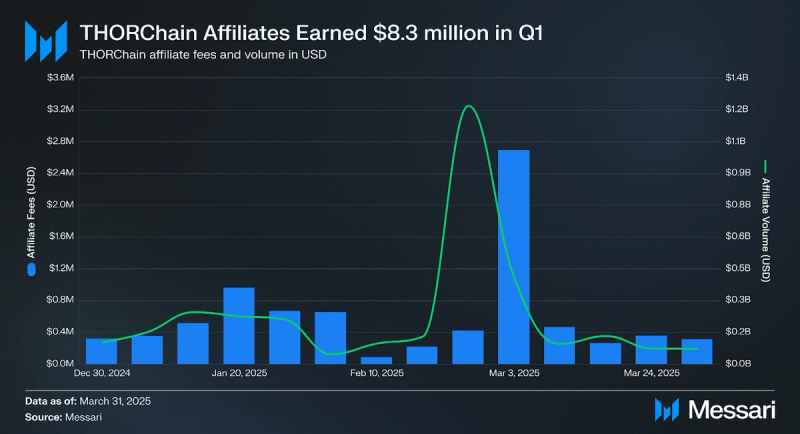
THORChain users typically interact with interfaces to broadcast transactions, rather than directly engaging with THORNodes. To incentivize these integrations, THORChain allows wallet developers to include an affiliate address and a custom fee rate ranging from 0-1,000 basis points. The protocol then collects these affiliate fees in a non-custodial and transparent manner for every transaction processed.
THORChain affiliate revenue dropped from a total of $11.4 million in Q4 to $7.9 million in Q1, a 37.3% decrease. On average, affiliates earned a combined $87,940 per day throughout Q1, with a peak of $492,533 on Feb. 27, 2025, partly in response to the Bybit exploit.
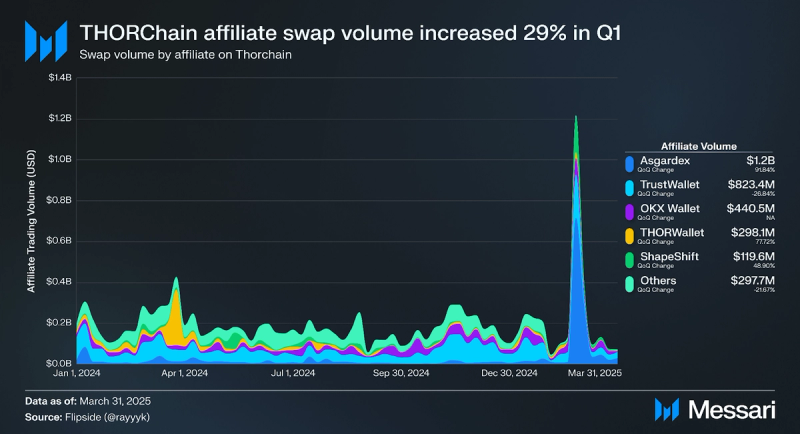
Affiliate volume rose 29.7% QoQ from $2.25 billion in Q4 to $3.21 billion in Q1, with Asgardex leading all affiliates with $1.22 billion in volume. The majority of swap volume occurred during the weeks of Feb. 24 and March 3, which accounted for $1.62 billion in volume, roughly 50.7% of the quarter’s total swap volume. Excluding those two weeks, affiliates averaged $22.4 million in weekly swap volume.
THORFi Unwind and Governance Response
In early 2025, THORChain faced significant financial challenges, leading to the suspension and subsequent unwinding of its THORFi lending and savers programs. These programs, integral to THORChain’s decentralized finance offerings, had accumulated substantial liabilities, prompting urgent measures to stabilize the network.
Background and Challenges
THORFi’s lending and savers programs were designed to enhance the utility of the THORChain ecosystem. However, their success was heavily reliant on the performance of THORChain’s native token, RUNE, relative to major assets like Bitcoin (BTC) and Ethereum (ETH). The lending mechanism involved burning RUNE to create loans and minting RUNE upon loan closure. If RUNE’s value declined after loan issuance, more RUNE would be minted upon closure than was initially burned, leading to inflationary pressures. Similarly, the savers program introduced leverage into liquidity pools, which, during periods of RUNE underperformance, exacerbated impermanent loss and negatively impacted liquidity providers.
As altcoins, including RUNE, began to decouple from BTC, concerns about THORFi’s sustainability grew. Negative sentiment and discussions about RUNE’s price decline created a feedback loop, further driving down its value and amplifying the protocol’s financial instability.
Timeline of Key Events
- January 9, 2025: In response to escalating concerns, an administrative key was used to temporarily pause the lending and savers programs. This decision was overturned by node operators via governance later that day.
- January 24, 2025: Node operators voted to suspend THORFi’s lending and savers programs to prevent potential insolvency and protect liquidity providers. This suspension was intended to provide a 90-day window for the community to develop a restructuring plan.
Financial Implications
The suspension of THORFi services had immediate financial repercussions. RUNE’s price experienced a sharp decline, dropping approximately 30% in the aftermath of the announcement. The protocol faced liabilities of around $200 million, primarily in BTC and ETH. Concerns arose regarding THORChain’s ability to meet creditor obligations, especially if users simultaneously redeemed their loans and savings positions.
Community and Development Response
In the wake of the suspension, the THORChain community engaged in extensive discussions to address the protocol’s challenges. Multiple proposals were submitted, focused on restructuring liabilities to ensure the long-term health of the network. The development team prioritized communicating the implementation and timeline for unwinding THORFi.
Path Forward
Following weeks of community discussion, Proposal 6 was formally approved by node operators on Feb. 6, 2025. Proposal 6 establishes a clear and contained strategy for addressing the protocol’s outstanding liabilities through the minting of a new unit of account called TCY (THORChain Yield). TCY is not a tradable asset but an internal accounting mechanism used to represent the protocol’s obligations to Lending and Savers users at a rate of 1 TCY per dollar of defaulted debt.
Under the terms of the proposal, all outstanding debts in BTC and ETH will be consolidated and denominated in TCY. When users withdraw from Lending or Savers positions, they will receive TCY at a 1:1 ratio with the value of their assets at the time of the program’s suspension. This TCY balance will then be gradually repaid over time in BTC and ETH as the protocol generates yield.
Crucially, repayment of TCY does not involve the minting of new RUNE. Instead, TCY will be repaid using protocol revenue, specifically, the network’s share of swap fees and validator earnings. These revenues will be routed into repayment queues for TCY holders. Each block, a portion of collected fees is allocated toward TCY redemption, which will be distributed proportionally to all holders based on the amount and maturity of their claim.
All TCY redemptions will be handled transparently, with onchain data feeds and public dashboards tracking the outstanding debt, repayment rates, and distribution progress. This ensures that repayments are verifiable and tamper-resistant, allowing users to monitor their positions in real time.
Additionally, Proposal 6 enforces strict separation between protocol debt and liquidity pool assets. TCY repayment does not draw from liquidity provider funds, ensuring that LPs are not indirectly penalized. This separation preserves the integrity of active pools while enabling the protocol to service its obligations in a controlled and non-inflationary manner.
While THORFi’s unwind marked a painful chapter for the ecosystem, it demonstrated the protocol’s ability to self-correct through decentralized governance and pragmatic reform.
Looking Toward Q2
THORChain’s Q2 2025 roadmap focuses on three core priorities: expanding L1 asset support, advancing the THORChain Developer Suite, and continuing the unwind of THORFi. The team plans to integrate new chains, including Solana, Ripple, and Cardano, significantly broadening the protocol’s cross-chain capabilities. Developer tooling will be improved through the rollout of the App Chain SDK and TX PIN, enabling deeper ecosystem growth and third-party application development. Meanwhile, the TCY debt repayment framework will be fully implemented, allowing users to withdraw Lending and Savers positions and begin receiving streaming repayments from protocol revenue.
Closing Summary
THORChain entered 2025 facing macro volatility, internal protocol stress, and shifting altcoin dynamics. RUNE’s 74.5% decline triggered a sharp contraction in market cap and TVL, but native asset deposits grew, and swap infrastructure remained active. The protocol’s critical Q1 milestone, winding down THORFi lending, showcased decentralized governance in action, averting insolvency and protecting LPs.
Despite a 24.4% drop in daily swap volume, THORChain handled record throughput during the Bybit hack, underscoring its role as a high-capacity settlement layer. With Proposal 6 approved and protocol debt ring-fenced, THORChain now pivots back to growth mode: scaling cross-chain support, deepening affiliate integrations, and executing its multichain liquidity vision.