Key Insights
- Waterfall Network launched its mainnet in July 2024, following years of research and multiple testnet iterations. It employs a DAG-based Proof-of-Stake consensus mechanism, enabling parallel block production and high scalability while maintaining decentralization.
- The network’s token, WATER, has an initial supply of 25 billion, distributed across nine allocations. It features both inflationary and deflationary mechanisms, with a Minimum Necessary Issuance model to dynamically adjust validator rewards based on staked supply.
- Waterfall Network’s ecosystem is in its early stages, but several key projects have launched or are launching soon, including Lamb OTC Market, AquaStake (a liquid staking platform), AquaDEX (a decentralized exchange), and AquaLend (a lending protocol), and more.
- Future developments include node support for mobile devices and long-term improvements in sharding capacity, parallel processing, and consensus mechanisms to enhance scalability and network efficiency.
Introduction
One challenge that has remained prevalent within the crypto industry is scaling. After years of research and billions of dollars spent on development, blockchain technology still struggles to compete with its Web2 counterpart on scalability. As an example, payment processor Visa is able to execute more than 65,000 transactions per second (TPS), while Ethereum and its entire rollup ecosystem currently handles around 200 TPS. However, as outlined in the blockchain trilemma, additional scalability usually comes at the expense of decentralization.
Interoperability is another consideration for blockchains. Although blockchains like Solana can outcompete Ethereum in terms of TPS, Solana is not EVM-compatible, meaning that popular dApps like Uniswap, Aave, and Curve cannot be natively supported on Solana. Thus, another tradeoff emerges for blockchains: should they abandon the EVM for more scalability, or remain EVM-compatible to tap into Ethereum’s deep pool of developers, applications, and users?
Waterfall Network is a Layer-1 (L1) blockDAG that seeks to address these challenges by providing an EVM-compatible Proof-of-Stake (PoS) smart contract platform that utilizes Directed Acyclic Graphs (DAGs). The project aims to provide a highly scalable platform for dApps while maintaining sufficient decentralization of its consensus.
Background
Waterfall Network (WATER) was built upon years of scientific research, and its leadership team consists of:
- Ron Resnick (CEO) – Ron Resnick is a business development executive with over 25 years of experience in high-tech industries, leading growth initiatives in blockchain, telecommunications, and wireless technology. He has held key leadership roles, including Executive Director of the Enterprise Ethereum Alliance, President of the WiMAX Forum, and various executive positions at Intel, where he spearheaded the launch of Intel’s 4G Broadband Wireless business.
- Dr. Sergii Grybniak (Head of Research) – Dr. Sergii Grybniak is an award-winning Ph.D. in Computer Science with over 15 years of experience in application development, including work with Fortune 500 companies and large-scale projects. He has contributed to respected international communities focused on DLT, published research in leading scientific journals, and co-chaired the IEEE Ukraine Blockchain Group, with a successful fintech startup exit to a top 10 U.S. bank.
- Richard Wang (Chairman of Association) – Richard Wang is a seasoned venture capitalist at DraperDragon Fund with over 20 years in high-tech business development and a strong track record of investing in blockchain startups since 2015.
- Jeff McDonald (Community Strategist) – Jeff McDonald co-founded the NEM Foundation and held key leadership roles from 2014 to 2022, bringing deep expertise in blockchain governance, education, and strategic development.
- Michael Terpin (Chief Evangelist) – Michael Terpon is a blockchain and AI entrepreneur, CEO of Transform Ventures, and founder of Transform Group, where he played a key role in launching multiple major crypto projects.
Waterfall Network has raised funding across two separate rounds. In October 2023, Waterfall Network announced that it raised $2 million in a Series Pre-A round led by ByteTrade Lab. Then, in December 2024, Waterfall Network announced funding commitments of $11.6 million. Waterfall Network’s mainnet went live in July 2024.
Technology
Waterfall Network is an L1 blockDAG that employs a Directed Acyclic Graph (DAG)-based Proof-of-Stake (PoS) consensus mechanism to achieve high throughput, finality, and scalability while maintaining decentralization. Its dual-layer architecture consists of a Sharding Network, which processes transactions and produces blocks in parallel, and a Coordinating Network, which ensures deterministic finalization and synchronization across shards.
Source: Waterfall Network
Proof-of-Stake (PoS) Consensus
Waterfall Network’s PoS consensus model enables parallel block production and deterministic finalization. Unlike traditional PoS blockchains that rely on a linear chain of blocks, Waterfall’s DAG structure allows multiple validators to create and confirm blocks concurrently, ensuring faster transaction processing and low-latency finality. Consensus occurs at two levels:
- Shard Network – Validators within each shard propose and validate blocks independently. Once a block is created, it references multiple parent blocks (“tips”) within the DAG structure. Validators during the block creation process reference only valid blocks.
- Coordinating Network – The Coordinating Network collects “spine” blocks (unfinalized blocks) from shards, applies topological sorting, and finalizes them deterministically. This ensures global ledger consistency and prevents block reorganization risks.
Each block must accumulate enough validator attestations before being considered finalized and irreversible. The Coordinating Network synchronizes epochs, slots, and validator roles, ensuring that all shards maintain a cohesive and conflict-free state.
Validators
Validators are responsible for proposing, validating, and attesting to blocks in Waterfall’s PoS consensus. To participate, a validator must stake 32,000 WATER and run the appropriate hardware.
At the beginning of each epoch, the Coordinating Network assigns coordinator roles to validators using a randomized selection process. Coordinators perform two primary roles:
- Proposers – Selected coordinators create new blocks, containing the order of non-finalized spine DAG blocks.
- Attesters – Сoordinators verify proposed blocks and sign off on their validity. A block is finalized only when it accumulates enough attestations. Once optimistic or final consensus is reached, it is sent to the Shard Network. At the beginning of each epoch, the Shard Network assigns BlockDAG proposers role to validators using a randomized selection process. Selected validators create new blocks, referencing multiple parent blocks (tips) in the DAG structure.
Validator exits are subject to a waiting period of 2 hours, ensuring network stability before funds can be withdrawn. If a validator’s exit queue is nearly empty, their departure is delayed to allow for system adjustments.
Sharding Network
The Sharding Network consists of multiple independent shards, each responsible for processing transactions and producing blocks. Unlike sequential blockchains such as Bitcoin or Ethereum, which process transactions in a single queue, Waterfall’s DAG-based sharding enables parallelized block production, significantly increasing throughput.
In sequential blockchains, transactions must wait for their turn, even if they are unrelated. For instance, a transaction where User A sends ETH to User B has no dependencies on another transaction where User C swaps USDT for USDC. However, a sequential blockchain would process one transaction at a time, regardless of whether they are interdependent. This creates a bottleneck, increasing latency and limiting scalability.
Waterfall’s Sharding Network eliminates this inefficiency by allowing multiple shards to process transactions independently. Since unrelated transactions do not require sequential validation, validators across different shards can simultaneously propose and validate blocks, removing the need for a single-validator bottleneck.
Each shard functions as a self-contained unit, maintaining its own transaction pool and state. Validators within each shard reference parent blocks (tips) from previous slots, ensuring that block production remains continuous and efficient. Once a block is produced, it is forwarded to the Coordinating Network, which ensures that all shards remain in sync.
Coordinating Network
The Coordinating Network serves as the global synchronization layer, ensuring deterministic finalization and cross-shard consistency. While the Sharding Network operates independently, the Coordinating Network prevents transaction conflicts and inconsistencies by establishing a definitive block order, and consequently, transactions.
Unlike traditional blockchains, where finalization depends on a single chain of blocks, the Coordinating Network collects spine blocks from all shards and applies topological sorting to establish an immutable transaction sequence. This prevents conflicting transactions across shards and ensures that once a block is finalized, it cannot be reorganized or invalidated.
In addition to finalization, the Coordinating Network manages validator assignments at the beginning of each epoch, ensuring a balanced and dynamic validator distribution. It also synchronizes epochs and slot timing across shards, preventing desynchronization issues. By enforcing global ledger consistency, the Coordinating Network ensures that Waterfall’s sharded architecture functions as a single, cohesive system.
Tokenomics
WATER is the native token of Waterfall Network and has a initial token supply of 25 billion with an uncapped max supply.
Allocations
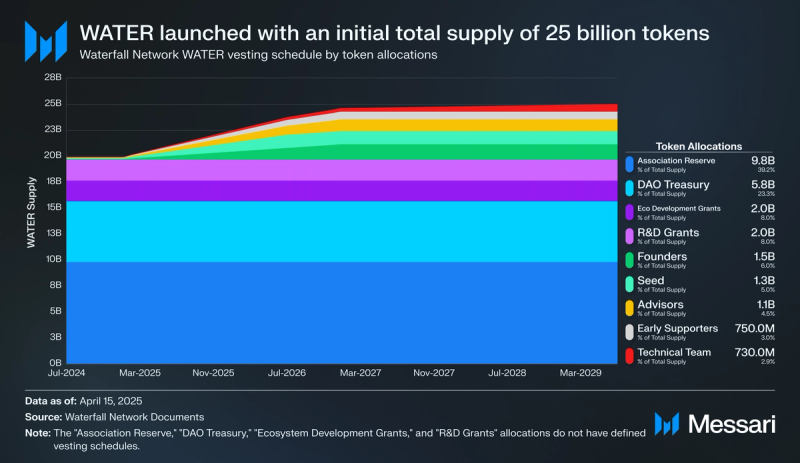
The WATER token went live in July 2024, and the initial total supply of 25 billion WATER tokens was allocated across nine different groups:
- Association Reserve (39.2%) – 9.80 billion tokens allocated for the further advancement and development of Waterfall Network and its ecosystem. These tokens do not have a defined vesting period.
- DAO Treasury (23.3%) – 5.83 billion tokens allocated for daily operations. These tokens do not have a defined vesting period.
- Ecosystem Development Grants (8.0%) – 2.0 billion tokens allocated to grants for ecosystem projects. These tokens are subject to vesting and will be determined on a case-by-case basis.
- R&D Grants (8.0%) – 2.0 billion tokens allocated to grants focused on research and development for Waterfall Network. These tokens are subject to vesting and will be determined on a case-by-case basis.
- Founders (6.0%) – 1.50 billion tokens allocated to the founders of Waterfall Network. 5% of this allocation was unlocked at TGE, with the remaining 95% subject to a 6-month cliff and subsequent 24-month linear vesting schedule.
- Seed (5.0%) – 1.25 billion tokens allocated to seed investors of Waterfall Network. 5% of this allocation was unlocked at TGE, with the remaining 95% subject to a 6-month cliff and subsequent 18-month linear vesting schedule.
- Advisors (4.54%) – 1.14 billion tokens allocated to advisors of Waterfall Network. 5% of this allocation was unlocked at TGE, with the remaining 95% subject to a 6-month cliff and subsequent 24-month linear vesting schedule.
- Early Supporters (3.0%) – 750.0 million tokens allocated to early supporters of Waterfall Network. 5% of this allocation was unlocked at TGE, with the remaining 95% subject to a 6-month cliff and subsequent 24-month linear vesting schedule.
- Technical Team (2.92%) – 730.0 million tokens allocated to the technical team behind Waterfall Network. 5% of this allocation was unlocked at TGE, with the remaining 95% subject to a 6-month cliff and subsequent 54-month linear vesting schedule.
Dynamic Supply
The WATER token features both inflationary and deflationary mechanisms that influence the total supply.
Inflation
Waterfall Network’s coin issuance mechanism is designed to ensure a sustainable validator incentive structure while preventing excessive inflation. The network follows a Minimum Necessary Issuance model, where new WATER tokens are minted to reward validators for securing the network and finalizing transactions. This issuance model dynamically adjusts based on the total amount of staked WATER tokens, ensuring that validator rewards remain sufficient without uncontrolled supply expansion.
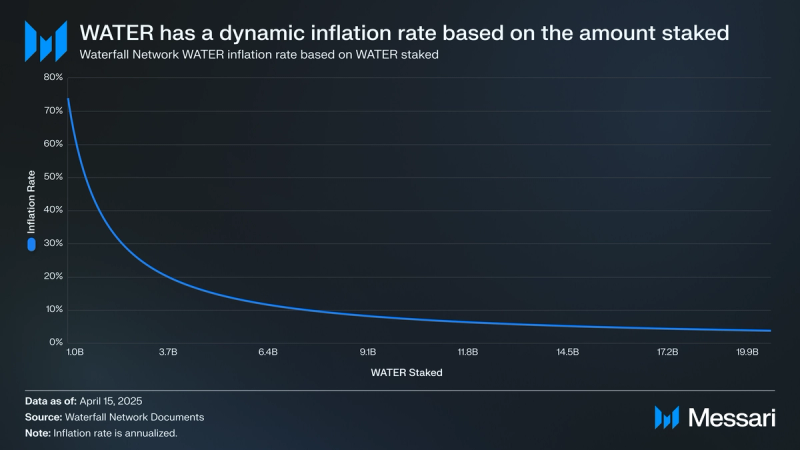
WATER’s annualized inflation amount follows the formula V = Ropt⋅Sopt⋅S, where:
- V = total annual issuance
- S = total amount of staked WATER tokens
- Ropt = 0.077 (7.7%) = optimal annualized reward rate
- Sopt = 9.60 billion WATER = optimal staked amount
Waterfall network is designed such that the optimal amount of staked WATER is 9.60 billion tokens. When that amount is staked, the annualized inflation rate is 7.7%. If less than 9.60 billion WATER is staked, then the annualized inflation rate increases to >7.7% to incentivize more users to stake, If more than 9.60 billion WATER is staked, then the annualized inflation rate decrease to <7.7% to disincentivize users from staking. As of writing, Waterfall Network is operating at less than the optimal stake with 1.34 billion WATER staked, resulting in an annualized inflation rate of 33%.
Deflation
To counteract inflation, Waterfall Network also incorporates burning mechanisms where a portion of each transaction fee is permanently removed from circulation. The percentage of burned tokens is governed by a burning multiplier, which can be adjusted. Additionally, penalties for validator misbehavior also result in token burns. If a validator:
- Fails to vote in committee decisions.
- Signs conflicting messages (e.g., double voting).
- Produces multiple blocks in the same slot.
- Provides invalid proof of an offense.
They may lose part of their staked tokens, which are then burned rather than redistributed.
Utility
The WATER token has several core features, giving utility to tokenholders:
Transaction Fees
WATER is the native token of Waterfall Network and, therefore, is used to pay transaction fees. Waterfall implements a dynamic fee model to ensure affordable transactions while preventing spam. Every transaction requires a base transaction fee, which is determined by network conditions and the amount of computational resources required to process it. The base transaction fee is influenced by:
- The total number of Verifiers (Validators) in the system.
- The total amount of staked WATER tokens.
- The gas required for execution.
- The maximum allowable gas per block.
Validator Staking
To operate a validator on Waterfall Network, a participant must stake 32,000 WATER tokens. Of note, Waterfall Network does not implement delegated staking at the network level.
Staking Rewards
Validators are incentivized to participate in the Waterfall Network through staking rewards, which come from newly minted WATER and a portion of transaction fees. Validators receive rewards for securing both the Sharding and Coordinating Networks.
In the Sharding Network, block production is incentivized by fees. Validators that propose a block receive tips from transactions included in their block and a portion of the transaction fees paid by users.
In the Coordinating Network, block rewards are minted and distributed according to participation in the consensus process. Validators are compensated for:
- Casting valid votes as committee members.
- Proposing a block that receives committee approval.
- Including finalized votes in their blocks.
A validator’s total reward consists of both base staking rewards and performance-based incentives tied to their efficiency and timeliness in achieving consensus. To encourage rapid voting, delayed attestations receive lower rewards, reinforcing active participation.
Network Activity
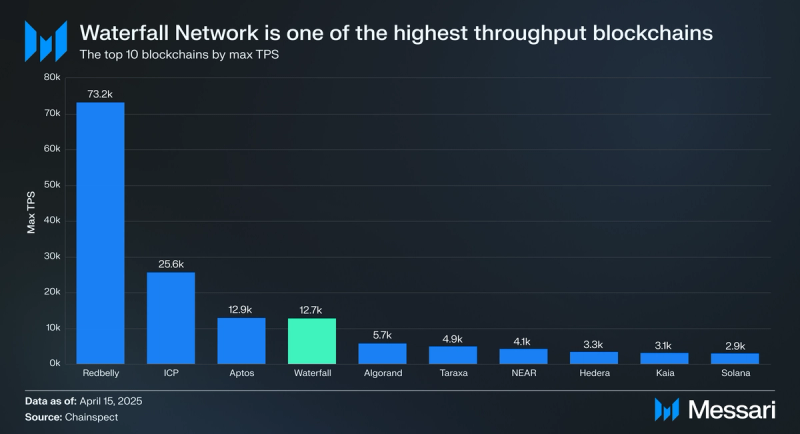
According to Chainspect, Waterfall Network is already one of the highest throughput chains in production today. Waterfall Network achieved a max TPS of 12,700, making it the fourth-highest blockchain in terms of throughput. Only Redbelly (73,200), ICP (25,600), and Aptos (12,900) have achieved a higher max TPS. Notably, Waterfall Network’s max TPS was higher than popular blockchains like NEAR (4,100), Hedera (3,300), and Solana (2,900).
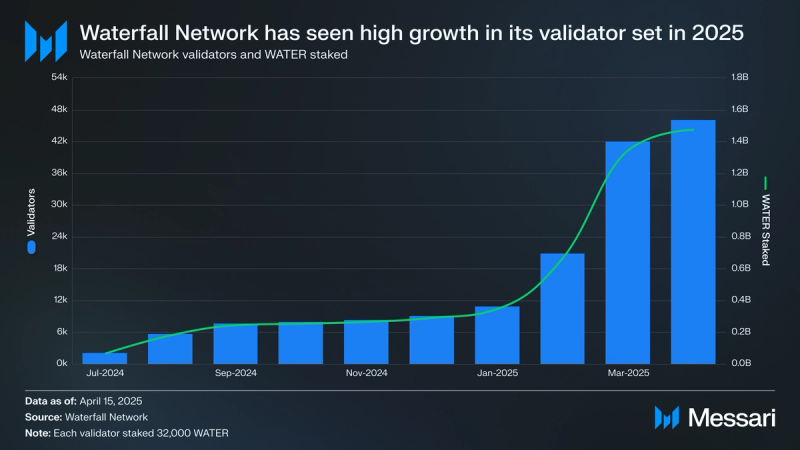
Waterfall Network has experienced significant growth in its number of active validators in 2025. On Jan 1, 2025, there were 9,900 validators. By April 15, validators had increased 366% to 46,100. Furthermore, since each validator stakes 32,000 WATER, the amount of WATER staked grows proportionately with validators. As of April 15, 1.47 billion WATER was staked, representing over 60% of the circulating supply and 6% of the total token supply.
Ecosystem
Although Waterfall Network has only recently gone live, a variety of ecosystem projects have already launched or are slated to launch soon.
Lamb OTC Market
Lamb OTC Market is an over-the-counter (OTC) trading platform built on Waterfall Network. It is the first dApp to go live on Waterfall Network and aims to provide a marketplace for a variety of assets. Key roadmap milestones include a Q2’25 public rollout with multichain support and Q3’25 ecosystem expansion through token listings and new trading features. Beyond 2025, the focus shifts to automation, DAO governance, and institutional services.
AquaStake
AquaStake is a liquid staking platform on Waterfall Network that allows users to stake WATER tokens without operating a validator. Users that stake with AquaStake receive JWATER, a receipt token that represents the underlying staked WATER. JWATER is a liquid staking token, enabling users to utilize JWATER in DeFi and other opportunities. As of writing, 2.5 million WATER has been staked on AquaStake.
AquaDEX
AquaDEX is an upcoming decentralized exchange (DEX) on Waterfall Network. It will utilize an automated market maker (AMM) architecture based on Curve, which prioritizes low-slippage trading.
AquaLend
AquaLend is an upcoming borrowing platform on Waterfall Network and will utilize an architecture based on Aave. Users can deposit accepted forms of collateral and earn interest, while borrowers can obtain loans on their collateral.
AquaSwap
AquaSwap is another upcoming DEX on Waterfall Network. It’s designed to reduce slippage, reward liquidity providers fairly, and fully use Waterfall’s scalable infrastructure to deliver a better trading experience.
LightningWorks
LightningWorks Web3 Comic on Waterfall Network. LightningWorks has launched Starblind #1, an NFT-enabled digital comic developed with the support of the Waterfall Network. This launch represents the next step in digital comics and NFT collectibles, offering fans a dynamic and immersive experience.
Cascadify
Cascadify is a Web3 website builder that empowers anyone to create decentralized systems integrated with the Waterfall Network.
Generative Mind
Generative Mind is an AI-driven blockchain analytics company specializing in real-time fine-grained natural language understanding, data aggregation, predictive modeling, and intelligence solutions for the Web3 ecosystem.
Roadmap
Past Milestones
Waterfall Network’s development has been phased and iterative, with past milestones including:
- 2020-2021 – Project Inception, Research Phase, and First Testnet Launch: Core team formation and foundational research into DAG-based consensus and scalability solutions.
- 2022 – Testnet Program Launch (Testnet 2 & 3): Initial testnets were launched to validate core technology and gather feedback, achieving early TPS benchmarks. (Testnet 2 Test 4, Testnet 3 Test 9)
- 2023 – Enhanced Testnet Program (Testnet 7 & 8, Google Consensus Test): Advanced testnets with increased scale and functionality, achieving significantly higher TPS, passing 2 million transactions public test proving network stability and ability to process large amount of transactions. (Testnet 7 Test 11, Testnet 7 Public Test 1, Testnet 8 Test 17)
- 2024 – Mainnet Launch (Secuirty Audit, Mainnet Tests & Launch): Final Mainnet tests for stability and performance, validating network stability with a massive validator set in the Google Consensus Test, security audits completed, official Mainnet launch of Waterfall Network and achieved the status of the first EVM-identical network to outperform by factual Mainnet scalability such non-EVM projects like Solana and Aptos (Mainnet Test 19, Mainnet Test 20, Mainnet Test 21, Consensus Test using Google infrastructure, Cointelegraph)
Future Roadmap
Although a detailed roadmap has not been published, Waterfall Network has disclosed some features they aim on adding in the future. In 2025, Waterfall Network plans on adding node support for smartphones and other mobile devices. Beyond this year, Waterfall Network has plans for increased sharding capacity, improved consensus, and distributed storage for transaction and state history.
Closing Summary
Waterfall Network is a newly launched L1 blockDAG that integrates a DAG-based PoS consensus mechanism to address blockchain scalability while preserving decentralization. Its mainnet went live in mid-2024 following extensive research and testing. The network is designed to support high-throughput dApps while maintaining EVM compatibility, allowing developers to leverage Ethereum’s established ecosystem.
With its ecosystem beginning to take shape, Waterfall Network is set to introduce essential financial applications such as OTC trading, liquid staking, decentralized exchanges, and lending platforms. Looking ahead, planned upgrades such as mobile node support, improved sharding, and enhanced consensus mechanisms signal the project’s commitment to continuous innovation and scalability. As adoption grows, Waterfall Network aims to position itself as a high-performance smart contract platform within the broader blockchain landscape.