Key Insights
- Roam is developing a credential-based wireless network that integrates WiFi OpenRoaming, eSIM provisioning, and blockchain-based coordination.
- Since its token launch in March 2025, Roam has onboarded over 600,000 customers, growing from 2.3 million to over 2.9 million, and increased its active node count from approximately 2.2 million to over 5.1 million.
- Roam’s market capitalization increased from approximately $35 million post-TGE to over $90 million by April 21, 2025.
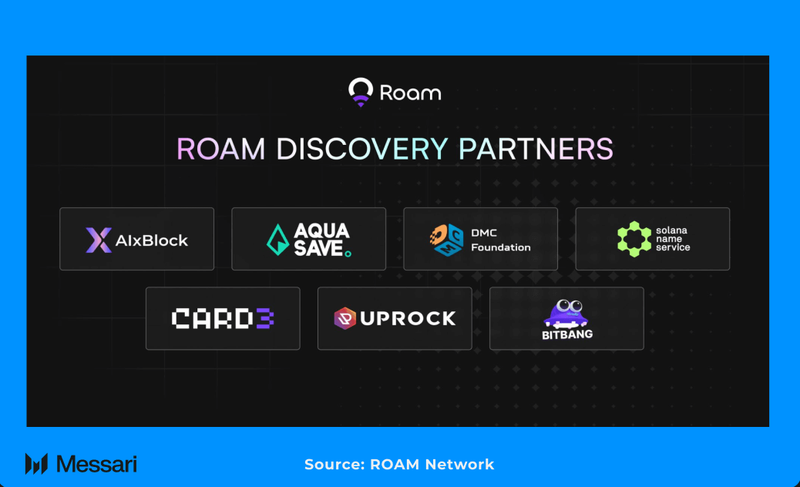
- Roam expanded beyond telecom by partnering with projects across AI projects (AIxBlock, DMC), identity (CARD3, SNS), gaming (Bitbangbot), and bandwidth sharing (UpRock).
Primer
Most wireless access systems rely on centralized authentication, carrier lock-in, and manual onboarding. This applies to both public WiFi and cellular networks. These design choices fragment the user experience, introduce security limitations, and restrict user mobility. Roam proposes an alternative architecture: a credential-based wireless network built on Solana, compatible with BSC and other EVM chains, that incorporates WiFi OpenRoaming and eSIM provisioning. Instead of centralized authentication, Roam uses verifiable credentials (VCs) and decentralized identifiers (DIDs) to support portable and authenticated access. Its architecture combines three components: blockchain-based coordination, DID/VC-based identity management, and a dual connectivity model that includes both WiFi and eSIM infrastructure.
Users connect via Roam-enabled hotspots and are verified through DIDs and VCs. Their connectivity is validated by network contributors called Roam Miners, which are physical WiFi routers that function both as wireless access points and as blockchain nodes. Roam Miners act as validators, verifying user credentials within the network.
Roam incentivizes users, node operators, and validators with Roam Points. Contributors earn these points by performing tasks such as onboarding new WiFi hotspots, contributing content delivery network (CDN) bandwidth, verifying hotspot authenticity, expanding geographic coverage, and performing daily check-ins that validate WiFi status and log this data on Solana. Roam has recorded over 440 million check-ins. Roam Points are convertible into the network’s token, ROAM.
To support this vision, Roam has successfully raised capital through multiple funding rounds, securing investments of $7.25 million from over 15 investors. Notable backers include Synergis Capital, Volt Capital, Anagram, Samsung Next, and SNZ Capital. For a full primer on Roam, refer to our Initiation of Coverage report.
Network Activity
Roam initiated its token generation event (TGE) on March 6, 2025. Since then, its customer base has grown from 2.3 million to over 2.9 million. This increase was driven by a token airdrop that distributed 6 million ROAM across eight major exchanges, community bounties, and its decentralized WiFi OpenRoaming and eSIM solutions.
During this period, the number of active nodes has more than doubled from 2.3 million to over 5.1 million. Roam’s market capitalization (USD) increased from approximately $35 million shortly after its TGE on March 6, 2025, to over $90 million by April 21, 2025. Following the peak, Roam’s market capitalization stabilized to around the $42–47 million range. Market cap data is only available starting March 12, 2025, which accounts for the gap at the start of the chart. The ROAM token’s price dropped a week following the TGE to $0.14, but rebounded to a high of $0.35 by April 21, 2025, reflecting higher network participation. In the months that followed, the price stabilized around $0.18, suggesting consolidation as early market activity cooled.
Partnerships and Ecosystem Expansion
L2 Integrations and Partnerships
Roam advanced its strategy across network infrastructure through two key integrations with two rollups:
- SOON: Roam partnered with SOON, a Layer-2 (L2) rollup based on the Decoupled Solana Virtual Machine (Decoupled SVM), in February 2025. This collaboration allows Roam to explore zk-enabled execution outside of Solana by deploying its credentialing and validation logic in modular rollup environments, where execution, settlement, and data availability are separated.
- MAP Protocol: Roam integrated with MAP Protocol, a Bitcoin L2 powered by ZK light clients, in March 2025. The partnership connects Roam’s connectivity layer to the Bitcoin ecosystem, supporting credential verification across Bitcoin-based rollups.
Infrastructure Integrations and Partnerships
Roam expanded its participation in infrastructure with two key integrations:
- UpRock: Roam integrated with UpRock, a mobile-first DePIN network that rewards users for sharing idle internet bandwidth, in February 2025. UpRock Prism powers real-time web crawling and stress testing; Roam nodes can now contribute to this data engine while earning rewards.
- Aquasave: Roam announced a partnership with AquaSave, a DePIN project focused on water efficiency, in April 2025. AquaSave’s AquaBanks collect and monetize environmental data across households, agriculture, and industry. Roam facilitates secure wireless transmission of this data over its decentralized network.
Bybit Partnership
Roam formed commercial partnerships to support product distribution and enterprise adoption:
- Bybit: Roam partnered with Bybit, a centralized exchange, to launch its Business eSIM product in April 2025. The integration allows Roam to issue and manage eSIMs directly through Bybit’s user accounts, using Bybit’s wallet infrastructure for authentication and payment. This setup enabled crypto-native enterprises to activate mobile data plans without traditional carrier contracts.
AI Integrations and Partnerships
Roam formed two data-focused partnerships to support permissionless AI development and low-latency data services:
- AIxBlock: Roam partnered with AIxBlock in April 2025, a decentralized compute platform offering access to AI models, GPU infrastructure, and human validators. Roam supports credentialing and onchain validation of AI outputs.
- DMC Foundation: Roam integrated with the DMC Foundation, which operates the Datamall Coin (DMC) protocol for scalable data storage and retrieval, in July 2024. Roam nodes help deliver fast, reliable data transfers to support decentralized AI pipelines and user-owned labeling.
Identity & Social Protocols Partnerships
To support more seamless onboarding and user attribution, Roam deepened its identity stack through partnerships with CARD3 and Solana Name Service (SNS):
- CARD3: Roam partnered with CARD3 in June 2025, a social identity protocol that combines AI and decentralized credentials. This integration allows for portable identity management and verifiable reputation across Roam’s network.
- Solana Name Service (SNS): Roam began supporting SNS in 2025, enabling users to link .sol domains to onchain data, wallet addresses, and InterPlanetary File System (IPFS) content. This simplifies identity management and improves accessibility by enabling consistent, user-friendly identifiers across Roam applications.
Ecosystem Engagement Initiatives and Partnerships
Roam formed several incentive-focused partnerships to lower participation barriers and drive early adoption through rewards, lending, and gamified engagement:
- Bitbangbot: Roam partnered with Bitbangbot in 2025, a Web3 gaming platform tied to hardware-based gameplay. The integration allows users to redeem Roam Points to participate in Bitbangbot games, linking wireless usage to gaming incentives.
- Huma Finance: Roam partnered with Huma Finance in January 2025, a protocol focused on income-based lending. The collaboration enabled the launch of the Roam Loan program, allowing contributors to acquire mining hardware on a deferred payment basis, with repayments made over time through accrued mining rewards.
- Roam Airdrop Initiative: Roam launched its token airdrop campaign on March 6, 2025, to coincide with the ROAM token’s debut on eight centralized exchanges, including Bybit, Bitget, and Gate.io. The campaign distributed 6 million ROAM tokens through exchange-led promotions, using trading rewards and user incentives to drive attention and participation around the Token Generation Event (TGE).
- Global eSIM Launch: Roam launched its Global eSIM product in September 2024, offering mobile data with no contract or expiry requirements. As part of this initiative, users earn data credits, a unit used to pay for network usage. By interacting with the Roam app, integrate usage-based rewards into the consumer experience.
Roadmap
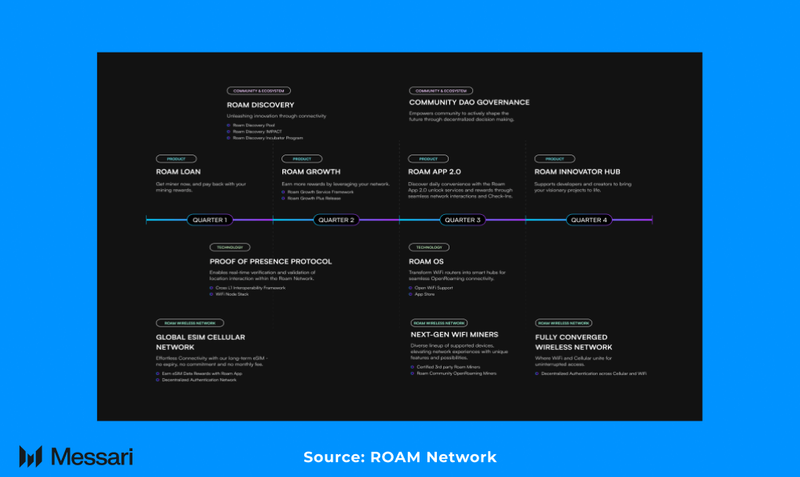
Following its TGE in March 2025 and early network buildout, Roam’s 2025 roadmap emphasizes modular identity systems, secure onboarding for wireless access, and compute-capable access points. Key initiatives follow a staged rollout that spans connectivity, governance, and developer tooling.
Ecosystem Expansion
Roam has steadily expanded its ecosystem through a multi-pronged strategy focused on community development, user incentives, and hardware deployment.
- Global eSim: Roam expanded its consumer connectivity offering with the launch of the Global eSIM, introducing contract-free mobile data and usage-based incentives. In April 2025, Roam extended this model to enterprises with the Business eSIM and has since announced plans for a Premium tier.
- Roam Discovery: Roam launched Roam Discovery in December 2024, a coordination platform aimed at ecosystem collaboration. This platform introduced initiatives such as the Discovery Pool, which provides early-stage funding; the IMPACT Program, which supports community-led deployments; and the Incubator, designed to assist developers and partners.
- Roam Growth: Roam introduced Roam Growth in December 2024, a complementary incentive program that created new reward structures based on user activity, network contributions, and validator uptime to strengthen user participation and validator engagement. As part of this initiative, Roam launched the Roam Loan program, enabling users to acquire mining hardware with repayments made from mining rewards.
- Exchange Liquidity and Distribution: On June 13, Roam launched its token on PancakeSwap (BSC), Binance, Meteora, and other Solana-based DEXs, activating trading and liquidity rewards across both chains. This marked the beginning of Roam’s on-chain market presence, with ROAM now averaging over $90 million in daily decentralized exchange (DEX) volume. The launch also featured the ROAM Airdrop and Trading Competition on Binance Alpha with about 133,00 contributors, drawing significant early participation.
- Proof of presence Protocol: Roam is also preparing to deploy several infrastructure upgrades in 2025. These include the Proof of Presence Protocol for real-time location verification, the Cross L1 Interoperability framework for multi-network compatibility, and the WiFi Node Stack for modular access control.
Governance
Roam plans to activate community DAO governance later in 2025, granting tokenholders control over protocol parameters, grant allocations, and treasury oversight. It also intends to launch the Roam Innovator Hub, a developer suite offering SDKs, grant resources, and infrastructure for third-party apps built on Roam credentials and location proofs.
Technology
- Roam App 2.0: Roam upgraded its mobile experience with the release of Roam App 2.0, launching the second phase of its Discovery Ecosystem in June 2025. This phase introduced seven collaborative projects: AIxBlock, AquaSave, DMC, Solana Name Service, Card3, UpRock, and Bitbangbot, focused on data management, digital identity, social features, and gaming.
- Roam OS: In December 2024, Roam announced it would be rolling out Roam OS, an operating system for miner hardware and routers in 2025. Roam OS supports native OpenRoaming connectivity, embedded compute functions, and third-party app hosting.
- Next Gen WIFI Miners & Fully Converged Wireless Network: In December 2024, Roam announced plans to distribute a new generation of WiFi miners in 2025, including both Roam-certified and community-sourced OpenRoaming devices. These devices feature improved validation logic, higher throughput, and compatibility with Roam OS. Roam plans to integrate its cellular and WiFi layers into a fully converged wireless network. This update introduces a unified access protocol that supports session continuity, credential reuse, and single-point identity verification across both layers.
Closing Summary
Roam proposes a new model for wireless access by combining decentralized identity standards with physical connectivity infrastructure. Its system is based on verifiable credentials, decentralized identifiers, and a dual connectivity approach across WiFi and eSIM. This architecture allows Roam to operate across networks and devices without relying on centralized access controls. It also supports interaction with other blockchain-based protocols through modular execution and credential portability.
In 2025, Roam has formed partnerships across infrastructure, execution, data, identity, and user engagement. It collaborated with SOON and MAP Protocol to connect its authentication stack to modular and Bitcoin-based rollups. Through integrations with AIxBlock and DMC, Roam contributes to decentralized data pipelines and AI verification frameworks. Partnerships with UpRock, CARD3, Solana Name Service, and Bitbangbot support Roam’s extension into bandwidth markets, identity services, and token-based engagement systems.
These developments position Roam at the intersection of wireless coordination and verifiable computing. Its early growth across user metrics, hardware distribution, and token activity reflects demand for decentralized access models that are portable, modular, and built for multi-network environments. With the rollout of Roam OS, DAO governance, and a unified wireless stack planned for later this year, Roam continues to formalize its infrastructure strategy through protocol-defined connectivity and credential-based access.