Key Insights
- Spark is a Star (SubDAO) of Sky that operates as an open-source liquidity and lending protocol via three main modules: the Spark Liquidity Layer (SLL), Savings, and SparkLend.
- The Spark Liquidity Layer (SLL) is Spark’s capital routing system responsible for minting, bridging, deploying, and managing stablecoin liquidity borrowed from Sky’s $7B+ stablecoin reserves across supported networks to DeFi and RWA protocols.
- Spark’s Savings protocol allows users to deposit stablecoins to earn yield from either the Sky Savings Rate (SSR) or Dai Savings Rate (DSR). Since Sky’s introduction of USDS in September 2024, Spark’s sUSDS vault has led to increased conversion from DAI to USDS.
- SparkLend is Spark’s permissionless, non-custodial money market protocol forked from Aave V3. Combined deposits and borrows to SparkLend are up 5.7% YoY to $5.3 billion.
- Spark’s SPK token launched on June 17, 2025, with SPK airdrops claimable for multiple campaigns. SPK is Spark’s native governance and staking token, staked to earn Spark and Symbiotic Points and, in the future, secure Spark’s token bridges via Symbiotic’s modular restaking infrastructure.
Introduction
DeFi has undergone rapid innovation, but it still faces persistent structural challenges. The proliferation of protocols and blockchains has fragmented liquidity, dispersing stablecoin capital across numerous disconnected markets. As a result, a significant portion of this capital remains underutilized in protocols where demand is insufficient to match the available supply. This imbalance reduces capital efficiency and contributes to unstable yields. Spark is a protocol within the Sky (formerly MakerDAO) ecosystem that addresses these issues through a suite of innovative products.
At the foundation is SparkLend, a non-custodial lending protocol that allows users to lend digital assets to earn yield or borrow them against collateral. Users can also deposit stablecoins like USDS, DAI, and USDC into Savings vaults through Spark Savings to receive non-rebasing receipt tokens such as sUSDS, sDAI, and sUSDC that increase in value over time. These tokens earn yield at rates set by Sky governance, whereby USDS and USDC deposits earn the Sky Savings Rate (SSR), and DAI deposits earn the Dai Savings Rate (DSR). Both the SSR and DSR are funded by protocol revenue, which includes fees from crypto-collateralized loans, investments in U.S. Treasury-backed real-world assets like BUIDL, and liquidity deployed to protocols such as SparkLend and the Spark Liquidity Layer.
Another core product is the Spark Liquidity Layer (SLL), which borrows newly minted stablecoins from Sky Allocator Vaults and automates liquidity provision across vertically integrated chains and DeFi protocols. This not only improves capital efficiency and stabilizes borrowing rates across markets but also extends access to the SSR and DSR on supported networks.
To align user activity with protocol growth and security, Spark utilizes the SPK token and incentive programs. SPK is Spark’s native governance and staking token, staked to earn rewards and, in the future, secure Spark’s token bridges via Symbiotic’s modular restaking infrastructure. Meanwhile, users can complete specified onchain actions, such as depositing specified tokens into select DeFi protocols, to earn weekly token rewards from Spark partners through exclusive programs like the Redstone campaign. By routing incentives through its platform, Spark supports partners by not only providing a coordination layer for DeFi liquidity but also a distribution layer for partner tokens to increase adoption.
Background
Spark was founded in May 2023 within Phoenix Labs by Sam MacPherson as the first SubDAO to launch under Sky Protocol’s “Endgame” roadmap, focused on scaling the ecosystem and further decentralizing Sky. The protocol debuted on Ethereum that month with SparkLend, and its scope expanded in August 2023 with the introduction of Spark Savings. While Spark Savings initially enabled users to earn yield through the DSR, support for the SSR was added in September 2024 with the launch of USDS. The platform expanded further in November 2024 with the introduction of the SLL. Other key events in the protocol’s history include:
- September 2023: SparkLend expands to Gnosis Chain in its first cross-chain deployment.
- July 2024: Spark launches the Tokenization Grand Prix with a $1 billion commitment from Sky toward tokenized US Treasuries.
- January 2025: The SLL integrates with Aave’s Core, Prime, and Base markets to enable the allocation of up to $1.5B in stablecoins to improve liquidity and stabilize borrowing rates across the ecosystem.
- February 2025: The SLL goes live on Arbitrum One to provide deeper liquidity and enable Spark Savings for stablecoin users on the network.
- April 2025: Spark launches the Spark Rewards program, which provides token rewards to users for onchain actions that are aligned with the protocol’s growth.
- April 2025: The Tokenization Grand Prix concludes with over $1 billion of liquidity deployed into RWAs, including BlackRock’s BUIDL, Superstate’s USTB, and Centrifuge’s JTRSY.
- June 2025: The SLL is deployed to OP Mainnet and Unichain, introducing support on the networks for the sUSDC and sUSDS stablecoins.
In June 2025, Spark began formalizing its governance structure with the launch of the SPK token. SPK will initially be used for sentiment checks via Snapshot voting, and is expected to take on a broader governance role as SparkDAO matures.
Technology
The Spark Liquidity Layer
The SLL is Spark’s capital routing system, responsible for minting, bridging, deploying, and managing stablecoin liquidity across supported networks and to DeFi and RWA protocols. Its design enables users to earn the SSR or DSR on any integrated chain while ensuring efficient deployment of liquidity across DeFi and earning sustained protocol revenue. Yield earned from these strategies is used to pay the SSR to users who deposit USDS and USDC into the respective Savings vaults, and the DSR to those who deposit DAI. Any remaining yield is sent to the Spark Treasury to support long-term sustainability and growth initiatives.
Supported Networks and Protocols
The SLL currently operates across Ethereum, Base, Arbitrum One, OP Mainnet, and Unichain. As part of its onchain yield strategy, it actively deploys liquidity into DeFi protocols on these networks, like SparkLend, Aave, Morpho, and Curve. In parallel, the SLL allocates capital to RWA tokens backed by short-term U.S. Treasuries, such as BlackRock’s BUIDL, Centrifuge’s JTRSY, and Superstate’s USTB to provide stable offchain yield exposure. These integrations diversify yield sources and strengthen the protocol’s capacity to deliver risk-adjusted returns via the Sky Savings Rate.
Spark Liquidity Layer’s Operational Architecture
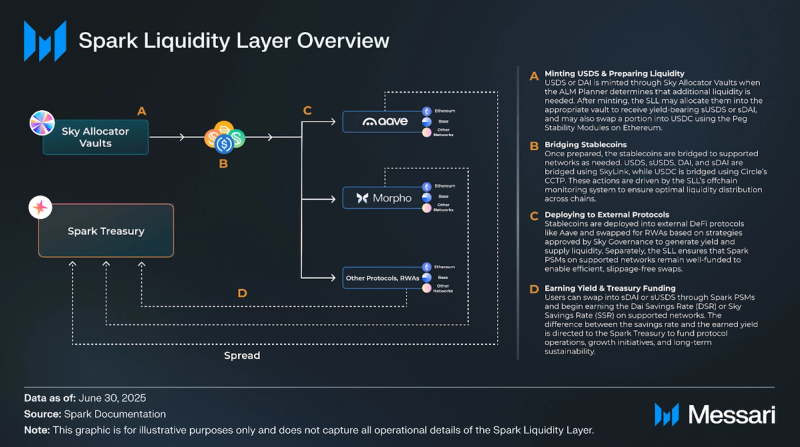
While only USDS and DAI are minted directly via Sky Allocator Vaults, the SLL can also utilize and bridge sUSDS, sDAI, and USDC. To use sUSDS, the system first mints USDS on Ethereum mainnet and deposits it into the Sky Savings Rate contract, which returns yield-bearing sUSDS. Both USDS and sUSDS can then be bridged to other chains via SkyLink, Spark’s canonical bridge. A similar process applies to DAI, which is deposited into the Dai Savings vault to receive sDAI and bridged using SkyLink. If USDC is required, the system swaps USDS or DAI for USDC using Sky’s Peg Stability Module (PSM) on Ethereum. Since SkyLink does not support USDC, the resulting USDC must be bridged using Circle’s Cross-Chain Transfer Protocol (CCTP).
A set of smart contracts known as the ALM Controller coordinates the minting, bridging, and deployment of stablecoins across networks. It operates in coordination with the offchain ALM Planner, which monitors yield and liquidity conditions of integrated protocols and determines when rebalancing or liquidity deployment is needed. When action is required, the ALM Planner submits a transaction through the RELAYER to either the MainnetController on Ethereum or the ForeignController on supported Layer-2 networks. The selected controller enforces protocol-defined rate limits and, if the request passes, issues one or more calls to the ALMProxy. The ALMProxy, which holds custody of all funds, then performs the corresponding external interactions based on the controller’s instructions.
For example, assume the SLL aims to deploy USDC liquidity into Morpho Vaults on Base. The ALM Planner first identifies the need, and the MainnetController mints USDS through Sky Allocator Vaults. The minted USDS is then swapped for USDC via Sky’s Peg Stability Module and then bridged to Base using Circle’s CCTP. Once on Base, the ForeignController calls the ALMProxy to deploy the USDC into Morpho Vaults according to parameters approved by Sky Governance. The yield generated from this strategy is used to fund the Sky Savings Rate, with any excess routed to the Spark Treasury.
This system provides a sustainable mechanism for funding the Sky Savings Rate while generating long-term revenue for the protocol. By enforcing strategy constraints and risk parameters through Sky Governance, Spark ensures that all capital is deployed transparently and in alignment with the long-term interests of the protocol and its users.
Savings
Spark’s Savings protocol allows users to deposit stablecoins to earn yield either from the Sky Savings Rate (SSR) or Dai Savings Rate (DSR). USDS depositors to the SSR earn a yield paid in USDS, while DAI depositors to the DSR earn a yield paid in DAI. The APY rate paid for both the SSR and DSR is set by Sky governance and comes from Sky’s revenue, which includes fees from crypto collateralized loans, investments into US treasury bills via RWAs, and liquidity provided to SparkLend and the Spark Liquidity Layer (SLL).
To date, there are three separate vaults to deposit to Spark Savings: USDC, USDS, and DAI. The USDC and USDS vaults deposit to the Sky Savings Rate, while the DAI vault deposits to the Dai Savings Rate.
When depositing into a vault, a user receives Savings Tokens (sUSDS, sUSDC sDAI), which represent the user’s share of the specific savings vault. Savings tokens are non-rebasing, meaning that as yield from the Sky/Dai Savings Rate accrues, savings tokens increase in value against the underlying deposit asset. Redemptions can be made at any time from the savings token (sUSDS, sDAI, SUSDC) to the underlying stablecoin (USDS, DAI, USDC) at the current redemption rate. Further details specific to each vault are provided below.
Savings USDS Vault
Deposits to the USDS vault are supported on Ethereum, Base, Arbitrum One, OP Mainnet, and Unichain. In addition to USDS deposits, the Spark application supports deposits of USDT, USDC, and DAI on Ethereum, and USDC on Base, Arbitrum One, OP Mainnet, and Unichain. USDT is subsequently exchanged for USDS via a Curve pool, while DAI is converted (upgraded) directly 1:1 for USDS, and USDC is converted 1:1 for USDS using the Sky Peg Stability Module (PSM) on Ethereum, and Spark PSM (an extension of Sky PSM liquidity on Ethereum) on other networks. The Sky/Spark PSM retains ample liquidity as approximately 25% of USDS backing is kept in stablecoins, such as USDC.
Savings USDC Vault
USDC deposits to the USDC vault are supported on Ethereum, Base, Arbitrum One, OP Mainnet, and Unichain. Deposited USDC is converted 1:1 to USDS via the Sky PSM on Ethereum and Spark PSM on other networks. The USDS is then contributed to the Sky Savings Rate.
Savings DAI Vault
DAI deposits to the DAI vault are supported on Ethereum and Gnosis, with deposited DAI contributed to the Dai Savings Rate (DSR). Notably, xDAI deposits on Gnosis earn a higher yield than the DSR (5.2% vs the current DSR of 2.0%). This is because xDAI is a bridged token from Ethereum, with all DAI in the bridge automatically deposited into the Dai Savings Rate. However, for users to earn yield, they must deposit xDAI in the Gnosis Savings xDAI contract. Moreover, Gnosis governance has elected to distribute all the yield accrued for the entire bridged DAI supply only to Savings xDAI depositors on Gnosis. As a result, Savings xDAI depositors earn additional yield according to the spread between the supply of xDAI and the amount of xDAI deposited in the Gnosis Savings xDAI contract.
SparkLend
SparkLend is a permissionless, non-custodial money market protocol on Ethereum and Gnosis that is a fork of Aave V3. To date, users can borrow/lend the following supported assets: wstETH, ETH, DAI, USDS, cbBTC, LBTC, weETH, WBTC, ezETH, rETH, rsETH, USDT, sUSDS, USDC, tBTC, sDAI, EURe, and GNO.
SparkLend uses oracle price feeds to price each supported asset, with the oracle providers used for a given asset shown at the bottom of the Spark application page for a given asset. To date, Sky governance controls all SparkLend parameters.
Users can deposit assets, which can be borrowed by other depositors. When depositing, users receive spTokens, which act as the receipt to withdraw assets from the protocol and are rebasing, meaning yield accrues to the holder by receiving an increased balance of spTokens. Likewise, debt accrues to borrowers as the balance needed to repay borrowed assets increases continuously. The interest rate paid by borrowers to lenders is based on the supply and demand of the borrowed asset.
With flash loans, users can complete an undercollateralized borrow for one block with no fees, provided the amount borrowed is returned before the end of the transaction. Notably, the flash loan fee is waived for users approved as flash borrowers by Sky governance. All other borrowing is overcollateralized, meaning the value of deposits must be greater than the value of assets borrowed for any given user. The Loan-to-Value (LTV) is the percentage of how much of an asset can be borrowed against a deposited asset, while the liquidation threshold is the percentage at which point a portion of a user’s collateral deposits are liquidated to bring the user’s LTV below the threshold. There is also a liquidation penalty paid to liquidators as a percentage of collateral liquidated from the protocol. The specific parameters for each supported asset can be seen on the asset’s liquidity market page. As an example, the current max LTV for SparkLend’s cbBTC liquidity market is 74%, while the liquidation threshold is 75%, and the liquidation penalty is 8%. Each borrower has a health factor (HF) that accounts for the above parameters and represents the value of collateral against the value of the debt. If a user’s HF goes below 1, anyone can make a ‘liquidationCall()’ to the asset’s pool contract to pay back part of the debt owed and receive discounted collateral according to the liquidation penalty. At any time, debt can be repaid and supplied collateral assets withdrawn, provided the withdrawal does not cause the borrower to exceed the allowed LTV.
Credit delegation is also available, which allows a depositor to deposit collateral and delegate borrowing power (their credit) to other users. Enforcement of the loan and its terms can be executed offchain via legal agreements or onchain via smart contracts. SparkLend also has borrow caps and supply caps, which determine the total amount of an asset that can be borrowed or supplied on SparkLend. If a borrow or supply cap has been instituted for a given asset, it can be seen on the asset’s liquidity market page.
Efficiency Mode (E-mode) allows borrowing at a higher LTV when the borrowed asset is correlated in price with the supplied collateral asset, such as two ETH derivatives, BTC derivatives, or stablecoins. E-mode cannot be enabled when already borrowing an asset uncorrelated to the deposit asset, such as borrowing sUSDS against ETH.
Additionally, assets only have siloed borrowing enabled when they have been marked by Sky governance as having potentially manipulable oracles. As a result, the protocol does not allow a given user to borrow any other asset when any amount of a given siloed asset is borrowed. Assets can also be listed as isolated, which makes the supplier of an isolated asset unable to supply other assets as collateral. Additionally, only specific stablecoins permitted by Sky governance can be borrowed against isolated assets. Whether an asset is isolated can be seen on its liquidity market page, as can any deposit or borrow caps, whether E-mode is available, and whether siloed borrowing is enabled. Finally, after depositing an asset, users can make that asset unavailable to be used by them as collateral, while still earning the deposit APY.
As an Aave V3 fork, SparkLend has a number of other notable carry-over features that are currently not enabled:
- Risk Admins: Allow Sky Governance to grant entities permission to update Spark risk parameters without needing a governance vote for each change.
- Price Oracle Sentinel: “introduces a grace period for liquidations and disables borrowing under specific circumstances.” This feature is designed for L2s to handle possible sequence downtime, but could in the future be extended to apply to L1s.
- Variable Liquidation Close Factor: Sets additional parameters for partial and full liquidation of a borrower based on the health factor (HF).
Other Programs and Features
Farming Rewards
Using the Spark application on Ethereum, anyone can deposit tokens to specific yield farms to earn rewards. As of the time of publication, there are two farms:
- Earn SKY: Users can deposit USDS, DAI, USDC, sDAI, or sUSDS to earn 5% APY rewards in SKY, the governance token of the Sky Protocol.
- Earn Chronicle points: Users can deposit USDS, DAI, USDC, sDAI, or sUSDS to earn Chronicle points. Chronicle is a decentralized oracle network that secures Spark, and Sky, among other DeFi and RWA protocols.
Sandbox Mode
Sandbox mode is a test version of the Spark application that allows users to familiarize themselves with it to understand how it works. It can be easily activated from the Spark application’s menu.
Spark Rewards and Points Programs
The Spark Rewards program offers weekly token rewards sourced in collaboration with other DeFi projects to users who take specific actions that contribute to the Spark ecosystem. As an example, users can currently earn Optimism’s OP token for depositing into sUSDC on Spark Savings on OP mainnet and Unichain. Once an action to participate in a campaign is completed, the Spark application shows tokens accruing in real time, which can be claimed once per week on Mondays. Reward claim deadlines and the criteria by which rewards are distributed are specified per campaign.
Likewise, the Spark Points program enables users to earn Spark Points by taking specific actions, such as staking Spark’s token (SPK), earning referrals, or using third-party protocols like Pendle. Spark Points can be used by the Spark team and/or governance to determine future incentives and rewards, such as potential additional SPK token distributions, and are trackable via the leaderboard.
Converting Tokens and Spark Peg Stability Module (PSM)
At any time, DAI on Ethereum can be converted to USDS 1:1 and vice versa, using the Savings page of the Spark application. Converting from DAI to USDS is termed “upgrading” as USDS is the new version of DAI issued by Sky, while converting from USDS to DAI is called “downgrading.”
Additionally, the Spark Peg Stability Module (PSM) extends the Sky PSM liquidity on Ethereum to additional networks (currently Base, Arbitrum One, OP Mainnet, and Unichain), with USDC on these networks convertible 1:1 for USDS, and vice versa. Users can access the Spark PSM from the Savings page of the Spark application.
Bug Bounty Program and Security Audits
First launched on Nov. 1, 2023, Spark has a bug bounty program through Immunefi where anyone can earn payments ranging from $1,000 to $5 million (paid in DAI on Ethereum), depending on the severity and classification of the vulnerability identified. Additionally, the Spark Liquidity Layer, Spark’s Savings USDS and DAI vaults, and SparkLend, have received numerous audits, which can be seen here.
Tokenomics
The SPK token launched on June 17, 2025, with SPK airdrops claimable for a number of campaigns. SPK is Spark’s native governance and staking token, with the entire 10 billion supply minted on Ethereum at genesis on June 4, 2025, by Sky Governance, and additional bridged-token contracts on BNB Smart Chain and Base.
Governance
Spark’s documentation states SPK will be used for signaling and sentiment checks via Snapshot voting, “with its role evolving as its distribution becomes more decentralized.” As a Star (SubDAO) of the Sky Protocol, Sky governance sets Spark’s high-level direction and standards.
Spark governance currently goes through Sky governance, while the Spark governance framework is being put in place. This Spark governance framework must adhere to the Sky Atlas, the governance framework for Sky and its Stars. The Spark Artifact in the Sky Atlas will be updated accordingly once the Spark governance framework and voting are implemented.
Staking
SPK on Ethereum can be staked to earn rewards. In the future, this staking will help secure Spark. Spark uses the staking infrastructure of Symbiotic, a modular restaking protocol that provides shared cryptoeconomic security, which will be used to secure Spark’s token bridges and other future protocol offerings. SPK stakers receive stSPK as the receipt token that represents a user’s stake. When unstaking, there is a withdrawal delay of two to four weeks because Symbiotic can only process withdrawals after the current and following two-week epochs are completed.
Staked SPK earns Spark Points and Symbiotic Points. Currently, SPK users earn three Spark Points per day per SPK token staked. Symbiotic Points are earned according to a number of factors, including the USD value of the assets staked, duration of stake, and whether the staked assets are actively staked to help secure the protocol rather than “pre-deposited” idle collateral.
Distribution
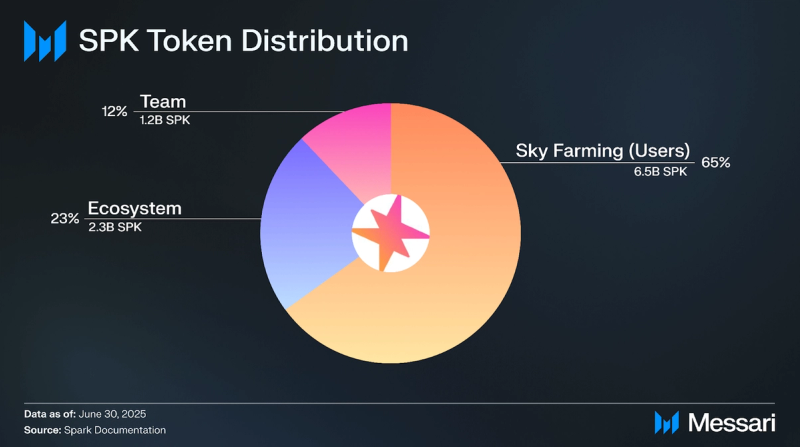
Sky Farming (Users) — 6.5 billion SPK (65%)
- This allocation is to USDS stakers who farm SPK through Sky’s token farms. SPK is distributed through these farms according to the distribution chart below:
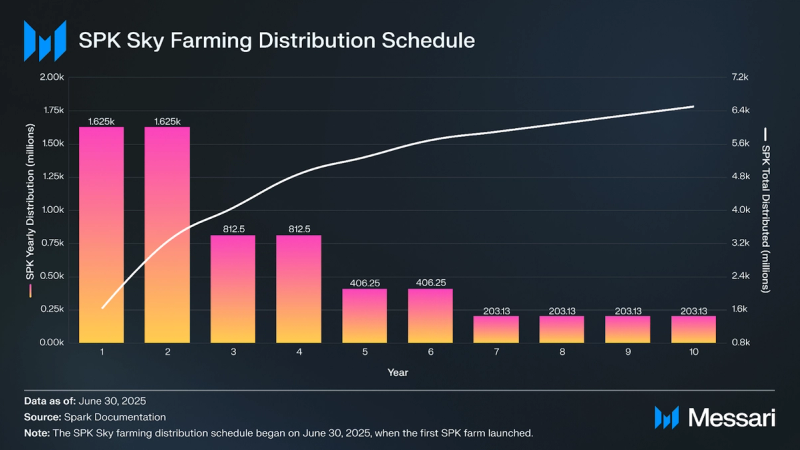
- Deposits to farms can be made from the Farms page of the Spark application or using the Sky application. The first farm launched on June 30, with users able to deposit USDS to earn SPK rewards. On the first day, $448.2 million USDS was deposited, and the SPK rewards APY was 15.6%. Additionally, SKY stakers can choose to receive SPK rewards.
Ecosystem — 2.3 billion SPK (23%)
- Spark documentation states these “SPK tokens were allocated to the Spark ecosystem to support the growth of Spark.” A key part of this allocation is the Spark airdrop program, which includes Pre-Farming, Ignition & Overdrive, Layer3, and Cookie Snaps campaigns. The SPK tokens for each campaign became claimable at token launch on June 17, 2025, with the last day to claim dependent on the campaign. All tokens not claimed by the last day to claim are returned to the Spark ecosystem treasury. Allocations to each airdrop campaign thus far are as follows:
- Pre-Farming: ~378.3 million SPK (~3.8% of the total token supply)
- Ignition: ~325.5 million SPK (~3.3% of the total token supply)
- Layer3: 500,000 SPK (0.005% of the total token supply)
- Cookie Snaps: 5 million SPK (0.05% of the total token supply)
Additionally, Ignition claimants can qualify for the Overdrive airdrop by staking the SPK they claimed until the end of the Overdrive period from July 29, 2025, to Aug. 11, 2025. All SPK for the Overdrive airdrop come from unclaimed SPK from the Ignition airdrop.
- A vesting schedule for the Ecosystem allocation was not disclosed.
Team — 1.2 billion SPK (12%)
- Spark documentation states, “The team allocation is designed to ensure long-term alignment with the core contributors building and supporting Spark.”
- A vesting schedule for the Team allocation was not disclosed.
Protocol Activity
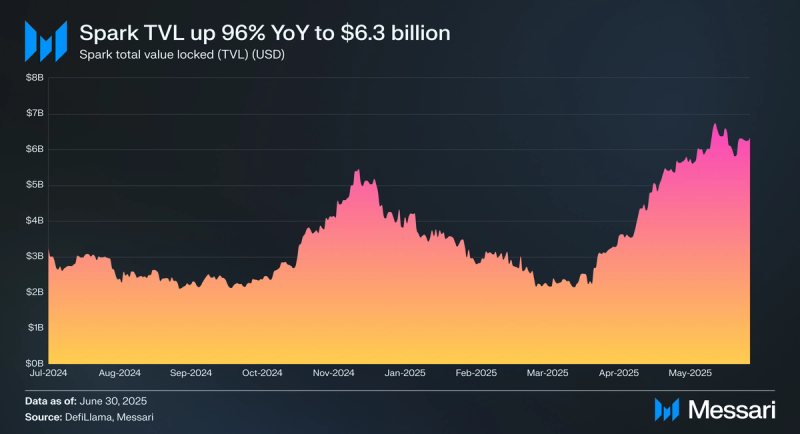
Spark’s TVL has increased 95.9% YoY from $3.2 billion to $6.3 billion. The total value of tokens held in the protocol’s smart contracts has grown significantly, as Spark’s SLL, PSM, Savings, and SparkLend deposits have all grown meaningfully in the last year.
Liquidity Layer
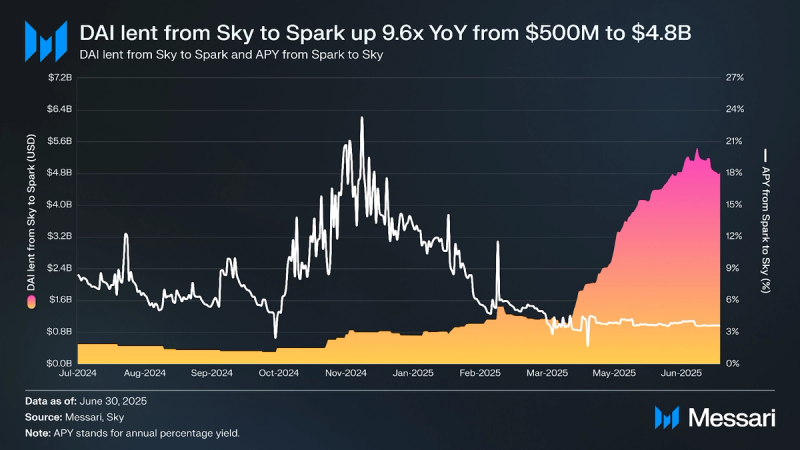
The amount of DAI lent from Sky to Spark increased 9.6x YoY from $500 million to $4.8 billion as of June 30, 2025. Until Nov. 17, 2024, all DAI lent by Sky to Spark was routed to the lending protocol Morpho to earn yield via the Direct-Spark-Morpho-DAI vault. Thereafter, funds began being lent to the Spark Liquidity Layer (SLL).
The direct Morpho vault is being phased out, with 98% of DAI lent to Spark lent to the SLL. Prior to the TGE of the SPK token on June 17, 2025, all profit generated by Spark was owned by Sky, which is represented by the APY on DAI lent. Notably, some of the DAI lent by Sky to Spark is kept by Spark as protocol liquidity rather than deployed to earn yield. The rate Sky charges its Stars (SubDAOs) like Spark to borrow from its balance sheet is market-driven and goes up if the balance sheet is nearing full utilization and down as the balance sheet is less utilized. Spark earns the spread between the cost of borrowing DAI from Sky and what it earns through its deployments in the SLL.
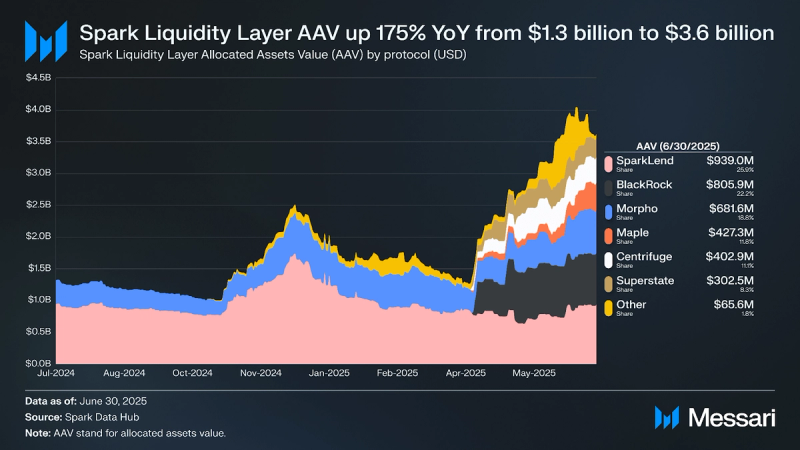
On June 30, 2025, the total value of assets allocated by Spark’s Liquidity Layer was $3.6 billion, a 175% increase year over year (YoY) from $1.3 billion. By protocol, SparkLend led with $939.0 million in allocated assets, followed by BlackRock with $805.9 million, Morpho with $681.6 million, and Ethena with $600.1 million. Together, these four protocols held 78.7% ($2.9 billion) of assets allocated by Spark’s Liquidity Layer.
Notably, Spark’s Liquidity Layer started allocating assets to Ethena on Jan. 13, 2025, while allocations to BlackRock, Centrifuge, and SuperState were first made on April 7, 2025. As of June 15, 2025, top assets allocated to include:
- BUIDL: Spark’s SLL held $806 million of BlackRock’s BUIDL. BUIDL tokens are designed to offer a stable value of $1 per token and are 100% backed by U.S. Dollar cash, U.S. Treasury bills, and repurchase agreements, with daily accrued dividends paid directly to investors’ wallets as new tokens each month.
- spDAI: $516.4 million in DAI on Ethereum has been deposited to SparkLend to receive spDAI, the receipt token, with yield distributed as additional spDAI.
- syrupUSDC: $427.4 million in USDC has been deposited to Maple Finance to receive syrupUSDC, the receipt token, which is non-rebasing (token price increases from yield accrual).
- sparkUSDC: Spark’s SLL held $424.5 million in sparkUSDC, the receipt token for USDC on Base Supplied to Spark protocol’s lending or savings product. sparkUSDC accrues interest over time by being lent out or allocated to external protocols like lending protocol Morpho to generate yield.
- JTRSY: Spark’s SLL held $403.0 million in Janus Henderson Anemoy Treasury Fund (JTRSY), a non-rebasing token (token price increases from yield accrual) backed by US Treasury Bills with maturities of less than six months.
- spUSDS: $405.4 million in USDS has been deposited to SparkLend to receive spUSDS, the receipt token, with yield distributed as additional spUSDS.
- USTB: Spark’s SLL held $302.1 million in USTB, a yield-bearing token representing shares of the Superstate Short Duration US Government Securities Fund that invests in short-duration US Treasury Bills.
On Oct. 23, 2024, Spark’s Liquidity Layer began allocating assets on Base. Prior to this, Ethereum was the only supported network. Thereafter, deposits were supported on several additional Ethereum Layer-2s, including Arbitrum One on Feb. 3, 2025, and OP Mainnet and Unichain on June 2, 2025.
When only Ethereum, Base, and Arbitrum One were supported, Ethereum’s AAV dominance dropped as low as 90.57% on March 27, 2025, before rising to a high of 95.8% on April 10. Thereafter, Ethereum’s dominance has slowly declined, hitting a low of 86.3% on June 30, 2025, as Base reached a high of 12.9%. Arbitrum One has never represented more than 1% of total AAV, while neither OP Mainnet nor Unichain has reached 0.3%.
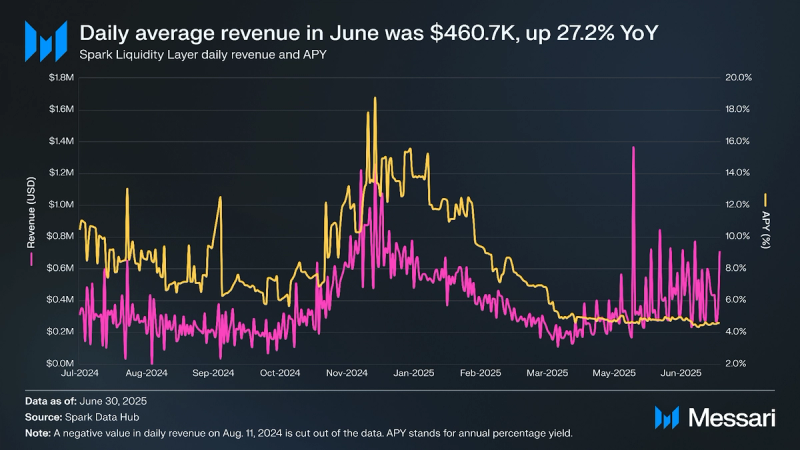
As the size of Spark’s Liquidity Layer (SLL) has grown, so has its daily revenue, despite a decline in APY. In June 2025, the SLL averaged $460,700 in daily revenue, up 27.2% year-over-year from an average of $362,200 in June 2024, even as daily average APY declined 57% YoY from 10.9% to 4.6% over the same period. The decline in APY reflects that yields across DeFi protocols have declined from mid-2024, even after a runup in digital asset prices (and as a result, DeFi protocol yields onchain) following the US presidential election in November 2024.
Yields from RWA assets Spark has allocated to, like BUIDL, JTRSY, and USTB, have declined more modestly as these assets derive their yield from US treasuries (often short-term) and equivalents. Yield for both the 3-month and 6-month US treasury bills are down roughly 1-1.1 percentage points YoY (-20%) from 5.25% to 4.24% for the 3-month and 5.39% to 4.32% for the 6-month.
Savings
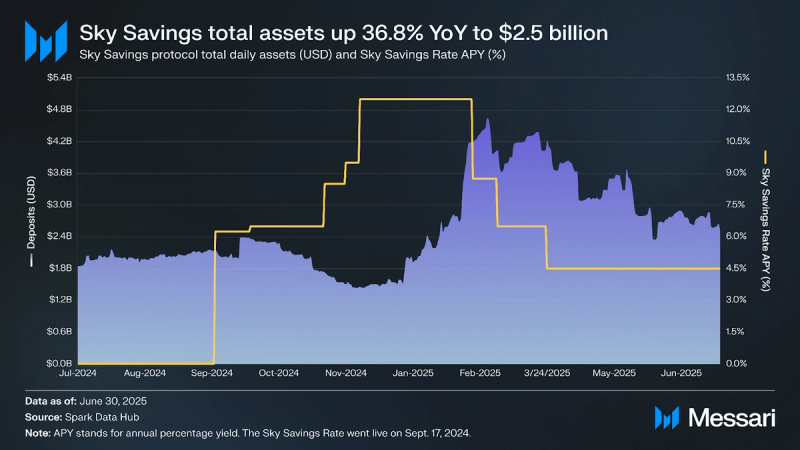
Total assets deposited in Sky’s Savings protocol (Sky Savings Rate and Dai Savings Rate) increased 36.8% YoY from $1.8 billion to $2.5 billion, as of June 30, 2025. This has come even as the Sky Savings Rate yield has been lowered three times in 2025, from 12.5% APY to 8.75% on Feb. 10, 8.75% to 6.5% on Feb. 24, and 6.5% to 4.5% on March 24. The Dai Savings Rate has declined from 11% to 2% over the same time period. This shows longer-term increased demand even as yields across DeFi and RWAs have fallen.
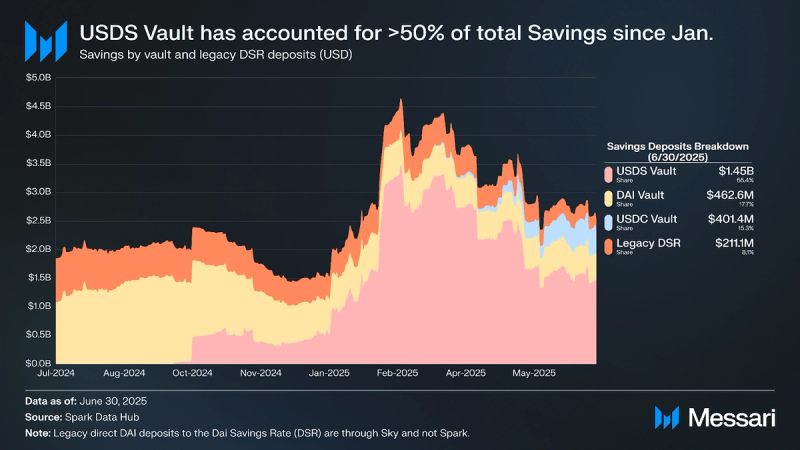
To date, Spark offers three separate vaults to deposit to Sky’s Savings protocol: USDC, USDS, and DAI. The USDC and USDS vaults deposit to the Sky Savings Rate, while the DAI vault deposits to the Dai Savings Rate (DSR).
Together, these vaults accounted for $2.3 billion in deposits to Sky’s Savings protocol (91.6% of all deposits). The remaining $211.1 million (8.4%) came from legacy direct deposits to the DSR, whereby each deposit is tracked internally by the contract using a mapping of balances, with deposited DAI plus accrued interest in DAI only withdrawable by the deposit address. A year earlier, on July 1, 2024, only 58.5% ($1.1 billion) of total deposits to Sky’s Savings protocol came from Spark’s Savings vaults, while 41.5% ($765.9 million) came from legacy direct deposits to the DSR, which have steadily declined since then following the launch of USDS on Sept. 18, 2024, and the USDS, DAI, and USDC vaults thereafter.
After launching in September 2024, the USDS Vault has accounted for more than 50% of total deposits to Spark’s Savings protocol since Jan. 12, 2025. In June 2025, the USDC Vault accounted for between 13-19% of deposits, while the DAI Vault has accounted for 17-19%.
SparkLend
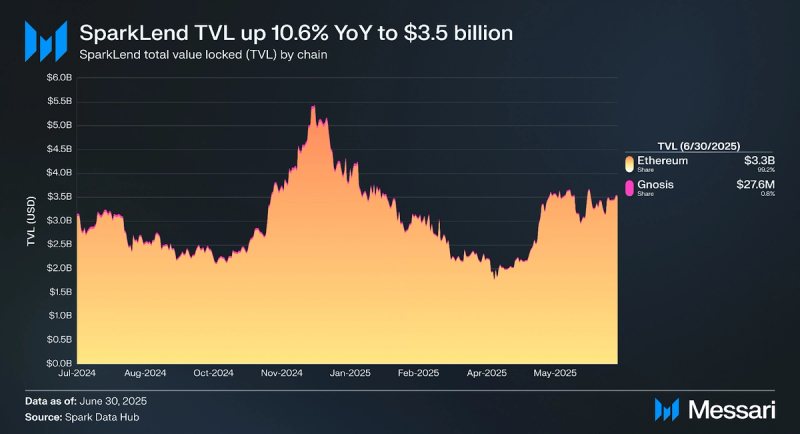
SparkLend had a TVL (USD) of $3.5 billion (+10.6% YoY) on June 30, 2025. $3.5 billion (99.2%) of the TVL was on Ethereum, while $26.7 million (0.8%) was on Gnosis. Like with many other protocols, SparkLend’s TVL surged following the US Presidential election on Nov. 5, 2024, peaking at $5.4 billion on Dec. 8, 2024. TVL then steadily declined to a low of $1.8 billion on April 8, 2025, before steadily increasing to reach a high of $3.7 billion on June 11, 2025.
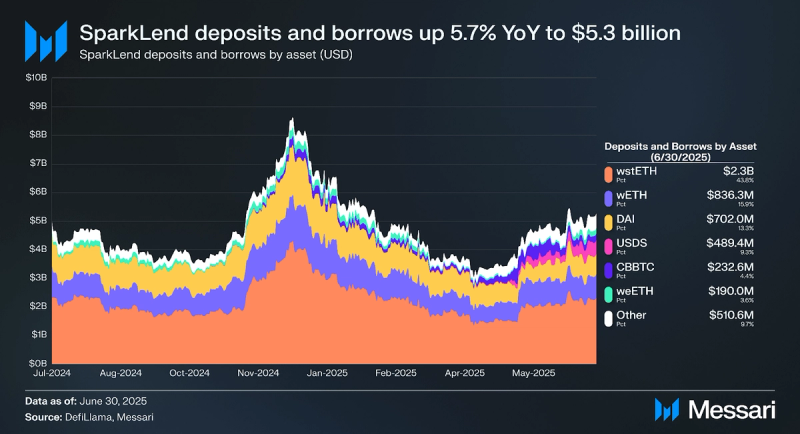
Likewise, SparkLend deposits and borrows have increased 5.7% YoY from $5.0 billion to $5.3 billion. Notably, DAI’s share of SparkLend’s deposits and borrows has declined from 21.7% ($1.1 billion) on July 1, 2024, to 13.3% ($702 million) on June 15, 2025, while USDS’s share landed at 9.3% ($489.4 million).
SparkLend Treasury
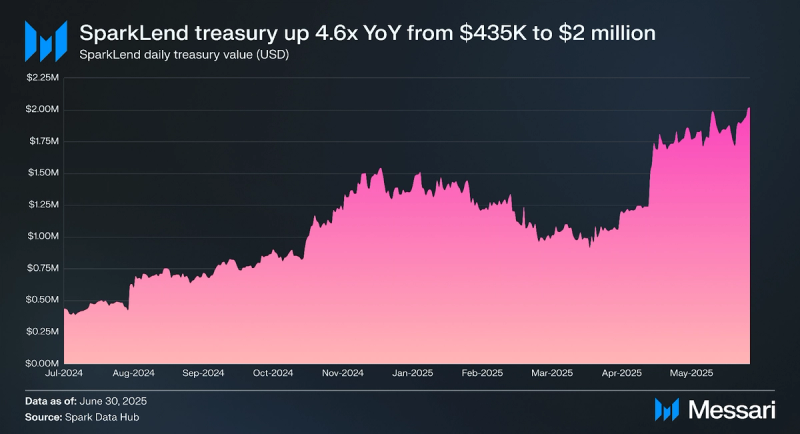
In addition to the revenue earned from the Spark Liquidity Layer, Spark’s SparkLend treasury accumulates earnings from the reserve factor fee for each market. For example, the reserve factor for WETH is 5%, meaning 95% of the interest generated from ETH borrows goes to WETH suppliers, while 5% goes to the SparkLend treasury. On June 30, 2025, Spark’s treasury was worth $2 million, up 4.6x YoY from $435,000 on July 1, 2024. The top five assets held in the treasury include:
- WETH: $1.44 million (66.8%)
- wstETH: $280,500 (13.0%)
- DAI: $167,180 (7.7%)
- USDS: $107,560 (5.0%)
- WBTC: $40,000 (1.9%)
Additionally, $122,510 (5.6%) was held in other assets, most of which was USDC, weETH, WXDAI, rETH, and USDT.
Closing Summary
Spark is a Star (SubDAO) of Sky that operates as an open-source liquidity and lending protocol via three main modules: the Spark Liquidity Layer (SLL), Savings, and SparkLend. The Spark Liquidity Layer (SLL) is Spark’s capital routing system responsible for minting, bridging, deploying, and managing stablecoin liquidity borrowed from Sky’s $7B+ stablecoin reserves across supported networks to DeFi and RWA protocols. The Savings Protocol allows users to deposit stablecoins to earn yield either from the Sky Savings Rate (SSR) or Dai Savings Rate (DSR), while SparkLend is Spark’s permissionless, non-custodial money market protocol initially forked from Aave V3. Spark’s PSM is also crucial, as it extends the Sky PSM’s liquidity on Ethereum to Spark-supported networks, allowing users to convert USDS 1:1 for USDC and vice versa.
Additionally, Spark’s SPK token launched on June 17, 2025, with SPK airdrops claimable for multiple campaigns. SPK is Spark’s native governance and staking token, staked to earn Spark and Symbiotic Points and, in the future, secure Spark’s token bridges via Symbiotic’s modular restaking infrastructure.
Since Sky’s introduction of USDS in September 2024, Spark’s sUSDS vault has led to increased conversion from DAI to USDS. As Sky continues to increase adoption of USDS by offering a competitive Sky Savings Rate, Spark’s TVL will continue to grow, creating a flywheel where more and more capital flows from the sUSDS vault to the Sky Savings Rate (SSR) module, and then back to the SLL for efficient capital deployment.