Key Insights
- Dabba will launch its native utility token, DBT, in the second half of 2025. DBT will be used to activate hotspots, settle protocol-level fees, and coordinate demand-driven network deployment across India.
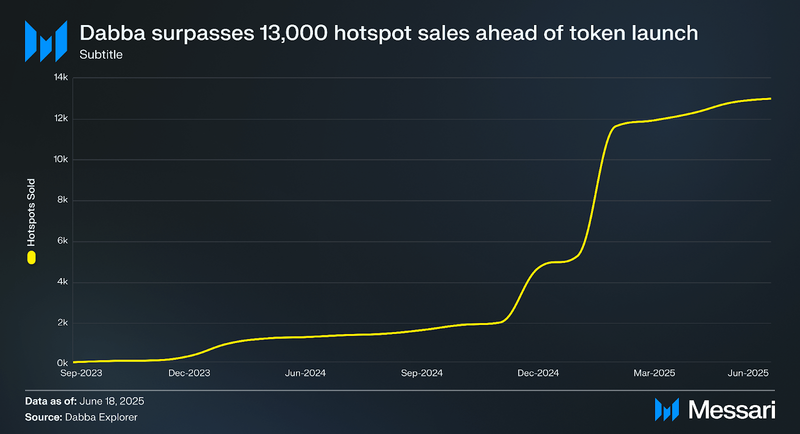
- Dabba sold over 13,000 hotspots to participants in more than 60 countries ahead of its token launch. This early traction signals strong global interest in the network’s utility, which currently supports connectivity for over 100,000 devices per day.
- Over 50,000 GB of bandwidth is consumed per day by end-users, facilitated by more than 5,000 hotspots deployed across regions with demonstrated need. This usage has led to Dabba being revenue-generating prior to the TGE.
- Over the next 18 months, Dabba aims to deploy more than 100,000 hotspots and partner with over 100 Local Cable Operators (LCOs). If achieved, this expansion could support over 2 million daily connected devices in underserved regions and create new earning opportunities across India’s digital infrastructure landscape.
- DBT’s token model powers a deflationary flywheel tied to real-world usage. As end-users consume bandwidth, DBT is automatically purchased and burned through fiat-priced Data Credit conversions. This mechanism links network activity to token scarcity and aims to strengthen incentives for infrastructure contributors and DBT holders as the network scales.
Primer
Dabba Network is a Decentralized Physical Infrastructure Network (DePIN) project focused on bridging connectivity gaps in India. It operates as a decentralized Internet Service Provider (ISP) that deploys WiFi hotspots in underserved regions to deliver high-speed internet access to end-users. Multiple supply-side stakeholders, such as fiber optic backhaul providers and Local Cable Operators (LCOs), are coordinated through an incentive-aligning token model driven by DBT tokens. Through this process, Dabba not only delivers high-speed internet access to end-users but also strengthens the competitiveness of independent businesses.
Dabba’s deployment model is centered on verifiable consumer demand. Hotspots are installed in areas with demonstrated demand to ensure that each deployment is revenue-generating from day one. This is facilitated through a managed sponsorship model, where individuals around the globe can purchase Dabba hotspots and lease them to LCOs. LCOs deploy the devices, and hotspot owners earn DBT rewards based on network usage.
As a Layer-0 DePIN, Dabba establishes the foundational connectivity required for other decentralized networks to operate. For example, Dabba has partnered with WeatherXM to deploy 800 weather stations across India. This positions Dabba not only as an ISP that provides last-mile connectivity, but as a host network for other decentralized services in emerging markets. For a full primer on Dabba, refer to our Initiation of Coverage report.
DBT Token Generation Event
Dabba will launch its native utility token, DBT, in the second half of 2025. DBT will have a maximum supply of 10 billion tokens, and 900 million DBT will be in circulation at the time of the Token Generation Event (TGE).
Of the maximum supply, 60% will be distributed to hotspot owners over a 50-year period based on network-usage. One billion DBT will be emitted in the first year, with 700 million allocated toward hotspot owners who will distribute a portion of their tokens to other stakeholders to sustain the network. Rewards will follow a 10 percent annual reduction in emissions each following year.
The remaining 40% of the supply is allocated to the following core entities:
- 8.46% to Token Warrants (845.6 million DBT)
- 8.00% to Dabba Foundation (800 million DBT)
- 18.00% to Wifi Dabba Inc. (1.8 billion DBT)
- 5.54% to Liquidity Incentive Pool (554.4 million DBT)
Within this allocation, WiFi Dabba Inc. will have 10% of its tokens unlocked at TGE. The remaining 90% will be locked for two years and then released gradually over the following 24 months through linear vesting.
Hotspot owners will also receive token airdrops via the Genesis rewards program. For each Dabba Lite hotspot bought prior to Feb. 28, 2025, owners will receive 100 tokens per day from the TGE. Meanwhile, owners who bought after that date will receive a one-time airdrop of 20,000 DBT, with those who bought their devices through the WeatherXM-Dabba Bundle also eligible to receive WeatherXM rewards.
Token Utility & Economic Design
DBT will serve as the primary coordination and utility token of the Dabba Network. It will be used to incentivize infrastructure contributors, facilitate hotspot deployment, enable bandwidth access through Data Credits, settle protocol-level fees, and for staking.
To activate a hotspot, owners will complete KYC and burn $10 worth of DBT to register the device, generating a non-transferable NFT linked to their wallet. An additional $70 in DBT is paid to enter a seven-year lease with a local operator, and $10 is used to preload backhaul connectivity. $10 in DBT is then paid toward marketing services to boost local adoption. This structure aims to enforce economic commitment and ensure each deployment is tied to real world usage.
Burn Mechanism & Deflationary Flywheel
The Dabba Network employs a mint-buyback-burn model that ties token supply directly to real-world network activity. DBT is minted to reward infrastructure contributors and burned as a result of consumer demand for internet access. This structure creates a self-balancing economic loop where token issuance and removal are governed by opposing sides of the network’s value chain.
Users access the internet by purchasing Dabba Data Credits (DCs), which are fixed at $0.012 per gigabyte and non-transferable. While end users pay for DCs in fiat, each payment triggers an automated protocol-level conversion: DBT tokens are bought on the open market and permanently burned via smart contracts. This aims to ensure that every dollar spent on bandwidth reduces token supply in a verifiable, transparent manner.
This burn mechanism aims to anchor DBT’s value to usage rather than speculation. As demand for internet access grows, so does the rate of DBT removal from circulation. At TGE, the burn rate is projected at $100,000 per month, with a month-over-month growth rate of 30%. This trajectory implies a cumulative burn of over $3.5 million in DBT equivalent within the first year of launch.
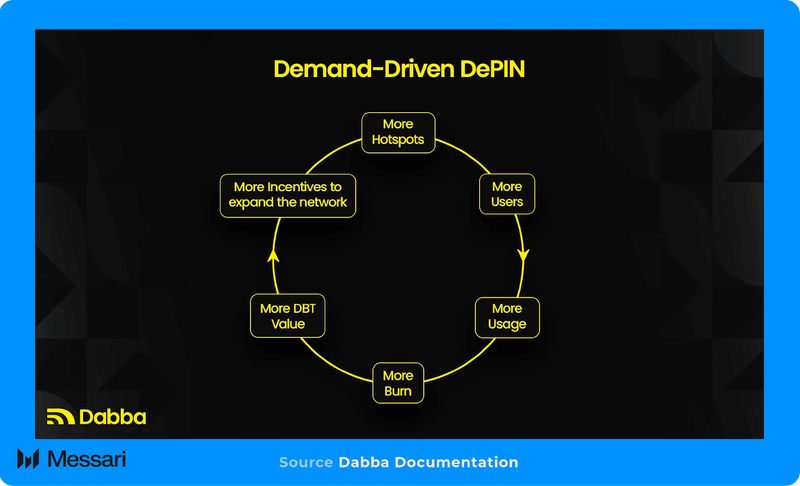
These dynamics aim to create a deflationary flywheel: more deployed hotspots lead to more users; more users generate higher fiat revenue; higher revenue drives increased DBT buybacks and burns; reduced token supply supports price appreciation; and rising token value strengthens operator incentives.
Adoption Metrics
Dabba reports over 5,000 active Dabba Lite hotspots deployed across India. In total, more than 13,000 units have been sold, with devices sold across over 60 countries. The live network currently supports an estimated 100,000 connected devices per day, with daily data throughput exceeding 100,000 gigabytes.
A key differentiator between Dabba and other DePIN projects is its partnership network with local businesses in India. As of writing, Dabba has partnered with 10 LCOs, such as Swami Wifi and Siddhi Net, that manage last-mile broadband connectivity and enable scaling in both urban and underserved regions.
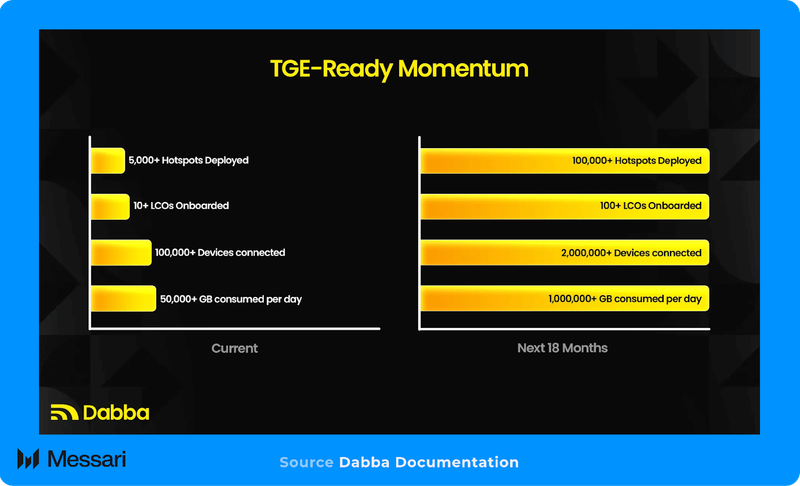
Over the next 18 months, Dabba plans to scale its network significantly. The project plans to surpass 100,000 hotspot deployments, onboard more than 100 LCOs, and support over two million daily connected devices by the end of the period.
Based on these targets, Dabba estimates that daily bandwidth consumption could exceed 1 million gigabytes. This growth trajectory is anchored in India’s large underserved population and favorable unit economics. The total addressable market includes over 700 million individuals without reliable internet access, with an estimated average revenue per user (ARPU) of $7 per month. Due to the strong demand for internet access in the region, Dabba projects user churn to remain 1% each month for the foreseeable future.
Hardware expansion is also underway. While the Dabba Lite hotspot remains the core access point, additional products such as Dabba Pro and Dabba Laser are in development. Dabba Pro is a hotspot designed for higher-capacity environments and smart-home integrations, while Dabba Laser is an optical backhaul solution that aims to reduce reliance on underground fiber infrastructure. Additionally, Dabba is in the early stages of developing a community-driven developer ecosystem, with plans to support dApps that rely on its network infrastructure and utilize DBT for access.
Strategic Partnerships
Dabba Network has formed several partnerships that leverage its connectivity infrastructure to support other decentralized networks and expand its geographic reach. These collaborations illustrate Dabba’s positioning as a base-layer DePIN provider that supports applications beyond internet access:
- WeatherXM: Dabba is deploying and managing 800 decentralized weather stations across India in collaboration with WeatherXM. These devices operate on Dabba-managed hotspots and contribute environmental data to WeatherXM’s decentralized weather oracle network. To support participation, Dabba offers a hardware bundle that includes three managed hotspots, 60,000 in DBT Genesis rewards, and 916 WXM token rewards that are distributed over a three-year period.
- Animoca Brands Japan: In collaboration with Animoca Brands Japan, Dabba is expanding its distribution of Dabba Lite hotspots in the Japanese market. The initiative includes tiered pricing discounts and localized outreach campaigns, with an emphasis on onboarding users into DePIN.
- BONK: Dabba has allocated 10,000 Dabba Lite hotspots for members of the BONK community, a memecoin project on Solana. Each hotspot activation results in a $20 BONK token burn, followed by a recurring $2 monthly burn per hotspot for 18 months. This mechanism creates a deflationary path for BONK while aligning its community with Dabba’s physical infrastructure growth.
Closing Summary
Dabba Network is approaching a major inflection point with the upcoming launch of DBT. Over the next 18 months, the project aims to scale rapidly by deploying more than 100,000 hotspots and onboarding over 100 Local Cable Operators.
As user adoption increases, higher daily data usage is expected to drive consistent DBT token burns tied to real network activity. The Token Generation Event will initiate this expansion and serve as a real-world test of Dabba’s scalability and incentive design. This model is designed to create steady, utility-driven demand for the token while minimizing speculative volatility. If it performs as intended, Dabba has the potential to become a foundational Layer-0 DePIN that both drives increased Web3 adoption and supports growth in underserved regions.