Key Insights
- On May 29, 2025, Galxe launched Starboard, a data-driven growth and analytics tool. Starboard gives projects a unified view of user activity across multiple channels.
- Starboard brings together onchain and offchain metrics to give projects a holistic view on how best to grow. Starboard tracks social metrics through X/Twitter and also onchain metrics such as total value locked (TVL), gas spent, transaction count, and volume.
- Starboard is already live with over 20 major partners. At launch, Starboard was released with notable projects such as Sui, Plume, 0G, and many more.
- Since launch, Starboard has indexed over 150,000 posts, capturing 3.09 million likes, 1.18 million retweets, 1.05 million replies, and 167,105 quotes, amounting to more than 230 million total views.
- Gravity Chain rolls out two separate simulation modes: Solo mode and AptosBFT mode. These two modes are crucial for Gravity to build out better developer experiences, system testing, and performance optimization.
Primer
Galxe is a Web3 Growth Platform powered by analytics, automation, and engagement solutions. Built on Gravity, an EVM-compatible Layer-1 (L1) blockchain, Galxe offers a suite of products, including Galxe Quest, Starboard, Passport, Score, Alva, Galxe Identity Protocol, and Rewards Hub, supporting identity verification, community growth, and real-time AI-driven insights. With the launch of Starboard, Galxe is entering the Infofi sector (information+finance), arming projects with actionable growth strategies powered by onchain and social data. Since its launch in 2021, Galxe has attracted 34 million unique users and over 7,142 projects to its platform.
At the core of Galxe’s ecosystem is Gravity, a high-performance L1 blockchain optimized for scalability, security, and omnichain interoperability. Gravity delivers over 1.0 gigagas per second throughput and sub-second finality, powered by its pipelined AptosBFT consensus engine and Grevm (Gravity EVM), a parallelized Ethereum runtime.
In July 2024, Galxe DAO approved the migration of its native token from GAL to G, which became Gravity’s gas token. The transition saw 7.2 billion G tokens enter circulation, forming the foundation for staking, governance, and payments across the Gravity ecosystem.
With strategic investments totaling $25.2 million and backing from firms like Multicoin Capital, Binance Labs, and Spartan Group, Galxe continues to drive adoption, community engagement, and decentralized identity innovation. For a full primer on Galxe, refer to our Initiation of Coverage report.
Website / X (Twitter) / Discord
Starboard
Starboard is Galxe’s latest product, designed to unify fragmented analytics by combining onchain and offchain data into a single comprehensive view. Most analytics tools focus on either onchain metrics or traditional engagement metrics. Starboard is the first-of-its-kind solution that delivers a unified view of user behavior, helping projects assess contributor impact, optimize reward distribution, and improve campaign targeting.
By tracking contributions across both environments, Starboard offers visibility into community return on investment (ROI), a metric that has traditionally been difficult for growth teams to measure. The platform works both ways, with teams being able to study both onchain and offchain metrics to understand the metrics that drive their growth, and on the other hand, users can sign up to Starboard and be rewarded for their onchain and offchain contributions. Starboard enables data-driven decision-making around user incentives and allows teams to fine-tune marketing strategies based on a comprehensive performance snapshot rather than siloed datasets.
Offchain Metrics
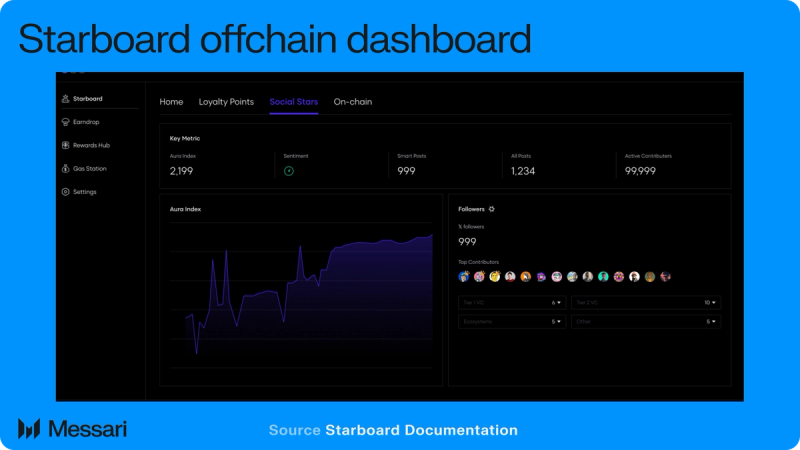
For projects looking to leverage Starboard, they will need to apply within the Galxe platform to be approved and to have their own featured Starboard. Once completed, Starboard provides various offchain metrics for projects to view in their dashboard. The offchain metrics consist of four different components:
- Aura Index: Galxe’s proprietary scoring system that benchmarks project influence and brand awareness across major social platforms. It consolidates activity into a standardized score to help projects track reputation over time.
- AI Sentiment: A machine learning model that analyzes social media content to detect trending narratives, hype cycles, and real-time sentiment around a project or ecosystem.
- Smart Posts: A curated feed of high-impact social media content ranked by reach, relevance, and engagement. This filter highlights meaningful discussions while reducing signal noise.
- Contributor Data: A classification system that identifies high-value contributors based on their historical influence and consistency. It distinguishes meaningful content from vanity engagement to improve targeting and reward allocation.
Contributor Data
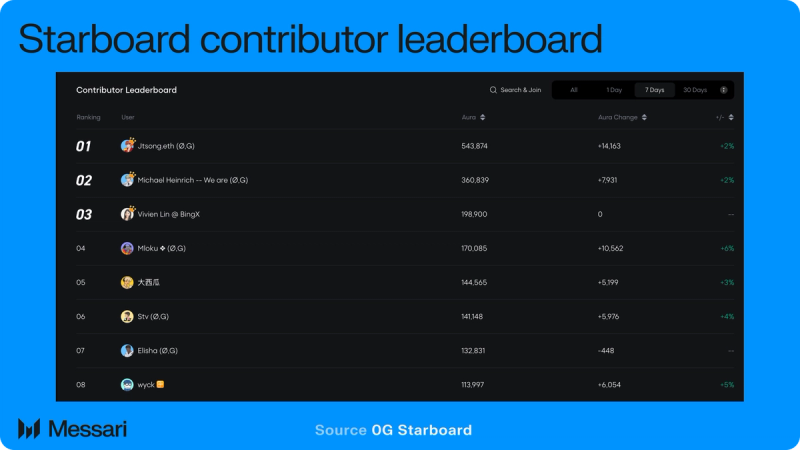
Contributor Data identifies high-impact individuals actively advancing a project’s growth. Projects that use Starboard can define success criteria, such as total value locked (TVL), user acquisition, or social engagement. Based on these preferences, they can generate custom leaderboards that surface contributors aligned with their goals.
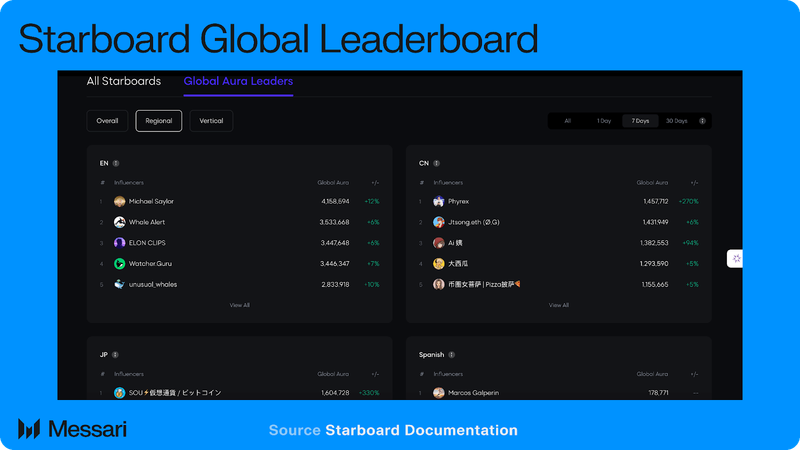
In addition to project-specific views, Starboard includes a global leaderboard that highlights the most influential contributors across all campaigns. This leaderboard can be filtered by region and sector, enabling a more granular understanding of who is driving results within specific communities or verticals.
Onchain Metrics
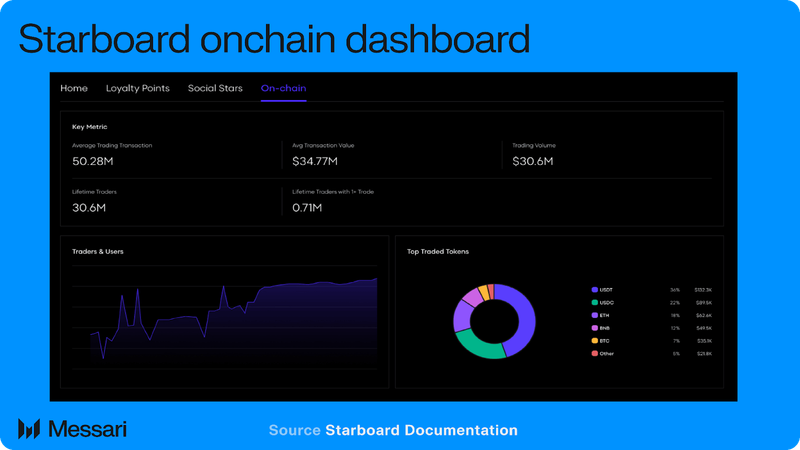
Starboard’s onchain analytics pair with their offchain insights to provide a performance analytics layer that helps protocols to assess contributor impact, refine incentive structures, and optimize campaign strategies. Onchain insights include broader metrics on the protocol itself, while offchain metrics are more granular and pull directly from users and their impact on social networks. In the onchain dashboard, onchain metrics include:
- TVL Monitoring: Tracks liquidity movement by product, chain, and timeframe to evaluate capital inflows.
- Transaction Tracking: Observes user behavior across activities such as swaps, deposits, and lending.
- NFT & Wallet Actions: Measures user loyalty based on asset holdings, ownership duration, and wallet composition.
- Prove ROI: This tool allows users to track the dollar amount they spend on campaigns and view its impact over time.
Post-launch Activity
Starboard saw strong adoption following its public launch in late May 2025. More than 20 projects joined the platform at launch, collectively offering over $5.0 million in campaign rewards to drive early engagement. Within the first few weeks, thousands of users enrolled in various contributor campaigns. Sui’s campaign has led the way, with approximately 8,140 active participants tracked on its leaderboard. Other early adopters include 0G Labs with around 2,237 contributors and Plume with approximately 1,086.
Each campaign is supported by a public leaderboard that updates in real-time. These project-specific rankings are further aggregated into the global leaderboard. Together, these tools provide a transparent system for surfacing top contributors and incentivizing sustained user participation.
Since launch, Starboard has indexed over 150,000 posts, capturing 3.09 million likes, 1.18 million retweets, 1.05 million replies, and 167,105 quotes, amounting to more than 230 million total views, giving projects a much more granular view on their social metrics and pinpointing the strong contributors to their communities.
$5.0 Million Reward Pool and Distribution
With the launch of Starboard, Galxe has rolled out a $5 million reward pool with their partner projects to allocate to users. Key contributions include:
- Plume Network: Committed approximately $450,000 in PLUME tokens and USDC, representing about 7% of its token airdrop allocation.
- 0G Labs: Allocated over $100,000 to incentivize content creation and community advocacy.
- Dango: Committed 1% of its future token supply to engage DeFi users and contributors.
- RollDex: Launched the “Airdrop the Bomb” campaign with a $200,000 pool in $ROLL tokens, notable given its community-driven fundraising model.
- Additional Partners: Sui, Irys, LightLink, GRVT, and KRNL Labs have also pledged rewards through token allocations, pre-TGE distributions, and airdrops. For example, KRNL committed 0.3% of its supply, valued at around $150,000, while GRVT has allocated 1 million GRVT tokens.
At the end of each campaign, rewards are distributed to users who build up their standing on the leaderboard for specific projects. The campaign typically runs for several weeks or months.
Gravity Chain Update
Gravity is a high-performance execution layer developed by Galxe, purpose-built for modular use cases such as AI, DeFi, and social applications. It is built on the Parallel EVM framework and leverages a modified version of the AptosBFT consensus algorithm, enabling low-latency finality and scalable block production across dynamic workloads. The chain is designed to support concurrent transaction processing and fine-grained pipelining, offering improved throughput over traditional EVM architectures.
Gravity recently implemented a set of technical upgrades aimed at improving performance, scalability, and developer tooling. Key enhancements include:
- Gravity Storage (LRU Cache): A least recently used (LRU) cache was added at the storage layer to reduce state access latency under Parallel EVM execution. This supports high-throughput use cases that rely on frequent, concurrent state reads and writes.
- Parallel State Root: Gravity combines designs to optimize Merklization computation, improving efficiency through both inter-tree and intra-tree parallelization, effectively reducing Merklization time.
- RPC Compression: Optional JSON-RPC compression reduces CPU overhead during stress testing, enhancing node performance under load.
- Block Production and Pipelining: Updates to block generation algorithms and concurrency handling improve throughput and reliability, especially relevant for AI and DeFi-focused deployments.
Under Solo tests, Gravity achieves up to 35,000 TPS (1.4 Gigagas/s) on a 16-core / 32GB SSD AWS instance. Performance distribution:
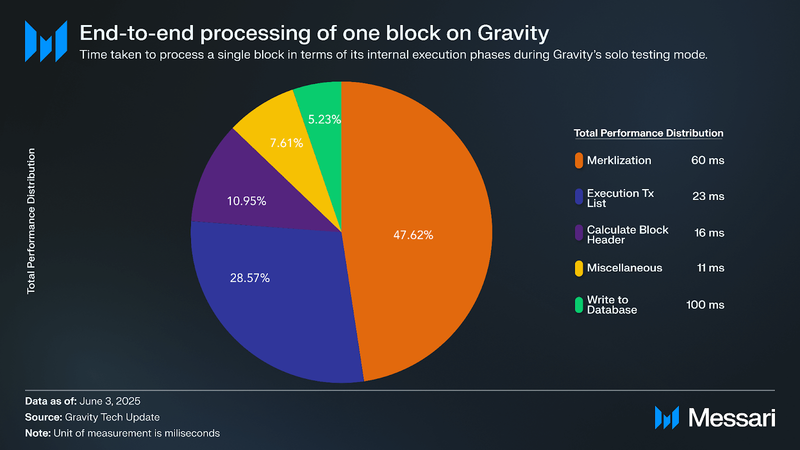
Traditional EVM chains are primarily constrained by transaction execution bottlenecks, while Gravity has significantly reduced execution time by introducing Grevm and optimizing the cache layer of Gravity storage. Based on the solo tests, the system’s overall performance is currently constrained by two key technical challenges. First, the process of converting transaction data into Merkle Trees (called Merklization) is still relatively slow and consumes a large share of processing time. Second, limitations in how quickly data can be read from or written to the storage system, known as I/O bottlenecks, further restrict the speed of execution. These issues reduce the system’s ability to fully take advantage of its parallel processing capabilities, which can lead to slower response times for users in high-demand situations. Gravity will look to improve on these bottlenecks to continually achieve better performance.
Expanding testing environments
Gravity’s latest release also introduces two new simulation modes:
- Solo Mode: A single-node test environment that simulates networking and consensus, enabling granular analysis of pipeline execution, Merklization, and database performance. Ideal for isolating bottlenecks during development.
- AptosBFT Mode: A configurable multi-node network based on the AptosBFT consensus protocol. This setup enables more realistic testing of distributed performance and consensus reliability.
Gravity moved to Celestia
Gravity’s integration with Celestia marks a strategic step toward modular blockchain architecture. By using Celestia for data availability, Gravity offloads the storage of transaction data to a dedicated, scalable layer. This separation reduces execution overhead and increases throughput, improving performance and resilience for high-demand applications such as AI and DeFi. In return, Gravity provides Celestia with a robust execution layer that functions as both a production-ready environment and a testing ground for emerging modular applications.
Future Outlook
Gravity’s development roadmap focuses on advancing real-time EVM execution on cost-efficient hardware to support lower-cost operations and a better user experience. By combining the parallel execution capabilities of its custom EVM with the concurrency model of AptosBFT, Gravity is positioned to deliver one of the most responsive and high-throughput L1 user experiences.
Key areas of focus for upcoming iterations include:
- Parallel insertion & deletion for Merkle Patricia Trie (MPT): The MPT is the data structure used to store Ethereum-like blockchain states. By implementing parallel insertion and deletion within this structure, execution bottlenecks can be reduced while fully utilizing disk bandwidth and IOPS resources. It improves performance and scalability under Gravity’s Parallel EVM architecture.
- Improvements to LRU cache performance within Gravity Storage for faster state access under load.
- Increased pipeline concurrency to enhance transaction throughput.
- Expansion of onchain configuration capabilities, including support for epoch transitions, JSON Web Key (JWK) management, and Distributed Key Generation (DKG) as used in the Aptos protocol.
Closing Summary
Galxe’s latest initiatives reflect a strategic shift toward strengthening its product offerings to focus more on growth for projects and establishing a strong foothold in the emerging Infofi sector. Starboard introduces an integrated analytics platform that combines onchain and offchain signals, allowing projects to surface meaningful contributors, refine incentive programs, and improve campaign effectiveness. With early adoption from more than 20 projects and over $5 million in committed rewards, Starboard is gaining momentum as a purpose-built engine for data-informed growth.
On the infrastructure front, Gravity continues to mature as Galxe’s high-performance execution layer. Recent upgrades to storage, consensus simulation, and pipeline processing have enhanced throughput and responsiveness. The addition of Solo and AptosBFT testing environments has improved developer visibility into performance bottlenecks. Gravity’s integration with Celestia further illustrates Galxe’s commitment to modular architecture.
Together, Starboard and Gravity reinforce Galxe’s position as a comprehensive platform for community engagement, growth analytics, and scalable infrastructure.