Key Insights
- Network activity strengthened, with average daily transactions up 105.6% QoQ to 132,474. Gaming was the largest driver of this activity, supported by the launch of the Moonbeam Gaming Hub, N3MUS tournaments, and new titles such as Tubbly, Olderfall, and Data2073.
- Gaming transaction count rose 154.8% QoQ to 1.6 million, while unique active wallets increased 76.1% to 8,500. N3MUS tournaments surpassed 600,000 games played during the quarter, and Tubbly quickly became the leading Moonbeam game by both transactions and wallet count by the end of June.
- Tokeniza influenced strong activity, adding 2.9 million transactions in Q2, a 104.8% increase from Q1, and surpassing 8.5 million cumulative transactions by the end of H1 2025
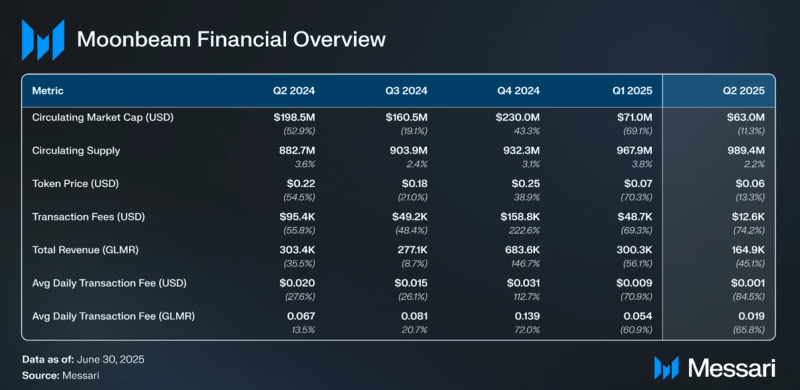
- GLMR’s market cap declined 11.3% to $63.0 million, DeFi TVL fell 27.7% to $8.1 million, and the total stablecoin market cap decreased 17.1% to $3.3 million. Transaction fees in USD dropped partly due to price action and the ongoing impact of Referendum 91, which lowered minimum gas prices and introduced PoV refunds.
- Ecosystem and governance initiatives advanced, with DataHaven’s StageNet launch on May 20, 2025, as an initiative for decentralized AI-first storage. Governance activity continued with treasury allocations through the Governance Guild.
Primer
Moonbeam (GLMR) is a Layer-1 parachain on Polkadot, serving as an EVM-compatible smart contract platform. It provides an Ethereum Virtual Machine (EVM) implementation and a Web3 API, enabling straightforward deployment of Solidity contracts and protocol interfaces with minimal modifications. Moonbeam enables cross-chain integrations, leveraging its Moonbeam Routed Liquidity functionality and bridge networks. Its primary features include cross-chain integration, staking, and onchain governance. The network includes multiple deployments: Moonbeam on Polkadot (December 2021), Moonriver on Kusama (June 2021), and Moonbase Alpha on testnet (September 2020). This structure ensures safe and rapid updates to Moonbeam’s mainnet.
In Q2 2025, DataHaven advanced its roadmap with EigenLayer by launching StageNet on May 20. This milestone provided an environment to test compatibility with the EigenLayer protocol and begin initial testing on storage primitives. As an Autonomous Verifiable Service (AVS) within EigenLayer’s validator ecosystem, DataHaven applies Ethereum’s validator set for security, using verification methods such as Merkle forests and digital fingerprints. Development also included work toward a trustless bridge between Moonbeam and DataHaven, alongside cross-chain communication through General Message Passing (GMP) protocols to facilitate asset storage, application deployment, and authenticated interactions. Additionally, DataHaven emphasized developer tools and SDKs to ease integration of its storage solutions into existing applications, while opening applications for companies and projects to become partners, thereby promoting ecosystem expansion.
Moonbeam’s technology stack, built with Rust and Substrate, provides a robust development environment. It boasts Ethereum compatibility, offering a full EVM implementation and Web3 RPC API, which integrates existing Ethereum tools and applications. As a key player in the Polkadot ecosystem, Moonbeam provides developers with an accessible route to leverage Polkadot’s network effects while utilizing Ethereum tooling and compatibility.
Website / X (Twitter) / Telegram
Key Metrics
Financial Analysis
Market Cap and Price
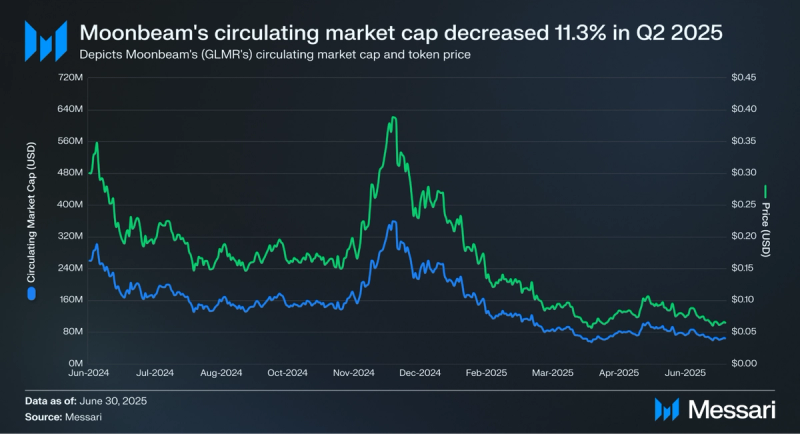
In Q2 2025, GLMR’s market cap was valued at $63.0 million, experiencing an 11.3% QoQ decline from $71.0 million in Q1 2025.
GLMR is the native token of the Moonbeam network. It serves several roles, including compensating block producers to secure the network, supporting onchain governance participation, and settling transaction fees. The token follows a fixed annual inflation schedule of 5.0%, with no predefined maximum supply.
Transactions
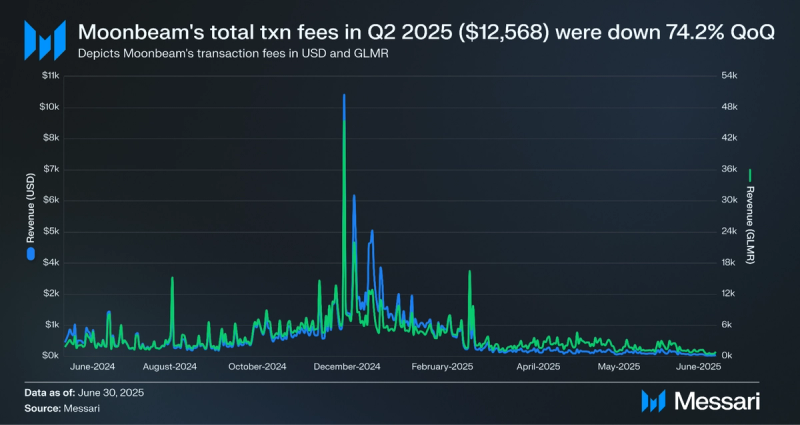
Moonbeam’s total transaction fees (USD) totaled $12,568 in Q2 2025, experiencing a 74.2% QoQ decline from $48,690 in Q1. Total average daily transaction fees (USD) were valued at $138.0, experiencing a 74.47% decline from an average of $541.0 in Q1. Denominated in GLMR, transaction fees amounted to 164,854 GLMR in Q2 2025, experiencing a 45.1% QoQ decline from 300,314 GLMR in Q1. Total average daily transaction fees (GLMR) were valued at 1,811, experiencing a 45.7% decline from a daily average of 3,336 in Q1.
These developments continue the progress initiated in Q1 and were partially influenced by the results of Referendum 91, which upgraded Moonbeam’s runtime to v3400. This upgrade supported a 75.0% reduction in the minimum gas price across all runtimes. Furthermore, it also introduced improved debugging tools, enhanced smart contract management, lower transaction fees, and implemented a gas refund mechanism for overestimated Proof-of-Validity (PoV) computations.
Of the transaction fees generated, 100% were burned, detailed further in Referendum 101.
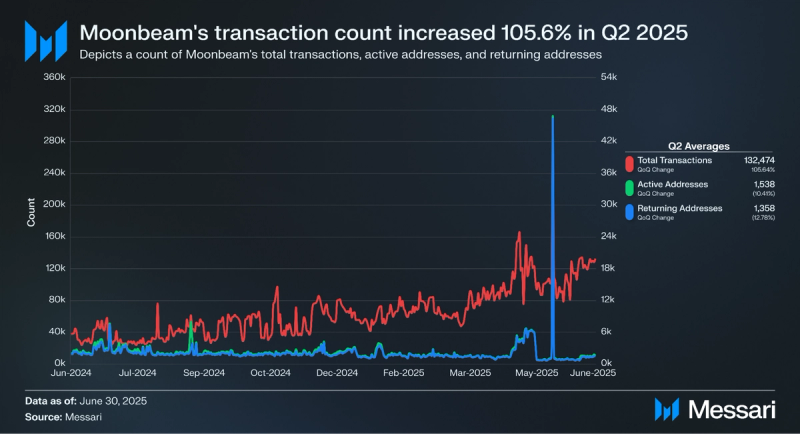
In Q2 2025, Moonbeam recorded an average of 132,474 daily transactions, representing a 105.6% increase from 64,419 in Q1. This surge was driven by heightened gaming activity and a network-wide transition to full EVM-native compatibility on May 29, 2025, which triggered a spike in onchain activity. The average daily active addresses and returning addresses were valued at 1,538 and 1,358, respectively. It is important to note that the true number of users on Moonbeam’s protocol was higher due to the widespread use of social logins and account abstraction in many of Moonbeam’s games. These design choices obscure wallet-level metrics, as thousands of users may interact through a select few visible addresses.
DeFi TVL and Stablecoins
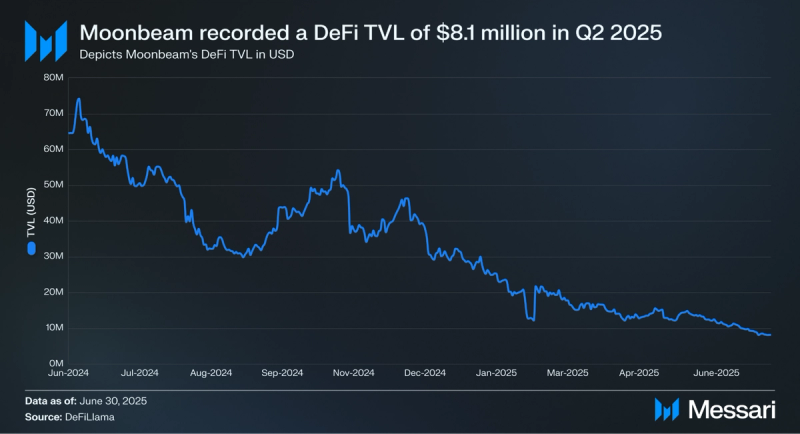
Moonbeam’s DeFi TVL (USD) was valued at $8.1 million in Q2 2025, experiencing a 27.7% QoQ decline from $11.2 million in Q1. The downturn was primarily concentrated around StellaSwap, the leading DEX on Moonbeam, which continues to account for the majority of onchain liquidity and trading activity. Despite the decline, StellaSwap remains the anchor protocol within Moonbeam’s DeFi ecosystem.
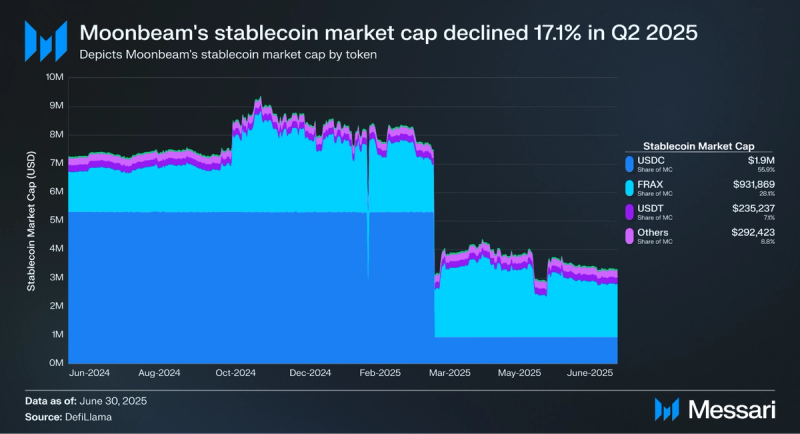
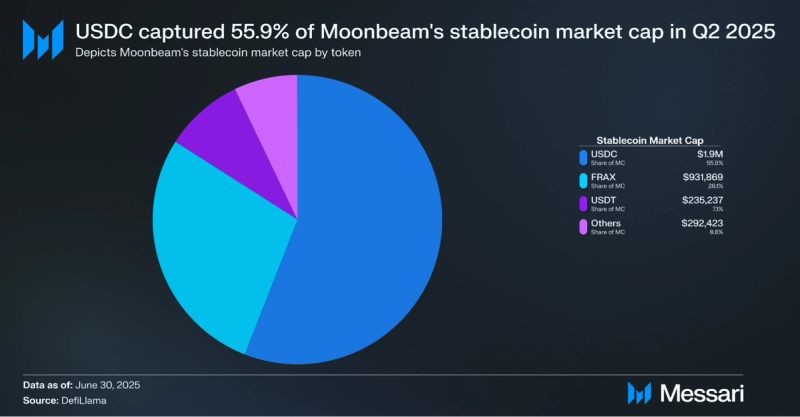
Moonbeam’s total stablecoin market cap dropped from approximately $4.0 million to $3.3 million, decreasing by approximately 17.1%. This contraction mirrors the broader downtrend in DeFi activity on the network and reflects waning liquidity across key applications like StellaSwap. As of June 30, 2025, USDC remained the dominant stablecoin, accounting for 55.9% of the total stablecoin market cap with $1.9 million in value. USDC’s dominance reinforces its continued role as the primary medium of exchange and collateral asset on Moonbeam.
FRAX followed with $931,869, making up 28.1% of the market, while USDT and other stablecoins contributed $235,237 (7.1%) and $292,423 (8.8%), respectively. The visible skew toward USDC and FRAX suggests limited diversity in stablecoin liquidity and underscores the challenges of expanding beyond the two major issuers.
On the governance front, Moonbeam launched Governance Guild Term 2, establishing a more structured approach to decentralized participation. The protocol delegated 5 million GLMR and 50,000 MOVR to 10 elected community delegates, marking a step toward broader governance decentralization. This model is designed to increase transparency and align decision-making with grassroots contributors, a dynamic that could resonate with communities drawn to open financial systems anchored by stablecoin usage and equitable participation.
Moonbeam’s Growth in the Gaming Sector
Gaming was the primary contributor to Moonbeam’s activity in Q2 2025. Gaming transactions rose 154.8% QoQ to 1.6 million, while unique active wallets increased 76.1% to 8,500. Much of this activity came from the launch of the Moonbeam Gaming Hub, continued N3MUS tournaments, and new game deployments. N3MUS tournaments surpassed 600,000 games played during the quarter, providing a steady source of activity and onboarding.
The June 17, 2025, launch of Tubbly illustrated this trend, recording 67,700 transactions and 2,007 unique active wallets within the first two weeks. Tubbly became the leading Moonbeam game by both transactions and wallet count by the end of June. Other new titles also recorded heightened activity, including Olderfall with 250,000 transactions, Wegainst with 128,000, and Data2073 with 87,000.
Tokeniza remained the largest individual application by transaction volume across Moonbeam. Since launching in January 2025, it has sustained monthly increases in activity, surpassing 8.5 million transactions by the end of H1 2025. More specifically, Tokeniza added 2.9 million transactions in Q2, a 104.8% increase compared to Q1. The project also advanced through its integration with PIX funding.
The Moonbeam Gaming Hub, developed with N3MUS and Sequence, was introduced to simplify onchain game deployment and reduce associated costs for developers. Community partnerships added visibility, including a collaboration with Flamengo Esports, which targeted mainstream audiences through competitive gaming.
Closing Summary
In Q2 2025, Moonbeam’s activity was anchored by gaming, which emerged as the largest vertical on the network. Gaming transactions rose 154.8% to 1.6 million, and unique active wallets increased 76.1% to 8,500, driven by the Moonbeam Gaming Hub, N3MUS tournaments, and the release of new titles such as Tubbly, Olderfall, and Data2073. Tokeniza also continued to play a central role, doubling transaction volume QoQ and surpassing 8.5 million cumulative transactions by the end of H1 2025.
While financial metrics contracted (GLMR market cap declined 11.3% to $63.0 million, DeFi TVL fell 27.7% to $8.1 million, and stablecoin market cap decreased 17.1% to $3.3 million), the broader ecosystem saw progress. DataHaven advanced with the launch of StageNet, and governance programs distributed rewards and delegated tokens to strengthen community participation.
Looking ahead, Moonbeam’s ability to sustain gaming traction while advancing protocol upgrades and governance programs will dictate long-term ecosystem resilience.