Key Insights
- Shaga is introducing “Gameplay-Action Pairs” (GAPs), a novel data asset class composed of synchronized gameplay frames and the corresponding player inputs.
- The Shaga network has captured over 259,400 hours of video game streaming data, a dataset with a potential market valuation of approximately $26 million.
- Shaga’s technical strategy leverages GAPs for a dual purpose: training advanced Neural Game Codecs (NGCs) to enhance its core cloud gaming product while also monetizing the data itself.
- The SHAG token will become the economic engine for the Shaga network. SHAG’s design aligns inventives across gamers, node operators, and AI researchers.
Primer
Shaga is a decentralized physical infrastructure (DePIN) network built on Solana that turns idle gaming PCs into a distributed cloud gaming platform from users providing their computing power. The project’s thesis begins with a significant market inefficiency: an estimated 59.5 million high-specification gaming PCs sit dormant for up to 80% of the day, representing billions of unutilized GPU-hours daily. Shaga aims to capture this wasted resource by enabling PC owners to monetize their hardware by streaming video games to users who lack the resources, allowing them to play on weaker devices. Shaga is solving the high costs and scalability issues that have plagued centralized cloud gaming services, and is led by industry experts Guido Pardini (CEO), Daeshawn Ballard (COO), and Aaron Sternberg (CRO).
Shaga’s platform is designed as a vertically integrated solution, combining compute, storage, and bandwidth from a single peer’s machine to deliver a low-latency gaming experience. Shaga believes this architecture is fundamentally superior to using fragmented DePIN solutions, where routing between different networks for storage, compute, and streaming would introduce unplayable levels of lag.
According to Shaga’s data, its initial invite-only phase has attracted a waitlist of over 962,000 users and delivered 259,400 gaming hours, suggesting significant early demand for its community-owned gaming infrastructure. Shaga has raised $5 million and is backed by Anatoly Yakovenko (Founder of Solana), Stephen Akridge (Cofounder of Solana), Amir Haleem (Founder of Helium), Yuan Gao (Founder of Gradient), and others.
Invite-Only Phase: Metrics & Growth
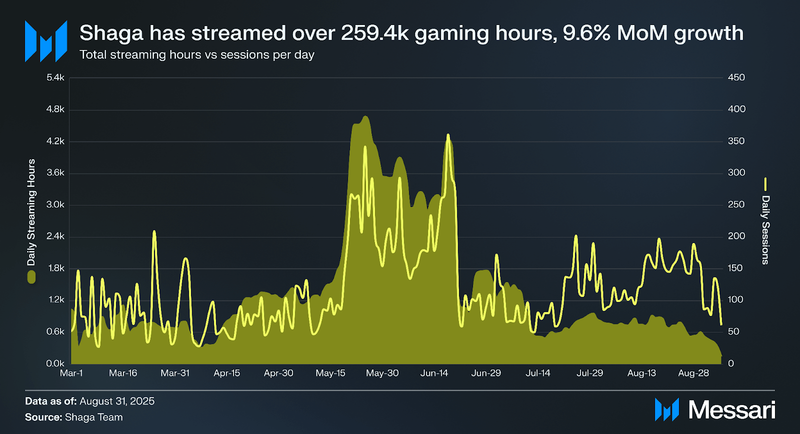
Shaga’s invite-only phase, which launched in March 2025, has served as a period for validating its infrastructure and demonstrating early network effects. The most significant milestone from this period is the accumulation of over 259,400 video game streaming hours.
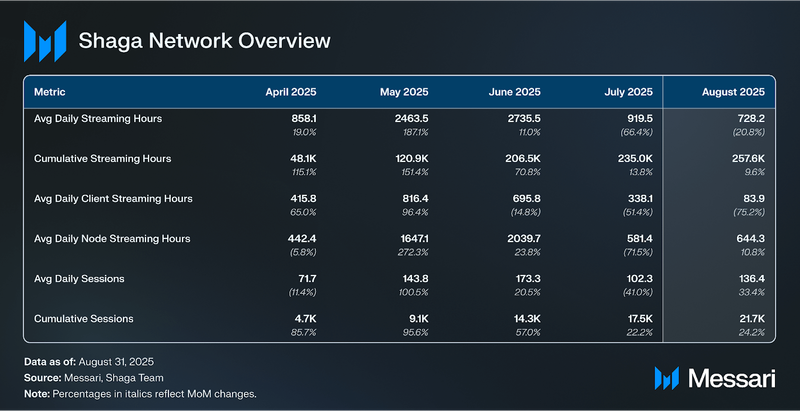
In August 2025, average daily streaming hours were 728.2, with 88.5% of hours coming from nodes and 11.5% of streaming hours coming from clients. Also, in August, average daily gaming sessions were 136.4, a 33.4% MoM increase, resulting in 21,700 cumulative sessions since launch. All supported games with live lobbies can be found here.
The Shaga network’s unit economics for PC owners reveal a compelling reason to join, particularly when factoring in the value of its generated data.
- Operating Cost: The primary operating expense for a network participant providing their gaming PC as a compute node is electricity. A standard 500W rig costs approximately $0.065 per hour to run at an average US electricity cost of $0.13 per kilowatt-hour.
- Data Value: The Gameplay-Action Pair (GAP) data generated during these sessions has a wide range of potential valuations. Internal estimates place a conservative floor at $1 per hour, while market intelligence indicates that data brokers are quoting rates between $50 and $100 per hour for this type of authentic, high-quality training data.
This contrast between the low cost of data generation and its high market value, along with the potential of future SHAG token incentives, creates a powerful incentive structure for network participation. When compared to incumbent centralized services like Xbox Cloud, which costs users around $20 per month, the Shaga model is positioned to be up to 26 times cheaper per player, even before accounting for data revenue. This economic advantage is a key driver of the network’s growth trajectory and sets the stage for its strategic evolution.
SHAG Token
The SHAG was set to launch on August 20, but the team postponed due to interest from exchanges that will partner with Shaga at launch. However, token information has been released, and the SHAG token is set to become the economic engine of the Shaga network. Its design connects three distinct functions that align incentives across gamers, node operators, and AI researchers:
- Cloud Gaming: SHAG is used to pay for video game streaming sessions. The peer-to-peer model allows lower-cost, low-latency access compared to centralized platforms like Xbox Cloud.
- AI Data Mining: Gameplay sessions generate GAP data, a scarce resource for training generative gaming AI. Players can earn SHAG by contributing this data as they stream games via Shaga. This data has substantial market value and could subsidize or eliminate gaming costs.
- AI Compute Training: Shaga nodes can redirect idle compute from GPUs to AI model training through shared infrastructure like Nous Research. Nous and Shaga share the same networking library, which would make this possible. Node operators earn SHAG for contributing compute, extending token rewards beyond user gameplay.
SHAG issuance follows a similar model to Bitcoin’s Proof-of-Work (PoW) dynamics. Node operators effectively convert electricity into tokens, with emissions calibrated to reflect real-world costs down to the kilowatt-hour. This thermodynamic approach filters participation to committed operators while discouraging farming. Conservative emission schedules are intended to preserve long-term value and avoid the dilution cycles seen in other DePIN projects.
The network further strengthens token value through its Solana-native structure. At launch, Shaga will conduct a token sale via Metaplex Genesis. 25% of the SOL raised will be staked with Marinade, and staking yields will be used for continuous SHAG buybacks. This mechanism aims to create a constant base level of demand for the token using SOL reserves.
Taken together, these design choices frame SHAG as both a transactional medium for accessing services and a reward instrument for contributing scarce resources like data, bandwidth, and compute.
Gameplay-Action Pairs: A New Data Asset Class
The centerpiece of Shaga’s evolving ecosystem is the introduction of a new, proprietary data asset class dubbed “Gameplay-Action Pairs” (GAPs). This moves Shaga beyond a traditional DePIN infrastructure project and positions it as a critical data source for the rapidly expanding AI industry.
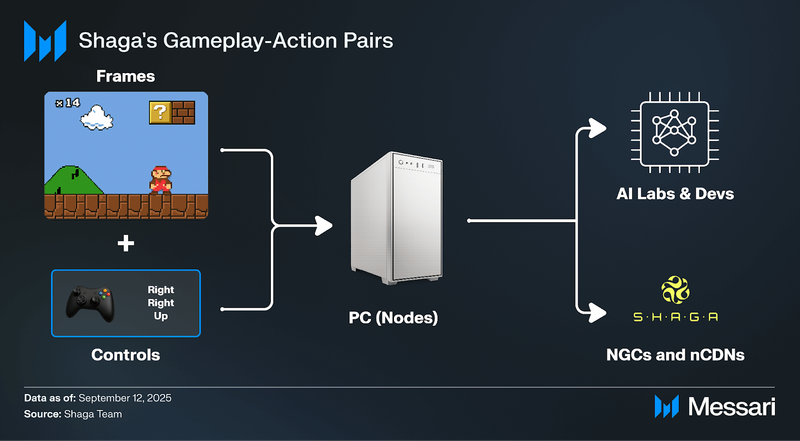
A Gameplay-Action Pair is a synchronized data package that contains two core components:
- Gameplay (Frames): A sequence of video frames capturing the in-game visual output.
- Action (Controls): The corresponding sequence of player inputs (e.g., keystrokes, mouse movements, controller actions) that directly caused those visual frames to be rendered.
This simple pairing is profoundly valuable because it captures causality. Unlike a standard gameplay video scraped from a streaming site, a GAP dataset provides a direct, verifiable link between a player’s intent (the action) and its consequence (the gameplay). This is the raw material needed to teach AI models not just what a game looks like, but fundamentally how to play it.
The demand for this data is driven by the limitations of synthetic datasets, which often produce AI agents that behave in mechanical, predictable ways at higher costs. Authentic data from human players, with all its nuances, mistakes, and moments of ingenuity, is essential for training AI that can operate in complex, dynamic environments. As noted by Shaga’s team, this data “must be mined live” and represents a unique distribution of probability and causality that AI models require.
Market Demand & Economic Flywheel
The ongoing AI arms race has created an urgent demand for high-quality training data. Shaga’s 259,400 hours of collected gaming data, when viewed through the lens of this market, transforms from a simple usage metric into a strategic asset with an estimated valuation of ~$26 million.
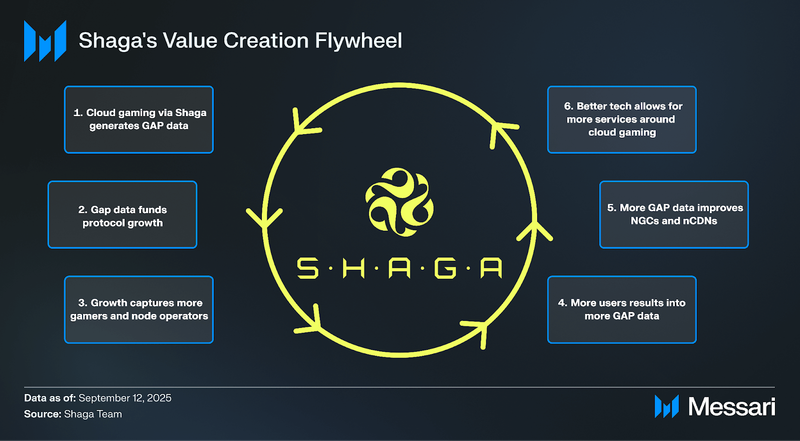
Shaga is architecting a system where this data value can be captured and redirected to fuel a self-sustaining flywheel:
- Data Monetization: AI labs and developers become the primary customers, purchasing GAP datasets to train their models.
- Subsidized Gaming: Revenue generated from these sales can be used to subsidize, or even entirely eliminate, the cost of cloud gaming for users. It could even evolve into a “play-to-earn” model where gamers are paid for generating particularly valuable data.
- Network Growth: Free or low-cost gaming attracts more users, which in turn generates more data. This increases the value and variety of the dataset, attracting more data consumers and creating a virtuous cycle of growth.
This model is conceptually similar to the business models of other successful DePIN projects like Hivemapper or Grass, where the utility of the network’s service (mapping or bandwidth sharing) is complemented by the monetization of the data it generates.
Technical Foundations & Strategic Defensibility
The creation and monetization of GAPs are backed by a unique technical stack and a clear vision that creates a defensible moat for Shaga.
- Neural Game Codecs (NGCs): The same GAP data that is valuable to external AI labs is also invaluable for optimizing Shaga’s own network. The project is developing Neural Game Codecs, which are AI models trained on GAPs to achieve breakthroughs in data compression and latency reduction. Traditional video codecs predict future frames based on past frames; NGCs can predict future frames based on past frames and player inputs, effectively compressing causality itself. This creates a powerful dual-use case for the data as it is both a product to be sold and a raw material for internal innovation, transforming the Shaga network into a self-improving Neural Content Delivery Network (nCDN).
- Read our previous report on Shaga to learn more about NGCs and nCDNs.
- Intellectual Property and DRM: Navigating the complex landscape of intellectual property (IP) is a significant challenge in monetizing gameplay data. To address this, Shaga has developed a blockchain-based Digital Rights Management (DRM) system, which won first place at a Metaplex hackathon in March 2025. This system is designed to allow for the use of GAPs in AI training while ensuring that game developers’ IP is protected. The long-term strategy involves partnering directly with game developers to establish royalty-sharing agreements, allowing them to benefit from AI-generated content trained on their games.
- Proof of Concept: To validate its data and attract initial customers, Shaga is partnering with a game on Solana, Star Atlas. An initial dataset of Star Atlas GAPs will be released on the machine learning repository Hugging Face. This will serve as a public, high-quality proof of concept, demonstrating the value and utility of the data Shaga’s network can produce.
Closing Summary
Shaga is strategically positioning itself at the intersection of decentralized infrastructure, cloud gaming, and artificial intelligence. By identifying and productizing Gameplay-Action Pairs, the project has moved beyond providing utility via cloud gaming and is now cultivating a unique and highly valuable data economy. The 259,400 hours of gameplay already collected represent a significant foundational asset, but more importantly, they validate a powerful economic model where the cost of gaming can be subsidized by the demand for AI training data.
This dual-sided value proposition creates a flywheel. Gamers are drawn in by the promise of low-cost, high-performance cloud gaming, while their gameplay generates the very data that funds and improves the network. The development of Neural Game Codecs exemplifies this synergy, using GAPs to create a more efficient cloud gaming experience, which in turn attracts new users and encourages further data generation. Combined with a forward-thinking approach to developer IP through its blockchain-based DRM, Shaga is building the data backbone for what it terms “Cloud Gaming 2.0.”
As generative AI continues to reshape the digital landscape, the demand for authentic, causal gaming data will only grow. Shaga’s ability to “mine” this data from the natural activity of its network provides a sustainable and scalable competitive advantage. The project’s success will ultimately depend on its ability to execute this ambitious vision, balancing the growth of its gaming community with the development of its data marketplace. If successful, Shaga could provide a blueprint for how decentralized networks can create symbiotic ecosystems where the value generated by user activity is leveraged to enhance the user experience itself.