Key Insights
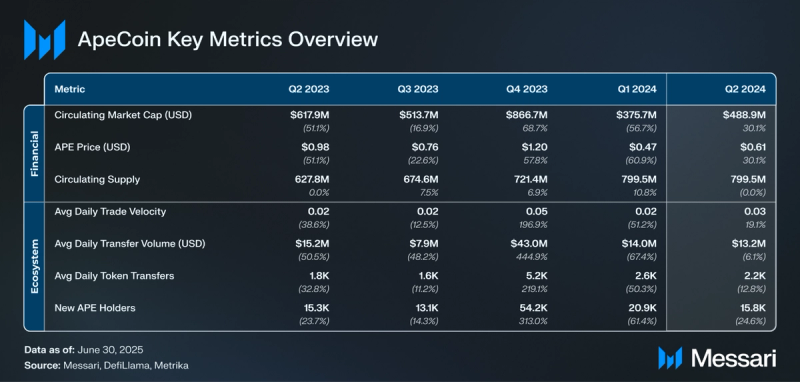
- ApeCoin’s circulating market cap increased 30.1% QoQ, reaching $488.9 million in Q2 2025. Token price rose proportionally from $0.47 to $0.61, marginally outperforming Ethereum’s growth during the same timeframe.
- ApeCoin’s DEX volume totaled $16.6 million in Q2, with mid-sized holders (Seals and Sharks) dominating, collectively accounting for over 75.0% of trading activity.
- Total claimed staking rewards grew 7.5% QoQ to 4.1 million APE. Mutant Ape Yacht Club (MAYC) and Bored Ape Kennel Club (BAKC) holders increased their holdings, while Bored Ape Yacht Club (BAYC) holders and APE tokenholders saw reduced QoQ participation.
- New APE tokenholder additions dropped 24.6% QoQ, totaling 15,765. This moderation followed heightened acquisition in prior quarters driven by ApeChain incentives.
- ApeCoin governance underwent a transformative shift with the approval of AIP-596. This effectively deprecates the existing DAO structure, centralizing governance and operational control under ApeCo, a new entity administered by Yuga Labs to address operational inefficiencies and align ecosystem development more strategically.
Primer
ApeCoin (APE) is an ERC-20 token that serves as the native asset of the ApeCoin ecosystem, used primarily for gas fees on ApeChain, staking rewards, and other utility integrations across ecosystem partners.
On Oct. 20, 2024, ApeChain was launched, transitioning ApeCoin to an operational Layer-3 blockchain built on Arbitrum’s Orbit framework. Designed to address Ethereum’s limitations, particularly with scalability and transaction fees, ApeChain utilizes APE as its native gas token for transactions, ensuring seamless and cost-efficient user interactions.
Previously governed by the ApeCoin DAO, APE’s governance structure was overhauled in June 2025 following the passage of AIP-596, which dissolved the DAO and transferred authority to ApeCo, a new entity formed by Yuga Labs. This transition was designed to address inefficiencies in decentralized coordination and align APE’s role more directly with ecosystem development.
Under the new model:
- ApeCo oversees governance, treasury management, and operational priorities, including ApeChain, Bored Ape Yacht Club (BAYC), and Otherside.
- The APE Foundation continues to provide legal and administrative support during the transition process.
With ApeCo’s creation, legacy structures such as the Special Council, WebSlinger, and the proposal/voting process were sunset. Instead, ApeCo administers funding and development directly, focusing on milestone-based execution and strategic initiatives.
Website / X (Twitter) / ApeChain
Key Metrics
Performance Analysis
Market Cap
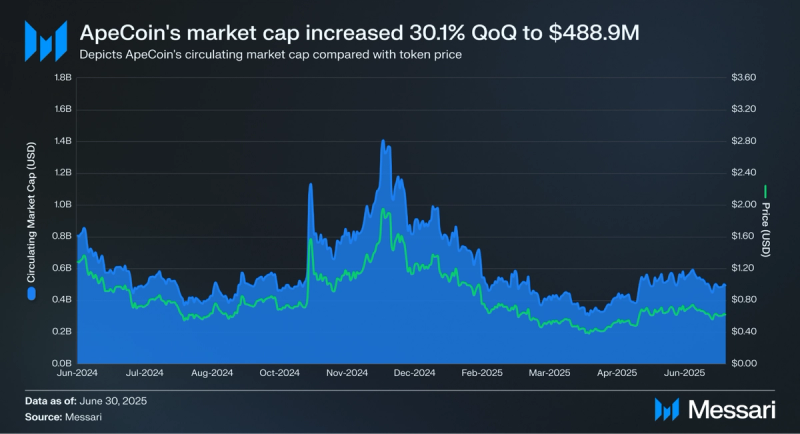
In Q2 2025, ApeCoin’s circulating market cap increased 30.1%, rising from $375.7 million at the end of Q1 to $488.9 million at the end of Q2. Similarly, the price of APE rose from $0.47 to $0.61 throughout Q2, mirroring its 30.1% increase in market cap.
APE’s quarterly high market cap was recorded on June 10, 2025, at $592.1 million with a token price of $0.74. This period of growth for ApeCoin slightly outpaced ETH’s performance over the same time frame, which rose 27.1% in Q2.
Total DEX Volume
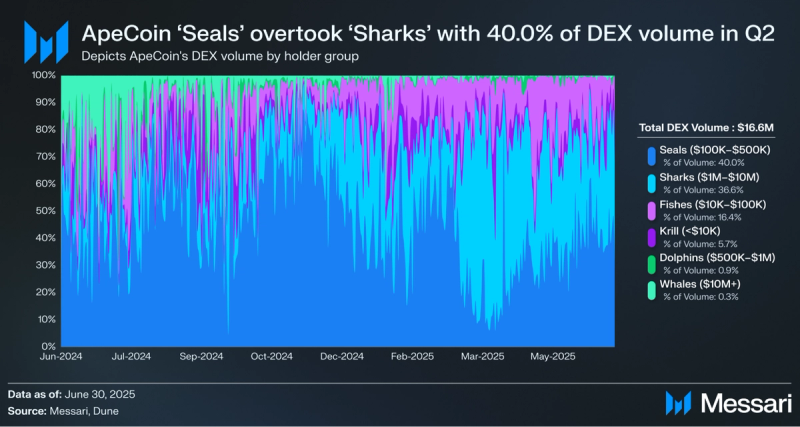
ApeCoin recorded a total Q2 DEX volume of $16.6 million. Trading activity was concentrated among mid-sized holders, with Seal and Shark wallets collectively accounting for over 75.0% of total volume.
Breakdown by holder group:
- Seals ($100,000–$500,000 in APE): $6.7 million (40.0%)
- Sharks ($1–10 million in APE): $6.1 million (36.6%)
- Fish ($10,000–$100,000 in APE): $2.7 million (16.4%)
- Krill (<$10,000 in APE): $951,000 (5.7%)
- Dolphins ($500,000–$1 million in APE): $148,000 (0.9%)
- Whales ($10+ million in APE): $50,800 (0.3%)
Seal wallets recorded a slightly higher aggregate volume than Sharks, contributing $566,000 more throughout Q2 despite operating within a lower holdings amount.
Claimed Staking Rewards
ApeCoin DAO began issuing staking rewards in Q4 2022 after passing AIP-21 and AIP-22, which finalized staking parameters. APE tokenholders and Yuga Labs’ ecosystem asset holders, including Bored Ape Yacht Club (BAYC), Mutant Ape Yacht Club (MAYC), and Bored Ape Kennel Club (BAKC), receive staking allocations.
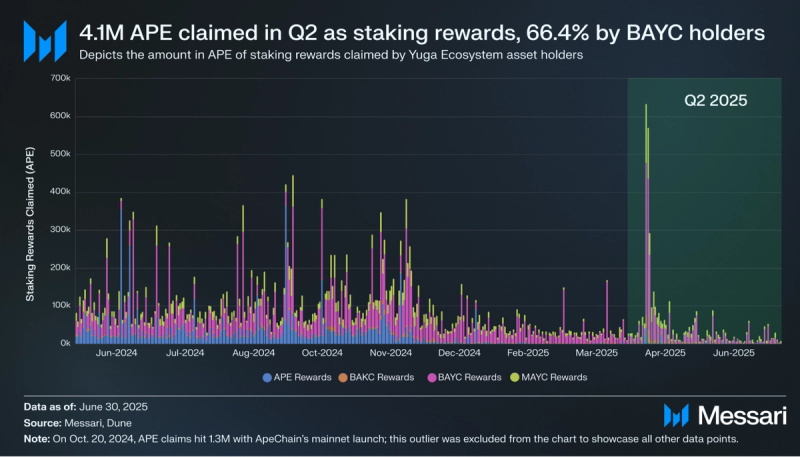
Yuga Ecosystem NFT holders and APE tokenholders claimed 4.1 million APE as staking rewards in Q2 2025, an increase of 7.5% QoQ from 3.8 million APE in Q1.
The distribution of staking rewards shifted slightly across cohorts:
- BAYC Holders: Claimed 2.7M APE (66.4% of total), flat against Q1’s 2.7 million APE
- MAYC Holders: Claimed 1.1M APE (26.7% of total), up compared to Q1’s 781,600 APE
- BAKC Holders: Claimed 222,327 APE (5.4% of total), up compared to Q1’s 108,954 APE
- APE Tokenholders: Claimed 143,153 APE (3.5% of total), down from Q1’s 207,524 APE
MAYC and BAKC holders both increased their nominal claims and share of rewards, while BAYC holders and APE tokenholders’ activity declined. The drop in APE tokenholder participation continued a reversal from Q4 2024, when ApeChain launch incentives drove elevated engagement among non-NFT holders.
The highest single-day claim volume in Q2 occurred on April 15, 2025, totaling 633,306 APE across all categories. This spike coincided with ApeCoin’s announcement that NFT staking rewards were going live on ApeChain.
New APE Tokenholders
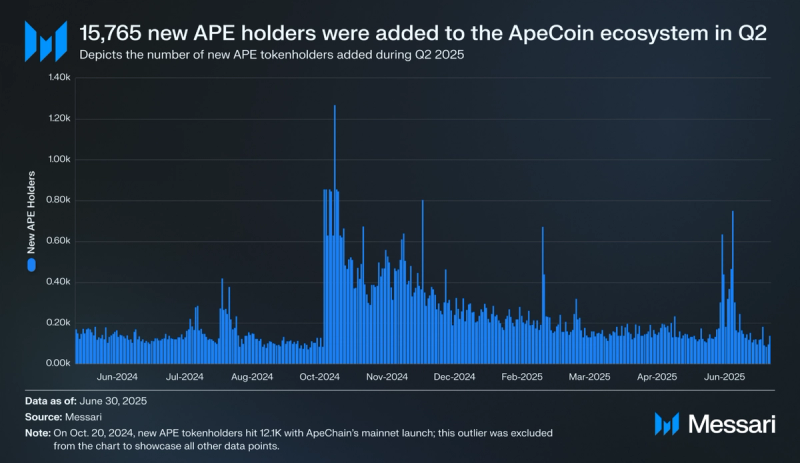
New APE tokenholders are defined as addresses that received APE for the first time. This metric excludes new tokenholders who custody their assets using centralized exchanges (CEXs).
15,765 new tokenholders were added in Q2 2025, representing a 24.6% QoQ decrease from 20,908 in Q1. The decline follows a high in Q4 2024, when 54,178 new tokenholders entered the ecosystem during a period of elevated activity driven by ApeChain-related incentives. While Q1 additions ranged between 100 and 400 addresses per day, Q2 figures trended lower and showed reduced volatility.
Governance Transition: From ApeCoin DAO to ApeCo
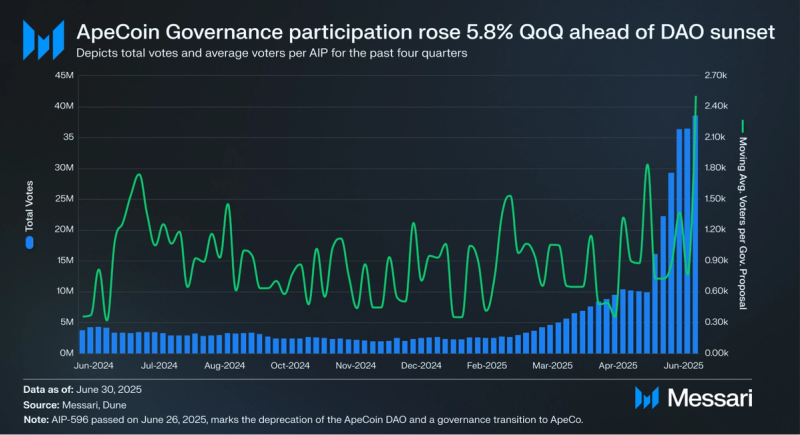
The adoption of AIP-596 initiates a structural change in ApeCoin governance, sunsetting the DAO and transferring governance, assets, and operational control to ApeCo, a new entity formed by Yuga Labs. The proposal describes the move as a response to coordination inefficiencies, diminishing participation, and inconsistent capital use. The revised model centers capital allocation and operational decision-making within a single administrative body to support ecosystem priorities such as ApeChain, Bored Ape Yacht Club (BAYC), and Otherside.
The previous governance structure comprised the ApeCoin DAO, the APE Foundation, the Special Council (Board), and WebSlinger. The DAO, consisting of APE tokenholders, held proposal and voting rights regarding ecosystem grants, partnerships, and operational matters. The APE Foundation executed successful proposals and supported legal administration. The Special Council provided oversight and had the authority to approve select grants independently. WebSlinger was responsible for administrative operations.
AIP-596 was submitted by Greg Solano, CEO of Yuga Labs, and received 3,173 votes. The proposal cited challenges with process efficiency, low-value proposals, and difficulty executing longer-term initiatives. Under the new structure, decision-making shifts to ApeCo, which will administer milestone-based funding, internal product development, and strategic initiatives.
The proposal includes the following implementation components:
- Approximately 11.25 million APE will be distributed to fund the staking contract.
- 10 million APE will be distributed for legal, administrative, and contractual transition expenses.
- All DAO and APE Foundation assets, including fiat currencies, tokens, intellectual property, smart contracts, and infrastructure, will be transferred to ApeCo.
- All prior governance structures, including AIPs not already in effect, elections, and working groups, will be terminated.
- The Executive Director of the APE Foundation will be delegated execution authority to carry out the transition process.
AIP-596 aligns with a broader pattern observed across DAO governance: early-stage community administration followed by more streamlined operational control. The ApeCoin DAO was used to fund builders, conduct pilot projects, and set up early infrastructure. This proposal marks the end of this period and introduces a new structure designed for faster execution and more direct resource management.
Closing Summary
ApeCoin’s Q2 2025 performance reflected a period of recovery and structural repositioning, most notably through governance. The token’s circulating market cap rose 30.1% to $488.9 million, with its price increasing from $0.47 to $0.61. DEX volume reached $16.6 million, with trading concentrated among Seal and Shark wallets.
Staking participation increased slightly from the prior quarter, totaling 4.1 million APE claimed. MAYC and BAKC holders expanded their share of rewards, while participation from APE tokenholders declined. The quarter also saw a continued slowdown in new tokenholder growth, with 15,765 addresses receiving APE for the first time, down 24.6% from Q1.
Most notably, Q2 2025 saw the passage of AIP-596, which formally dissolved the ApeCoin DAO and transferred governance, funding authority, and ecosystem oversight to ApeCo, a newly created entity under Yuga Labs. This marked the end of the DAO-led governance phase and the beginning of a new administrative structure for ApeCoin. The restructuring provides a streamlined framework that may support more efficient execution in future quarters.