Key Insights
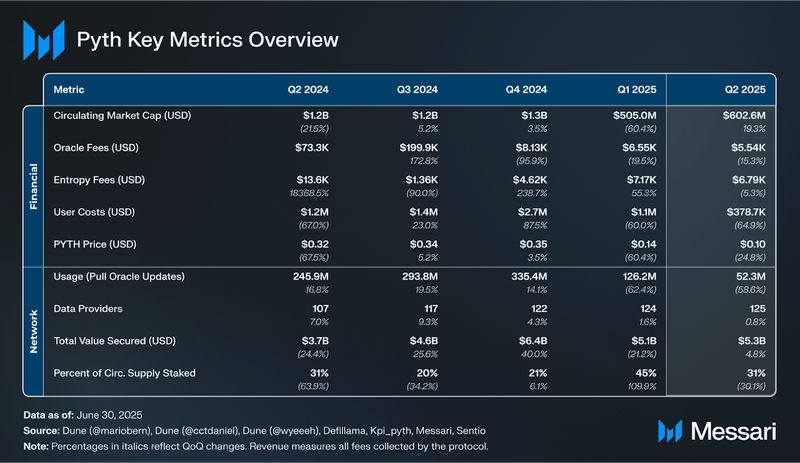
- Pyth TVS reached $5.31 billion in Q2’25, rising 4.8% QoQ as most other oracles posted losses or flattened. Pyth was one of only two networks to see growth over Q2.
- Price updates rose to 648,240 in Q2’25, a 10.8% increase from the previous quarter. This brought the cumulative update count to 759.1 million, continuing the long-term trend of organic growth across chains.
- Entropy processed 2.89 million requests in Q2’25, a 78.1% increase QoQ and the fifth straight quarter of growth. Revenue slightly declined to $31,971, reflecting wider use across lower-fee applications.
- PYTH staked in Oracle Integrity Staking reached 938 million, up 46.9% QoQ. The increase came shortly after Pyth’s May unlock, suggesting newly circulating tokens flowed into the staking program.
- Pyth continues to expand its RWA coverage through 540+ Equities (UK, HK and JP), emerging market FX and IPO-day listings.
Introduction
Pyth (PYTH) is an oracle network that aims to offer accurate prices for cryptocurrencies, equities, foreign exchange pairs, ETFs, and commodities. Oracle networks aggregate external data and make it available for onchain application use. Pyth fosters a network of first-party (primary source and aggregator) data providers and coordinates a “pull” oracle model. This model scales price feeds across many chains and lowers network costs by offloading update fees to data consumers (applications and developers). Pyth offers four core products:
- Price Feeds (live updates for smart contracts)
- Benchmarks (historical market data)
- Express Relay (priority auction to eliminate MEV)
- Pyth Entropy (secure random number generator)
- Pyth Lazer (low-latency market data solution for centralized and decentralized trading venues)
The integrity of Pyth’s data is dependent on its contributing publisher network, which comprises over 124+ data providers from global exchanges, trading firms, market makers, institutions, and DeFi. A few notable providers include Jane Street, Cboe Global Markets, Binance, Raydium, Osmosis, Galaxy, and 0x. Pyth is focused on making financial market data available to developers on an expanding list of blockchain networks (104+ chains as of writing). For a full primer on Pyth, refer to our Initiation of Coverage report.
Key Metrics
Performance Analysis
Total Value Secured (TVS)
Starting in Q2 2025, Total Transaction Volume (TTV) will no longer be included as a primary metric in Pyth Network reporting. While TTV provided a useful perspective on transaction-level oracle usage, it has seen limited adoption across the industry and has been removed from external aggregators such as DefiLlama. In its place, reporting will focus on Total Value Secured (TVS), which will benefit from updated data sourcing methodologies to ensure consistency across time periods. These methodological changes may result in minor QoQ shifts in reported figures but will support greater accuracy and comparability moving forward.
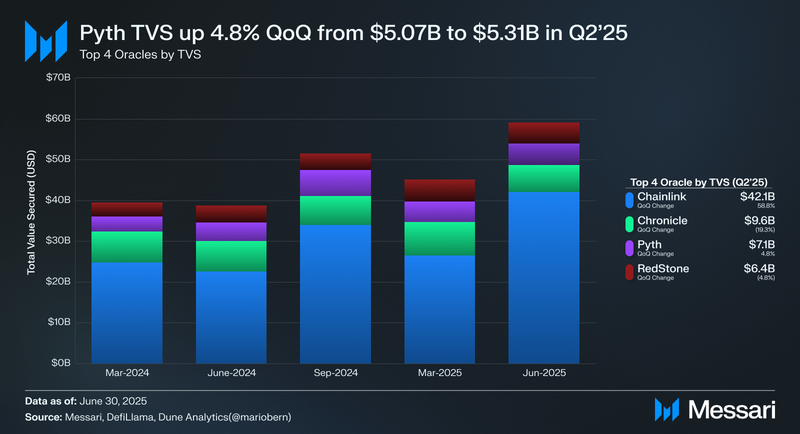
In Q2’25, Pyth Network secured $5.3 billion in TVS, up 4.8% QoQ from $5.1 billion in Q1’25. Despite a smaller absolute value relative to larger players, Pyth was one of only two major oracles to post positive growth during the quarter. Chainlink led in total secured value at $42.1 billion, up 58.8% QoQ. Chronicle fell 19.3% QoQ to $9.6 billion, while RedStone declined 4.8% QoQ to $6.4 billion.
WINkLink was removed from this quarter’s comparison due to inconsistent data from DeFiLlama and limited coverage from other sources. Depending on data availability, it may be reintroduced or replaced in future reports.
Price Updates
As a pull oracle, Pyth’s demand is reflected by the volume of price updates it provides. In Pyth-secured applications, DeFi users initiate smart contract calls that simultaneously request the latest Pyth price data within the same transaction. This means that each time a DeFi protocol requires updated price information, a call is made to Pyth, and the oracle publishes a real-time price update directly within the transaction.
To capture the scale and responsiveness of Pyth’s infrastructure, we report two key metrics:
- Price Updates: The number of individual update events requested and delivered by the oracle during user transactions.
- Cumulative Updates: The total number of updates recorded since inception, reflecting the growth in aggregate oracle usage over time.
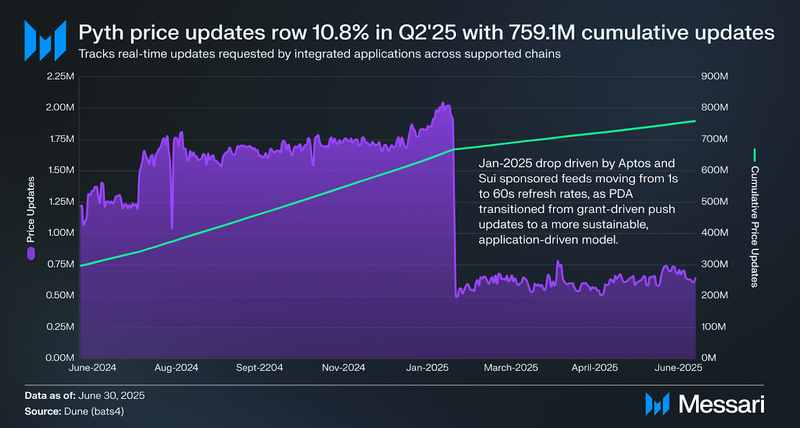
In Q2’25, Pyth processed 648,240 price updates, up 10.8% QoQ from 585,056 in Q1’25. This growth suggests sustained activity across integrated applications and highlights the continued demand for real-time oracle data.
The cumulative update count reached 759.1 million by the end of Q2’25, rising from 702.0 million in Q1’25. This represents an 8.1% increase QoQ, continuing the network’s long-term upward trend in oracle engagement.
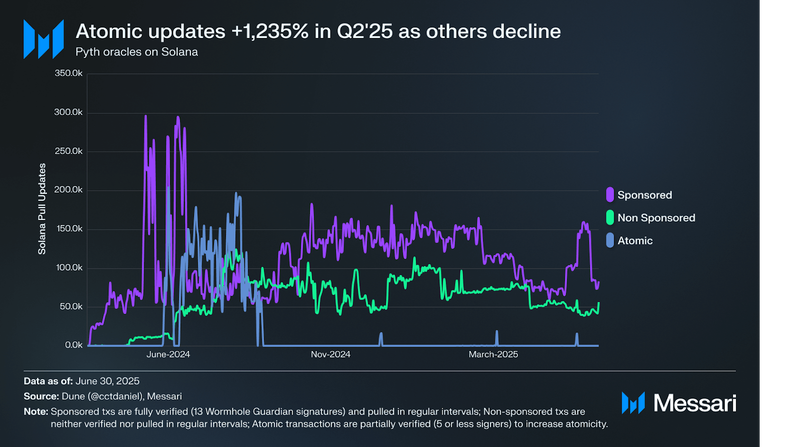
Sponsored updates remained the dominant transaction type on Solana in Q2’25, totaling 8.80 million transactions. This marked a 29.7% decline in Q1’25 but continued to reflect widespread reliance on the Pyth Scheduler, a permissionless offchain service that submits verified prices using Wormhole Guardian signatures. The sustained dominance of sponsored updates indicates ongoing adoption of automated oracle refreshes across Solana-based applications.
Non-sponsored updates, which are manually triggered and bypass the Scheduler, declined to 5.28 million in Q2’25 from 7.30 million in Q1’25, representing a 27.7% decrease. This reduction points to a moderation in use cases requiring granular or on-demand price reads. Atomic updates increased to 39,638 (with a few days constituting the majority of growth) in Q2’25, up from 2,967 in Q1’25, marking a 1,235% increase. However, they remained a minor share of total update activity following their peak in Q3’24.
Entropy
Pyth Entropy offers developers a secure way to generate random numbers on the blockchain, leveraging two-party randomness to ensure trustworthy outcomes. This randomness solution supports applications requiring unpredictability, such as NFT mints, gaming, and consensus mechanisms.
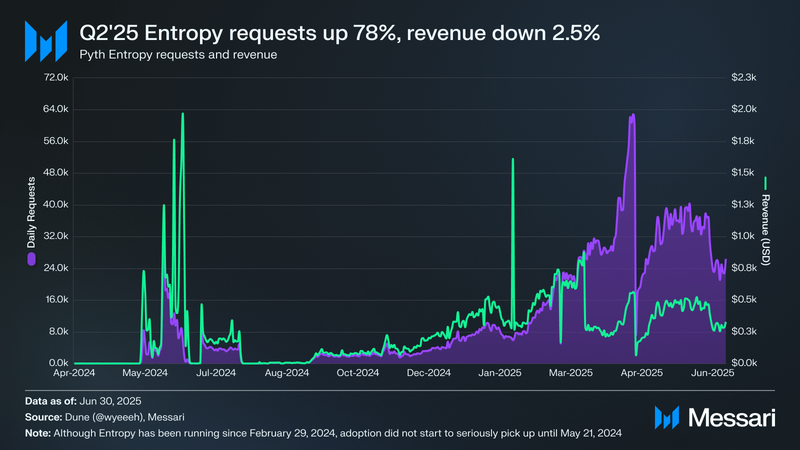
Pyth Entropy processed 2.89 million requests in Q2’25, up 78.1% from 1.62 million in Q1’25. Revenue reached $31,971, a slight decrease of 2.5% QoQ. This marks the fifth consecutive quarter of tracked growth in request volume, reflecting continued adoption of Pyth’s onchain randomness service. The divergence between volume and revenue suggests increasing usage across applications with lower per-request fees or greater batching efficiency.
User Costs (EVM)
While the cost of pulling a Pyth update is minimal, users are still responsible for the gas fees associated with their DeFi transactions. These gas costs apply solely to users, with no expense incurred by Pyth.
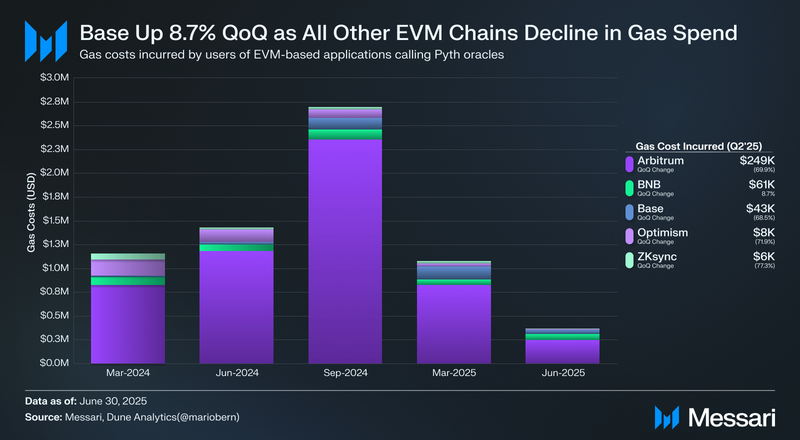
Gas costs continued to decline across most EVM chains in Q2’25. Arbitrum remained the largest contributor by total gas expenditure at $249,078, though costs fell 69.9% from the prior quarter. Base rose to second place, increasing 8.7% to $61,612, with its market share more than tripling. BNB Chain dropped 68.5% to $43,082, falling to third. Optimism and ZKsync recorded the steepest declines, down 71.9% to $8,891 and 77.3% to $5,956, respectively. These shifts indicate a rebalancing in activity and network usage across L2 ecosystems.
RWA and Crypto Price Feeds
Starting in Q2’25, we are including data on the composition of Pyth Network’s active price feeds. This breakdown highlights the breadth of market coverage supported by the oracle infrastructure. Beginning next quarter, quarterly growth metrics will also be tracked and reported for each feed category to improve visibility into evolving demand patterns.
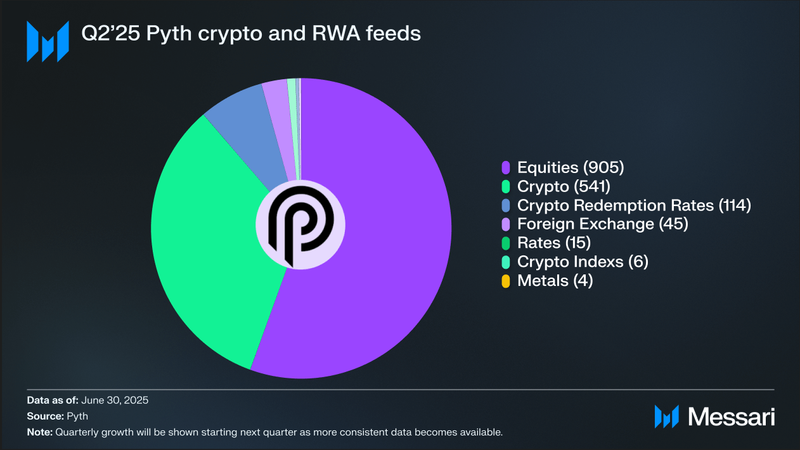
Pyth supports live feeds across multiple sectors, including equities, crypto, foreign exchange, interest rates, metals, and redemption rate products. While crypto remains a core vertical, the growing share of traditional and real-world asset coverage reflects Pyth’s expanding presence across both decentralized and institutional markets.
Some key additions include:
- Equities: Pyth expanded its coverage of traditional markets with live, sub-second feeds for the top 100 UK equities, alongside Hong Kong equities and select Japanese equities. These feeds provide institutional-grade pricing across 100+ blockchains, enabling use cases such as tokenized RWAs, on-chain indices, and portfolio strategies.
- Emerging market FX: Pyth introduced on-chain pricing for major emerging market currencies, including INR, IDR, and KRW. The feeds make historically restricted offshore FX markets publicly available in real time, enabling use cases such as DeFi forex derivatives, stablecoin conversions, and enterprise hedging.
- IPO-day listings: Pyth now provides day-one feeds for newly listed public stocks. For example, the $CRCL feed was live on its first trading day, streaming across 100+ blockchains with no delay.
Express Relay on Solana (Kamino Usage)
Express Relay is Pyth Network’s offchain auction-based system designed to mitigate Maximum Extractable Value (MEV) in decentralized finance. Instead of relying on traditional transaction ordering, Express Relay runs isolated auctions where searchers compete for the right to execute user orders. These searchers pay SOL tips, which are incentives returned directly to users. This enhances execution quality and offsets costs that would otherwise be lost to slippage or MEV.
Kamino Finance integrated in Q4’24 to power Kamino Swap, a Solana-based trading platform. The integration enabled decentralized limit orders with centralized exchange-level execution, allowing market makers to compete on price while delivering value back to users through search tips. Kamino has since become a key venue demonstrating how Express Relay can bring high-performance, low-cost trading infrastructure to DeFi.
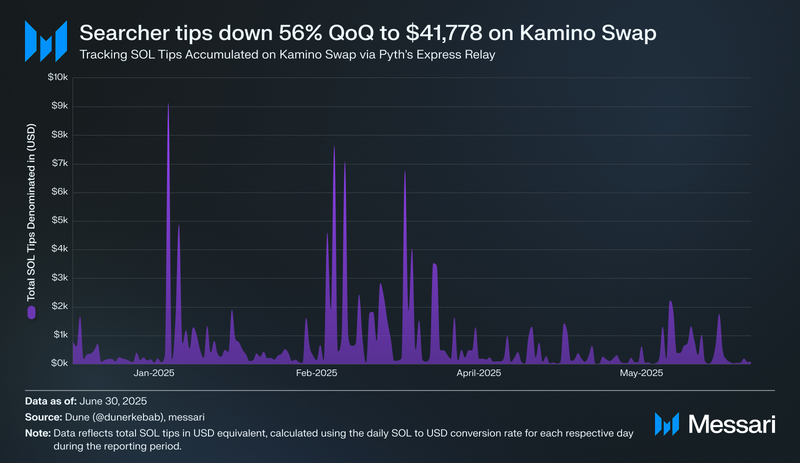
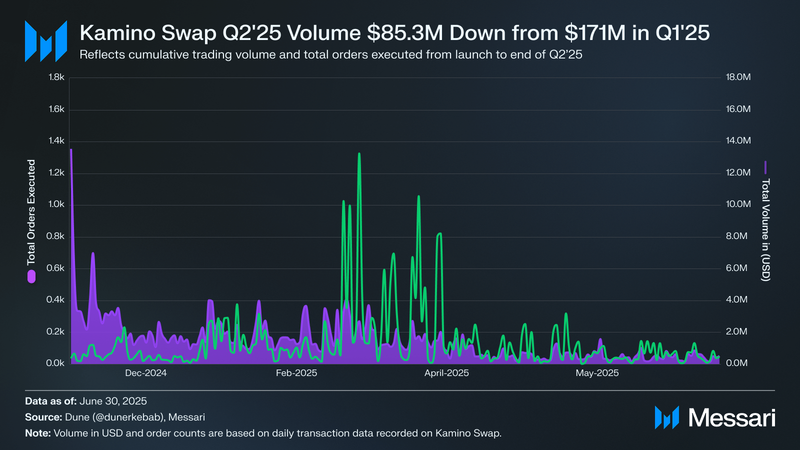
In Q2’25, Kamino Swap processed $85.3 million in limit order volume, down 50.1% from $171 million in Q1’25. A total of 11,012 orders were executed, a 34.4% decline from 16,787 in the prior quarter. Users received 41,778 USDC worth of SOL in searcher tips, down 56.0% from approximately $95,000 worth of SOL in Q1’25.
Top traded pairs:
- SOL/USDC
- cbBTC/USDC
- USDT/USDC
The substantial increase in volume and user incentives, despite a flat order count, suggests a meaningful rise in average trade size and greater participation by high-value traders. Express Relay continues to drive liquidity and efficiency for decentralized execution on Solana.
Oracle Integrity Staking (OIS)
Oracle Integrity Staking (OIS) was introduced on Sept. 21, 2024, as a key addition to Pyth Network’s staking framework, designed to enhance data reliability through economic incentives. OIS enables p5articipants to stake PYTH tokens toward specific data publishers, aligning financial incentives with price accuracy. Stakers allocate their tokens to publishers, who are rewarded for providing high-quality data and penalized for inaccuracies. This model ensures that all current and future Pyth price feeds are secured by an incentive-driven mechanism, reinforcing the integrity of oracle data.
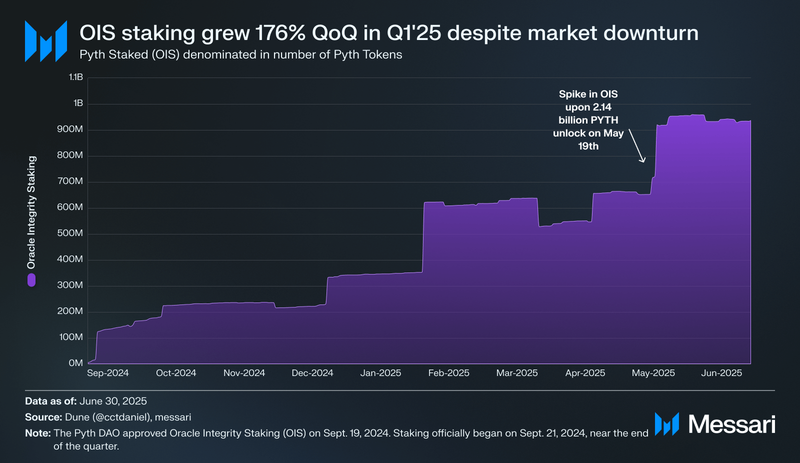
In Q2’25, total PYTH staked in Oracle Integrity Staking (OIS) reached 938.0 million, up 46.9% from 638.7 million in Q1’25. The increase in staked supply closely followed the May token unlock, which released 2.1 billion PYTH into circulation. While the growth reflects continued use of OIS, the timing suggests that newly unlocked tokens contributed significantly to the rise in stake participation.
Major Token Unlock
On May 19, 2025, Pyth released approximately 2.13 billion PYTH tokens into circulation, representing 21% of the total 10 billion supply. This 18-month unlock followed the project’s vesting schedule, which includes token releases at 6, 18, 30, and 42 months after launch. The event increased the circulating supply by an estimated 141% and had been previously communicated to the community.
Pyth Lazer Adoption
Pyth Lazer, a commercial product offering precision data streaming for institutional users, is beginning to show stronger traction. As of today, roughly 15 applications across both Web2 and Web3 are using Lazer subscriptions, generating an annual recurring revenue (ARR) of about $1.8 million. These clients are paying subscription fees of approximately $10,000 per month, providing early evidence of monetization for Pyth’s proprietary infrastructure. While the usage base remains relatively modest, the recurring revenue highlights demand for enterprise-grade access to Pyth’s real-time oracle feeds. Pyth contributors are developing a transparent framework to allow community members and stakeholders to verify these figures.
Qualitative Analysis
Protocol Updates
In Q2’25, the Pyth DAO approved and executed OP-PIP-58, which upgraded the Pyth Lazer contract on Solana mainnet to support ECDSA signatures. This enhancement followed successful testing on devnet and testnet and aimed to improve cross-chain compatibility and reduce payload size for transmitted price updates. While ECDSA signatures are more costly to verify than Ed25519, their smaller payloads improve flexibility for integrating with EVM and other non-Solana chains. The upgrade reflects ongoing efforts by the DAO to optimize cross-chain data delivery and expands the cryptographic options available within Pyth’s infrastructure.
Governance
The PYTH token is an SPL token on Solana with the core utility of PYTH being governance. PYTH holders can guide protocol development by staking the asset and voting on Pyth Improvement Proposals (PIPs). Pyth DAO also consists of the Pythian Council and the Price Feed Council. Both councils are responsible for voting for and implementing certain operational PIPs.
Pyth DAO has two types of PIPs: Constitutional and Operational. Constitutional PIPs involve protocol updates, determining structure, and guiding the administration of the Pyth DAO. They require greater than 67% support for implementation. Operational PIPs involve elections and the management of the treasury, Pythian Council, and Price Feed Council. Voting on these PIPs can be delegated to Council members and requires greater than 50% support for implementation.
PIPs
Throughout Q2, Pyth had no new Constitutional PIPs. On the other hand, 20 Operational PIPs were approved, reflecting its continued governance activity on Solana. The relevant proposals are listed below, showcasing the ongoing development and improvements within the Pyth ecosystem.
Operational:
- OP-PIP-58: Upgraded the Pyth Lazer contract on Solana mainnet to enable support for ECDSA signatures. This enhancement allows for more compact cross-chain messages and expands compatibility with verification schemes used on non-Solana chains. The proposal was approved following successful testing on Solana devnet and testnet. More details are available in the Protocol Updates section.
- OP-PIP-59: Elected the third Pythian Council and approved a stipend of 100,000 PYTH. Four new members joined the council, including Yaser Jazouane from Douro Labs, Marc Tillement from Pyth Data Association, George M from XBTO, and Lee Mount from Euler Labs. The stipend covers a six-month term with 12,500 PYTH allocated to each councilor.
- OP-PIP-60: Upgraded the Pyth Oracle contract on TON testnet to support parsing more than three price feed IDs per update by implementing cell chain traversal to work around TON’s 1023-bit cell limit. This enables efficient multi-feed updates in a single transaction. The proposal passed on April 11, 2025, and prepares the codebase for an upcoming mainnet deployment once fully tested.
- OP-PIP-61: Discontinued operations of one now-inactive Pythnet validator node that had ceased contributing data. The removal enhances network reliability by ensuring only active data publishers are part of the permissioned validator set. The proposal passed on April 14, 2025, following standard DAO procedures.
- OP-PIP-62: Deployed the upgraded Pyth Oracle contract on TON mainnet, extending the testnet improvement to production. Now supports parsing more than three price feed IDs per update by traversing cell chains and working around TON’s 1023-bit cell size limit.
- OP-PIP-63: Discontinued operations of another inactive Pythnet validator node to maintain reliability and active participation in the validator set. The proposal passed on April 26, 2025, and followed the standard DAO process.
- OP-PIP-64: Deployed a second upgrade to the Pyth Oracle contract on TON testnet to refine multi-feed parsing logic and improve gas efficiency. This update optimizes how cell chain traversal is handled, reducing validation overhead and preparing the system for TON mainnet consistency testing.
- OP-PIP-65: Upgraded Solana’s Pyth Express Relay program with a new swap_V2 instruction that supports configurable fees (in parts per million) across token pairs. It relaxed token account constraints so fee receiver accounts are only required if fees are positive. The upgrade also adds a secondary relayer field to minimize downtime during signer transitions. This followed the initial swap rollout under OP-PIP-54.
- OP‑PIP‑66: Elected three members to the third Price Feed Council, Mario Bernardi (PDA), Nicholas Diakomihalis (Douro Labs), and Anton Totomanov (Objective Labs), and approved a total stipend of 315,000 PYTH (45,000 PYTH per member) for a six‑month term. This council oversees feed listings, publisher selection, and minimum publisher requirements.
- OP-PIP-67: Appointed Douro Labs as the exclusive relayer for Pyth Express Relay. In return for operating endpoints, managing auction runtime, ensuring uptime, and handling offchain infrastructure, Douro Labs will receive 6% of PER platform fees; the remaining 94% goes to the DAO. The fee split is configurable and can be adjusted by the Pythian Council.
- OP‑PIP‑68: Upgraded the Pyth Oracle contract on TON mainnet to version 2, enabling full support for parsing more than three price feed IDs per update through enhanced cell chain traversal logic. This improvement addresses TON’s 1023‑bit cell size limit and allows multi-feed updates in a single transaction, improving efficiency and reliability.
- OP‑PIP‑69: Delegated protocol‑generated assets (PGAs) to 16 newly onboarded Pythnet validators. The delegation strengthens decentralization by distributing stake across more participants and enhances network resilience and security.
- OP‑PIP‑70: Increased oracle update fees from 1 to 10 weis on three EVM testnets: Arbitrum, Base, and Optimism. This adjustment helps downstream protocols test higher fee scenarios before mainnet rollout, while keeping costs affordable on testnet environments
- OP‑PIP‑71: Upgraded Entropy to version 2.0 on testnet, introducing configurable gas limits, enhanced callback failure reporting, improved event definitions, and a simplified developer API. These updates make random number generation more robust and developer-friendly by surfacing gas usage and error states onchain.
- OP‑PIP‑72: Upgraded Entropy to version 2.0 on Abstract testnet, introducing the same features as the testnet upgrade: configurable gas limits, enhanced callback failure reporting, improved event definitions, and a simplified developer API. This ensures consistency and reliability across testnet environments.
- OP‑PIP‑73: Discontinued operations of 7 inactive Pythnet validator nodes to maintain a reliable validator set. The removal streamlines active participation and improves network efficiency. Passed on May 21, 2025.
- OP‑PIP‑74: Delegated protocol‑generated assets (PGAs) to a newly onboarded validator named Anza, expanding the Pythnet validator set and enhancing decentralization and network robustness.
- OP‑PIP‑75: Discontinued operations of 36 inactive Pythnet validator nodes to clean up the network and enhance overall efficiency. Passed on June 12, 2025.
- OP‑PIP‑76: Discontinued operations of one inactive Pythnet validator node to ensure the validator set remains active and efficient. Passed on June 25, 2025.
Partnerships and Integrations
Sygnum Bank Partnership
In April 2025, Sygnum Bank joined Pyth Network as a first-party data publisher. As a regulated digital asset bank with operations in Switzerland, Singapore, Luxembourg, and Abu Dhabi, Sygnum brings institutional-grade market data directly onchain. This integration enhances the quality and credibility of Pyth’s price feeds, supporting more accurate execution and improved transparency across DeFi markets. The partnership reflects growing alignment between traditional financial institutions and decentralized infrastructure.
FX and Equity Data Expansion
On May 7, 2025, Pyth Network partnered with Integral, a backend infrastructure provider that services institutional foreign exchange trading for clients including Mizuho, Raiffeisen Bank, and Pictet. The integration allows these institutions to publish foreign exchange price data directly to the Pyth Network through their existing infrastructure, without requiring additional engineering work. This partnership expanded Pyth’s real-time FX coverage and reflected continued institutional alignment with decentralized oracle infrastructure.
In parallel, Pyth launched real-time onchain pricing for several emerging market currencies, including the Indian Rupee, Indonesian Rupiah, South Korean Won, Chilean Peso, and Taiwan Dollar. These feeds offer immutable and transparent data in a segment traditionally limited by restricted access and centralized control.
The network also extended its equity coverage with real-time price feeds for tokenized stocks and traditional listings. This included support for newly listed companies on their IPO day, UK equities from the top 100 London-listed firms, Hong Kong equities, and feeds for the top 100 Korean and Japanese equities. Price updates are published as frequently as every 400 milliseconds and are made available across supported blockchains without licensing restrictions.
Community Support and Engagement
In Q2 2025, Pyth Network ran a focused marketing campaign centered on the themes “Proof of Pyth” and “Pyth is everywhere.” The messaging, deployed across Twitter and other channels between April and June, aimed to emphasize network reliability and adoption across DeFi. As part of its Southeast Asia outreach, Pyth participated in the Solana Summit 2025 in Vietnam. The team led a workshop and joined a panel on building user-friendly applications, aligning with efforts to improve Web3 usability and strengthen regional engagement.
Closing Summary
In Q2’25, Pyth Network demonstrated continued growth across key infrastructure and adoption metrics despite a broader cooldown in DeFi activity. Total Value Secured rose 4.8% QoQ to $5.31 billion, positioning Pyth as one of the few major oracles to record positive TVS growth. Price update activity increased 10.8% QoQ, with cumulative updates reaching 759.1 million. Entropy usage also expanded for the fifth consecutive quarter, and staking participation in Oracle Integrity Staking rose 46.9% following the network’s major token unlock in May.
User gas costs declined across most EVM chains, and Pyth’s real-time coverage of traditional assets, especially FX and equities, continued to expand. Kamino Swap activity on Solana slowed in terms of volume but maintained integration depth, with Express Relay sustaining its role in enabling decentralized execution. Meanwhile, partnerships with Sygnum Bank and Integral strengthened Pyth’s institutional presence, and new chains like Berachain and Sonic began contributing to price update flows.
Pyth remains focused on real-time, cross-chain data delivery, and Q2’25 illustrated the protocol’s resilience and adaptability in a shifting market landscape. As the network continues to scale its footprint across asset classes and blockchain environments, future quarters will further test its ability to anchor data infrastructure for a decentralized financial system.