Key Insights
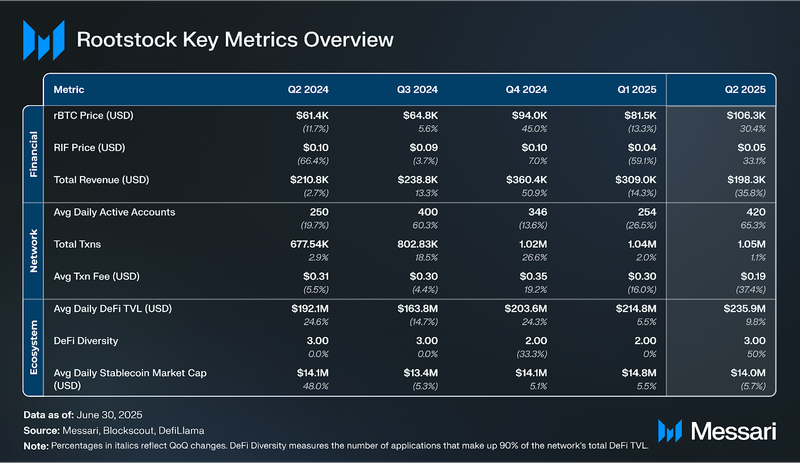
- Rootstock saw a significant increase in daily active addresses and new user onboarding in Q2, with active addresses up 65.3% QoQ and a record 8,307 new addresses. This growth was driven by new protocol integrations including Solv, LayerBank, and Midas, as well as ecosystem campaigns focused on staking and user engagement.
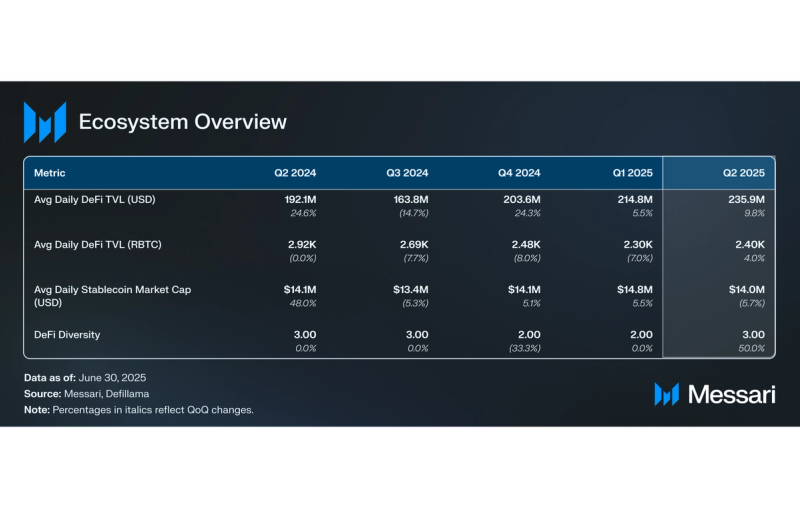
- Rootstock’s DeFi TVL rose 9.8% QoQ to $235.9 million in Q2, with Uniswap’s share expanding from $7 million to $35 million as liquidity deepened across major protocols.
- Merged mining participation reached an all-time high in Q2, averaging 87.1%, up from 81.1% in 2025 Q1, after the integration of Foundry, the world’s largest Bitcoin mining pool.
- USDT0, Tether’s omnichain stablecoin, went live on Rootstock in Q2, expanding access to composable dollar liquidity across the BTCFi ecosystem and supporting cross-chain DeFi integrations.
- Rootstock Institutional was introduced by RootstockLabs to support bitcoin treasury companies, trading funds, and financial institutions in accessing opportunities within Rootstock’s Bitcoin DeFi ecosystem.
Primer
Rootstock is a permissionless Bitcoin sidechain that launched its mainnet in January 2018. The project extends Bitcoin by enabling smart contract functionality while preserving Bitcoin’s security and monetary properties. Rather than introducing a native token, Rootstock uses BTC as its base asset in the form of “programmable Bitcoin” (rBTC), a token that maintains a two-way peg to Bitcoin.
rBTC is used for gas fees on Rootstock. The token allows owners to interact with decentralized applications (dApps) on the Rootstock network for minting, swaps, and more. rBTC uses the Powpeg bridging system that connects Bitcoin and Rootstock.
Rootstock secures its network using merged mining and Deterministic Conflict Resolution (DECOR+) consensus, a Proof-of-Work (PoW) protocol that maintains the Bitcoin block format.
Rootstock has several additional components, such as the Rootstock Virtual Machine (RVM), a forked version of the Ethereum Virtual Machine (EVM) that allows for high compatibility with EVM. Rootstock also features the Rootstock Infrastructure Framework (RIF), a utility token designed to scale Bitcoin utility by powering governance and grants through the RootstockCollective DAO. It also powers comprehensive blockchain-based infrastructure services such as the RIF Token, RIF Wallet, rBTC Flyover, RNS (RIF Name Service), and RIF Relay.
For a complete primer on Rootstock, refer to the Initiation of Coverage report.
Website / X (Twitter) / Telegram
Key Metrics
Performance Analysis
Financial Overview
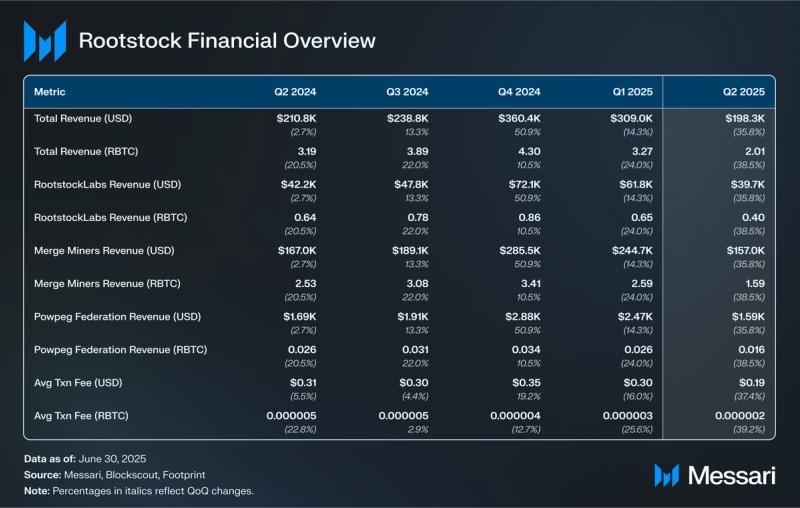
Rootstock’s average transaction fees fell to just $0.19 (0.000002 rBTC) in Q2 2025, the lowest in the past five quarters. This reduction followed network optimizations implemented earlier in the year by Rootstock’s merge-mining partners and core contributors, which lowered user costs by over 60%. While these changes improved accessibility, they also contributed to a 35.8% QoQ decline in total revenue, which fell to $198,290. The updated fee structure enhances Rootstock’s competitiveness by making the network more affordable for users and developers, particularly for applications requiring high transaction throughput or cost-sensitive interactions. Over time, this positions the network to attract a broader set of use cases and user segments, though sustaining protocol-level revenue will require continued growth.
Network Overview
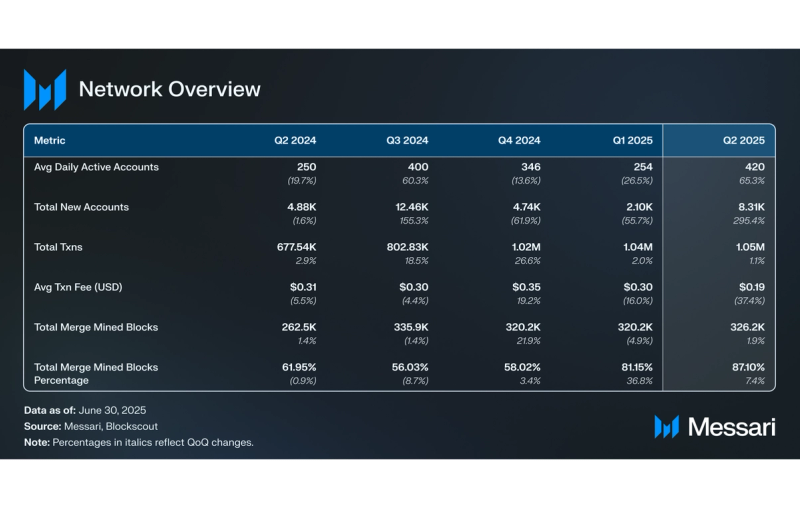
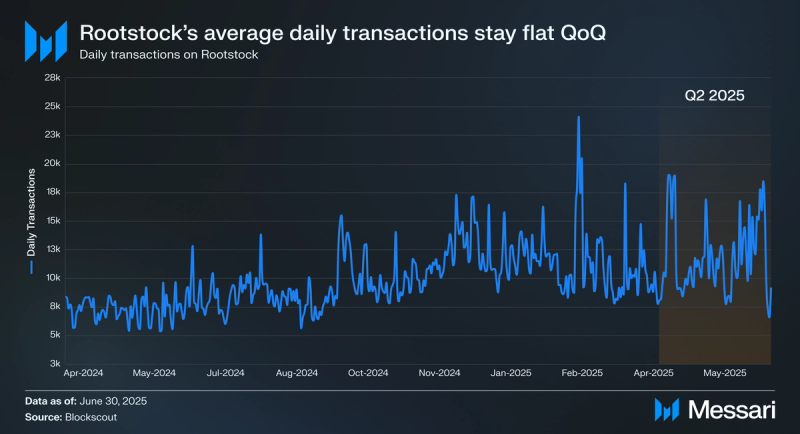
Rootstock’s daily transaction activity remained steady in Q2 2025, posting a modest 1.1% increase in total transactions, from 1.04 million to 1.05 million QoQ. Daily transaction volumes hovered between 7,000 and 13,000 for much of the period, peaking near 23,000 but failing to sustain any upward breakout.
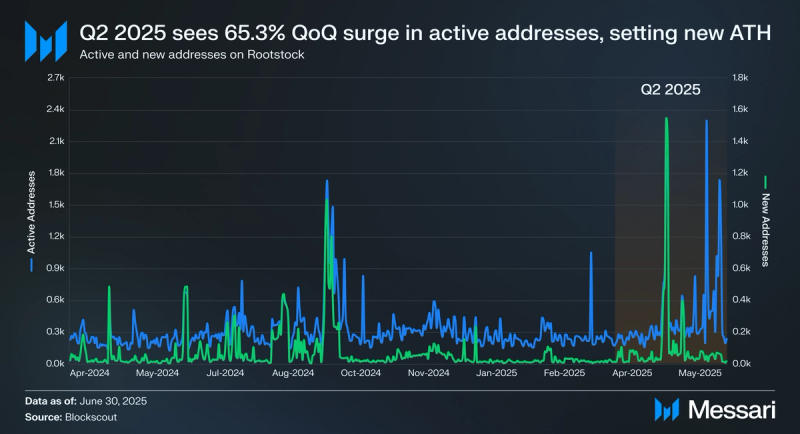
Rootstock staged a strong rebound in user activity during Q2 2025. Average daily active addresses surged 65.3% QoQ to 420, up from 254 in Q1 2025. New addresses reached an all-time high of 8,307, nearly a fourfold increase from the previous quarter’s 2,101. This growth was most evident in mid-May when new account creation peaked with over 1,500 new addresses in a single day. Active addresses reached a high in mid-June, with more than 2,200 active users, far surpassing the baseline of previous months.
This spike aligns closely with Rootstock’s Staking Surge campaign, a community initiative aimed at encouraging broader exploration of staking and liquidity functionalities within the Rootstock ecosystem. The campaign, which ran from May 15 to June 14, 2025, likely played a central role in driving both the influx of new accounts and the increase in active user participation, as users were attracted by the yield incentives and the network’s expanded DeFi capabilities.
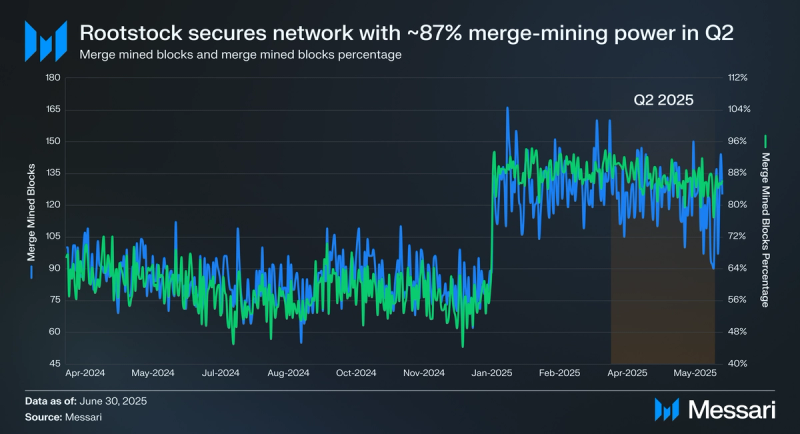
In Q2 2025, Rootstock maintained a strong security posture through consistently high levels of merged mining participation. The average merged mining percentage increased to 87.1%, up from 81.1% in Q1, reinforcing Rootstock’s alignment with Bitcoin’s hash power and enhancing resistance to potential attacks. In addition to the higher participation rate, the total number of merged mined blocks also rose to 11,444, reflecting an 8.2% QoQ increase.
Ecosystem Overview
DeFi TVL
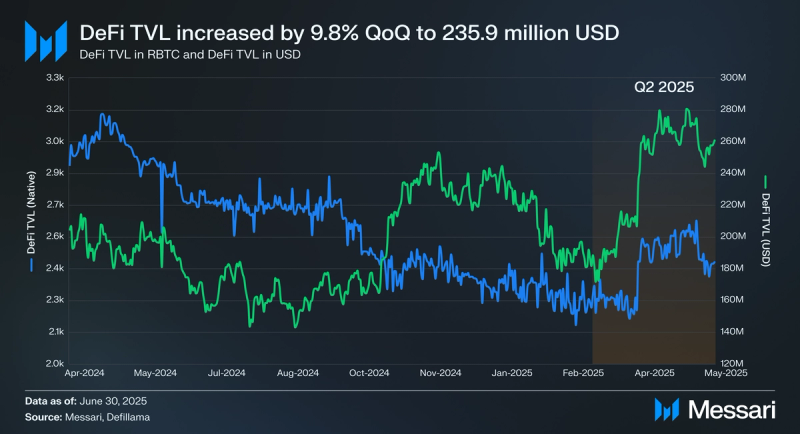
Rootstock’s DeFi TVL saw a strong rebound in Q2 2025, with USD-denominated TVL rising 9.8% QoQ to $235.9 million. This recovery marked a sharp reversal from the lows recorded earlier in the year. In April, TVL briefly surged past $260 million before stabilizing near $236 million by the end of the quarter. The increase in capital allocation to Rootstock DeFi protocols was likely tied to the Staking Surge campaign, which helped attract renewed user engagement and liquidity inflows, as well as ecosystem integrations with protocols like Solv, LayerBank, and Midas.
Stablecoins
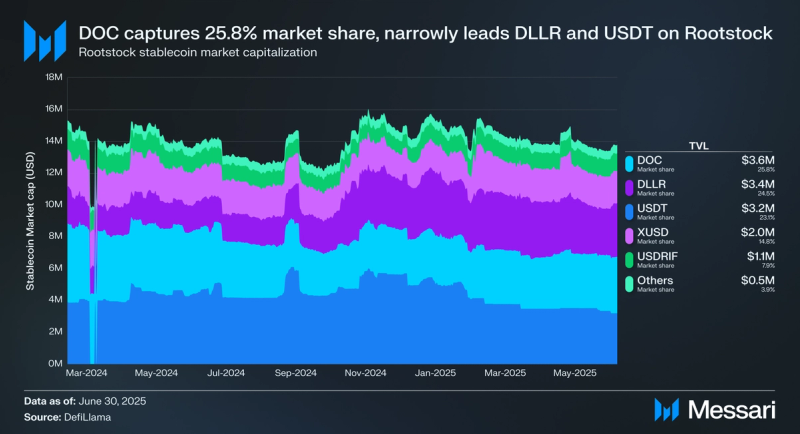
In Q2 2025, DOC led Rootstock’s stablecoin market with a 25.8% share and $3.6 million in TVL, narrowly ahead of DLLR (24.5%) and USDT (23.1%). The three stablecoins together account for nearly three-quarters of the market, reflecting a relatively balanced distribution among the top issuers. While overall stablecoin market capitalization on Rootstock has declined slightly from its late-2024 peak, market share volatility has remained low, suggesting entrenched user preferences. XUSD, USDRIF, and smaller issuers make up the remaining 26.6%, with XUSD holding a 14.8% share.
DeFi TVL by protocol
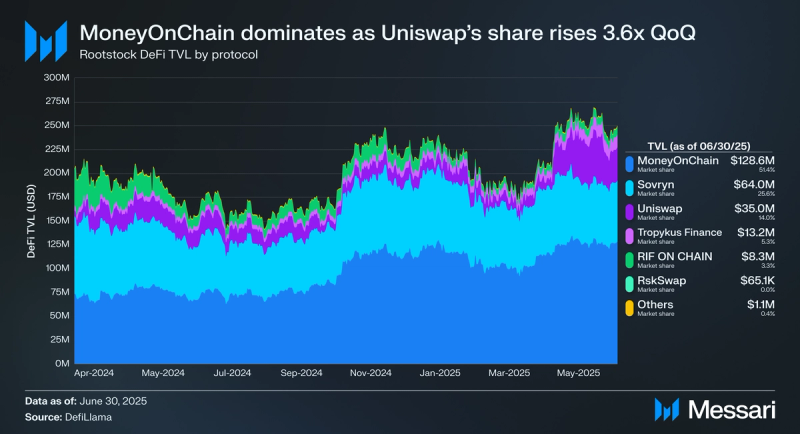
As of Q2 2025, MoneyOnChain retained its dominant position within Rootstock DeFi, accounting for $128.6 million in TVL, or 51.4% of the total, up 29.3% QoQ. The quarter also saw a material shift in Uniswap’s share, with TVL increasing by 400% from $7.0 million to $35.0 million, raising its market share from 3.3% to 14.2%. Uniswap’s gain in market share coincided with relative declines in some smaller protocols such as RIF On Chain and Tropykus, whose TVLs remained stable or grew at a slower pace. Sovryn remained the second-largest protocol by TVL, rising 4.0% from $61.5 million to $64.0 million, though its relative market share declined slightly from 28.9% to 26.0%. The structural concentration of liquidity persists, with MoneyOnChain and Sovryn jointly accounting for 77% of Rootstock DeFi TVL. However, Uniswap’s recent growth signals a potential shift in liquidity preferences.
Ecosystem Highlights
Union Bridge Establishes Secure BTC Interoperability
Fairgate, in collaboration with Rootstock Labs, announced Union Bridge, a trust-minimized Bitcoin bridge powered by BitVMX. Unlike custodial or federated bridges, Union Bridge enables trust-minimized transfers between Bitcoin and Rootstock without relying on trusted intermediaries.
The process is governed by an optimistic verification framework: peg-out requests are verified by a decentralized and independent set of protocol participants that can be challenged via fraud proofs on Bitcoin. In cases where the approval is delayed, operators may front the BTC, which is recoverable only if no valid fraud proof is submitted during the dispute window.
BitVMX FORCE Launched to Advance Bitcoin’s Scalability
Fairgate, RootstockLabs, and Input | Output introduced BitVMX FORCE, a collaborative alliance to expand Bitcoin’s computational capabilities through the BitVMX framework. The initiative brings together expertise in research, infrastructure, and applied engineering to standardize and advance disputable computing on Bitcoin.
BitVMX extends the BitVM model to N-party disputable computation, enabling complex operations while preserving Bitcoin’s security guarantees. Through RISC-V compatibility, BitVMX integrates with existing development toolchains, allowing builders to deploy Bitcoin-native applications without specialized infrastructure. BitVMX FORCE will coordinate research, protocol upgrades, and adoption pathways, with an emphasis on ensuring compatibility with future Bitcoin soft forks.
Midas Brings Yield-Bearing Bitcoin and Treasury Tokens to Rootstock
Midas has launched two yield-bearing tokens, mBTC and mTBILL, on Rootstock, expanding access to Bitcoin-native DeFi and tokenized RWAs. mBTC is a permissionless token that distributes Bitcoin-denominated rewards and integrates with EVM-based protocols, initially supporting wrapped Bitcoin variants like wBTC and cbBTC with a target yield of 4%. In parallel, mTBILL provides onchain exposure to short-dated U.S. Treasuries through fractionalized ownership of ETF-backed assets. Issued by Midas, a regulated German platform, mTBILL is designed for retail accessibility with no minimum investment.
Solv Protocol Unlocks Native Bitcoin Liquidity on Rootstock
Solv Protocol has integrated with Rootstock to bring BTC directly into DeFi through rBTC and SolvBTC. This enables users to stake, lend, and access yield strategies while remaining secured by Bitcoin’s PoW consensus. rBTC, Rootstock’s Bitcoin-pegged asset, provides a trust-minimized bridge to deploy BTC across EVM-compatible dApps, while SolvBTC introduces a liquid staking model tailored for Bitcoin capital.
USDT0 Brings Omnichain Stablecoin Liquidity to Rootstock
USDT0, the omnichain version of Tether’s USDT, is now live on Rootstock. This integration enables users to access dollar-denominated liquidity within Rootstock’s Bitcoin-secured DeFi ecosystem. USDT0 moves natively across chains via LayerZero’s OFT standard, offering a composable and frictionless stablecoin experience. It removes fragmentation, improves trade execution, and simplifies stablecoin access for users and builders across the Rootstock ecosystem.
RSK Meme Token Launchpad Democratizes Token Creation on Rootstock
The RSK Meme Token Launchpad introduced an accessible platform for creating tokens on Rootstock without requiring technical expertise. Built on Rootstock’s EVM-compatible sidechain, the launchpad allowed users to design and deploy tokens in minutes while inheriting Bitcoin’s PoW security. Initially deployed on testnet, the platform simplified token configuration, deployment, and liquidity integration, with plans for advanced tokenomics, DAO governance, and cross-chain support after mainnet launch.
LayerBank Expanded Lending Access on Rootstock
LayerBank, a decentralized lending protocol, integrated with Rootstock to bring Bitcoin-backed borrowing and lending to the BTCFi ecosystem. The integration enabled users to supply rBTC and other assets on Rootstock to earn yield or take out overcollateralized loans.
BitMask was integrated with Rootstock
BitMask was integrated with Rootstock enable Bitcoin-secured smart contracts, combining BitMask’s RGB wallet infrastructure with Rootstock’s EVM-compatible ecosystem.
syBTC Went Live on Rootstock
Symbiosis, a cross-chain liquidity protocol, integrated with Rootstock to expand Bitcoin access within its ecosystem. The collaboration introduces syBTC, Symbiosis’s native bridged Bitcoin asset, which allows users to transfer BTC into Rootstock’s EVM-compatible environment. Once on Rootstock, syBTC can be used for stablecoins, lending, and yield strategies while benefiting from Bitcoin-backed value and faster settlement.
Toaster Finance was deployed on Rootstock
Toaster Finance, a DeFi platform specializing in yield farming and auto-compounding strategies, integrated with Rootstock to extend its offerings to Bitcoin-secured smart contracts. Through this integration, users gain access to multiple liquidity pools, staking opportunities, and automated yield optimization while benefiting from Rootstock’s EVM-compatible ecosystem anchored to Bitcoin’s security.
Roadmap Progress
In Q2 2025, Rootstock’s community advanced two key milestones outlined in its roadmap. First, the network integrated Solv Finance to introduce Bitcoin-native liquid staking, giving retail and institutional users access to yield-generating opportunities without compromising liquidity or Bitcoin’s PoW security. Second, Rootstock expanded its BTCFi ecosystem, delivering sustainable yield opportunities through Rootstock-native DeFi protocols. By leveraging rBTC as programmable Bitcoin, users can access diversified strategies and organic returns.
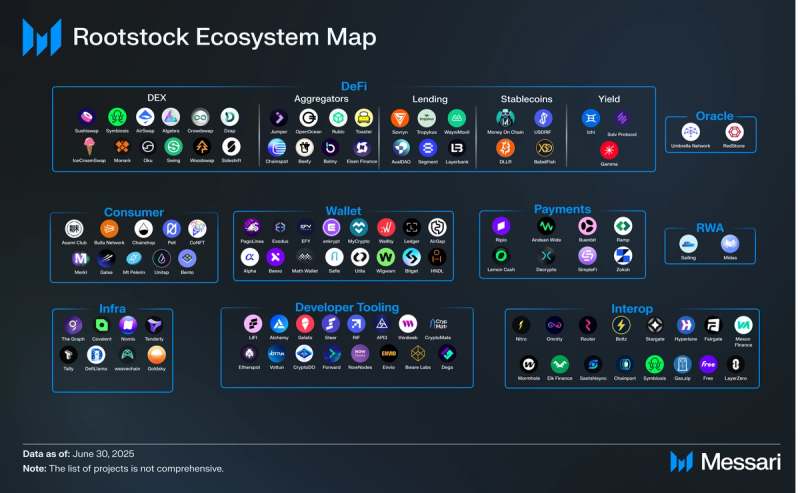
A complete list of the projects being built can be seen via Rootstock’s Ecosystem Portal.
Technical Developments
Reed Network Upgrade Proposal
In June 2025, RSKIP-518, a consensus-level network upgrade codenamed Reed, was proposed on Rootstock with a focus on enhancing the PowPeg bridge. The upgrade aims to lower the cost of peg-out transactions, which are used to convert rBTC back into BTC, and to broaden participation among pegnotaries, the entities that co-sign peg operations using secure hardware and monitor Rootstock’s two-way peg with Bitcoin.
Several additional RSKIPs were included under the Reed proposal, with some marked testnet-only to allow phased testing before potential mainnet deployment. These include enhancements tied to the Union Bridge initiative, which explores a more trust-minimized bridge design using BitVMX. Key proposals include RSKIP-305 for Segwit-based peg-out efficiency, RSKIP-502 for new bridge methods, and RSKIP-516 for cryptographic precompiles.
Difficulty Adjustment Proposal
In June 2025, a proposal was introduced to improve block time consistency in Rootstock by modifying its difficulty adjustment algorithm. The current system adjusts mining difficulty after every block using very short-term data, which makes it highly sensitive to variance. As a result, minor fluctuations in network conditions, including the presence of “uncle” blocks, can cause sharp swings in difficulty and unstable block times.
RSKIP‑517 proposes a more resilient approach that recalibrates difficulty using a sliding window of recent blocks rather than individual block timestamps. This windowed method smooths out noise and avoids overreacting to isolated anomalies. The proposal also introduces an “uncle threshold,” meaning uncle blocks would only influence difficulty once their frequency surpasses a defined limit.
This change aims to reduce volatility in block production and lay the foundation for a faster and more predictable block interval, ultimately enhancing transaction finality and user experience on Rootstock.
Attestation Service Launch
In May 2025, the Rootstock Attestation Service (RAS) was launched in Rootstock via Explorer v3, allowing users and developers to issue and verify claims onchain. These attestations can be stored directly on Rootstock for permanence or offchain with cryptographic references, giving users flexibility depending on privacy and storage needs.
RAS supports a wide range of use cases, including identity verification, document notarization, supply chain tracking, and credential issuance. Inspired by the Ethereum Attestation Service (EAS) framework, RAS provides developers with a ready-to-use foundation to integrate attestations into dApps secured by Rootstock’s Bitcoin-backed infrastructure.
Lovell 7.1.0 Release
RSKj Lovell 7.1.0 was released in Rootstock, introducing several enhancements aimed at improving node performance, usability, and developer compatibility. This new version includes SnapSync, an experimental fast sync mode that accelerates node setup by downloading a snapshot of the blockchain state instead of syncing the entire history. It also improves the Fiat Stable MinGasPrice feature by allowing predefined gas price ranges, enhances upgrade awareness through warning messages for disabled upgrades, and increases Ethereum compatibility by adding mixHash and nonce fields to block JSON-RPC responses.
Improved Bitcoin Bridging
PowPeg App version 2.6 and Flyover version 2.1.2 were upgraded on Rootstock, delivering improvements to both security and user experience. PowPeg now verifies the user’s return address before initiating a transfer, reducing the risk of misdirected funds and enhancing bridge safety. Flyover (Powpeg Fast Mode) was also upgraded to support larger transactions, increasing the maximum transfer size to 5 BTC. Additionally, Flyover’s processing time was significantly reduced, allowing for faster Bitcoin transfers while maintaining robust security guarantees.
Integration with The Graph
Rootstock completed the Chain Integration Process with The Graph, unlocking indexing rewards for developers. This integration allows dApps built on Rootstock to access fast and reliable onchain data through The Graph’s decentralized network of indexers.
Community Updates
Governance
RootstockCollective Concluded First Delegate Race: RootstockCollective completed its first two-week delegate race following its onboarding with Tally.xyz, inviting community members to become key decision-makers in the DAO. Participants campaigned to receive stRIF delegation, with the top six earning official recognition and increased visibility within governance. Recognized Delegates are expected to represent token holders, engage in proposal discussions, and vote responsibly to help shape the DAO’s direction.
RootstockCollective V4.3: The release introduced UX and infrastructure improvements, including clearer proposal titles for easier browsing, more consistent icon usage across community and delegation views, and technical upgrades such as migrating to Next.js 15.2.4, TailwindCSS 4.1.3, and replacing ethers.js with viem.
RootstockCollective Shepherds Program: RootstockCollective introduced its first cohort of “Shepherds,” a group of governance-focused contributors supporting DAO decentralization. The initial group includes Arana Ventures, PGov, StableLab, Avantgarde, and Chrono Triggered, each bringing expertise across governance, operations, treasury management, and Bitcoin ecosystems. These Shepherds will guide protocol decisions and help strengthen the Collective’s institutional governance framework.
RootstockCollective Triple Airdrop: RootstockCollective launched three simultaneous airdrops to mark its six-month milestone and integration with Tally.xyz. The program included (1) a referral airdrop, rewarding users who invited friends to stake at least 25,000 RIF; (2) a welcome airdrop for new members staking 25,000 RIF for one month; and (3) an engagement raffle, encouraging participants to promote the Collective on social media.
RootstockCollective x Reown Integration: RootstockCollective integrated Reown’s AppKit to expand wallet compatibility and reduce onboarding friction for DAO participants. The upgrade extended support from two wallets to a broader set, including MetaMask, SafePal, Bitget Wallet, SubWallet, Wigwam, and Rabby, significantly lowering technical barriers to participation.
RootstockCollective x Bitcoin Pizza Campaign: RootstockCollective launched a limited-time staking campaign incentivizing first-time RIF stakers with entries into a raffle for the Pizza Ninja NFT. Participants earned one raffle ticket per 100 RIF staked every 24 hours, capped at 60 entries per wallet.
Campaigns & Developer Initiatives
The AI BUIDL Lab Hackathon wrapped up with 211 participants and 90 project submissions, marking a strong showing for AI-integrated applications on Rootstock. Hosted on DoraHacks and backed by partners like Thirdweb and Alchemy, the hackathon featured three main tracks and two bounty categories. Here are the winners:
- DeFi & Payments
- ProtectedPay: Enables secure, escrow-protected crypto transfers to prevent errors and scams.
- AiFi: An AI-powered DeFi hub focused on remittances and micro-lending for Latin America.
- Commerce & Gig Economy
- Identity & Reputation
- Bounties
- AuditFi: An AI tool for evaluating smart contract security and trust.
- RSK Smart Yield Engine: A dynamic yield optimizer for RSK-based DeFi, built using AI design sprints.
Rootstock Staking Surge Campaign Launch: Rootstock community members ran the Staking Surge campaign, running from May 15 to June 14, with a $390,000 rewards pool to incentivize DeFi participation across the Solv Protocol and Pell Network. Participants earned rewards by staking rBTC, WrBTC, and SolvBTC, adding liquidity on Rootstock DEXs, and completing social tasks. The campaign was split into two parts: Solv Protocol offered $300,000 in rewards for liquidity providers on Sushi, Oku, and WoodSwap, while Pell Protocol allocated $90,000 across staking incentives and raffle prizes.
Rootstock Gas Slash Campaign Wrap-Up: Rootstock community members concluded the Gas Slash Campaign with over $6,000 in RTBC and gas fee savings distributed to more than 60 wallet addresses in the form of RIF rewards. RIF token holders can now stake in RootstockCollective, vote on DAO proposals, and support Bitcoin-centric builders. The campaign encourages continued engagement through programs like Hacktivator, which rewards contributors across development, design, translation, and community roles.
Rootstock x Binance Academy’s Learn & Earn Launch: RootstockLabs, member of the Rootstock community partnered with Binance Academy to launch a Learn & Earn campaign, inviting users to explore Bitcoin DeFi through educational content. Participants who complete the Rootstock module and pass a short quiz are eligible to earn RIF token rewards.
Closing Summary
In Q2 2025, Rootstock recorded a sharp rebound in user activity. Average daily active addresses rose 65.3% to 420, while new addresses reached an all-time high of 8,307, supported by incentive programs and expanded protocol integrations. Transaction fees declined more than 60% to $0.19 following network optimizations, improving accessibility but reducing quarterly revenue by 35.8%. DeFi TVL increased 9.8% to $235.9 million, with MoneyOnChain retaining its leading share and Uniswap’s liquidity growing more than fourfold. Stablecoin adoption remained evenly distributed across DOC, DLLR, and USDT.
Ecosystem growth was reinforced by the addition of lending, staking, and yield protocols, including Solv, LayerBank, Midas, and Toaster Finance. The launch of USDT0 introduced omnichain stablecoin liquidity, while technical progress included the Attestation Service, RSKIP-517 to improve difficulty adjustment, and the Reed upgrade proposal (RSKIP-518) to strengthen bridging. Rootstock closed the quarter with higher user participation, deeper liquidity, and incremental improvements in network infrastructure.