Key Insights
- Total network fees rose 324% QoQ, reaching a new all-time high. Etherlink contributed 74% of this volume, marking a major shift in activity from L1 to L2. The surge in fees reflects growing engagement from both users and developers.
- Etherlink processed 20.5 million transactions in Q2’25. A 474% increase from the previous quarter, driven by the rollup’s Mainnet launch, illustrates the network’s position as an important execution environment within the Tezos ecosystem.
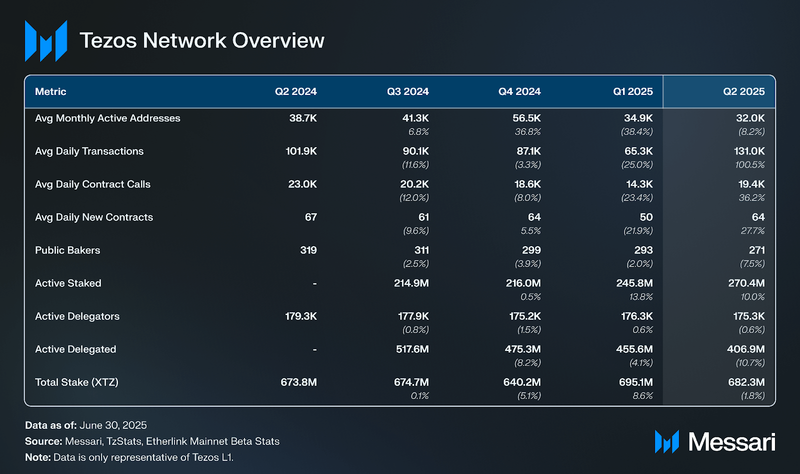
- Validator participation declined modestly. Publicbaker count fell 7.5% to 271, while active stake rose 10%. Maintaining staking levels aligned with the protocol’s 50% target, suggesting continued security.
- The Rio upgrade modernized Tezos’ protocol architecture. The upgrade reduced network cycle time from three days to one, improved validator responsiveness, and allocated 10% of participation rewards to validators supporting the DAL.
- RISC-V support was introduced. This will allow developers to build more complex rollups using features like runtime code generation and fine-grained gas metering. It complements, but does not replace, existing WebAssembly-based rollups.
Primer
Tezos (XTZ) is a Proof-of-Stake (PoS) blockchain network known for its strong focus on security, upgradeability, and democratic community governance. Its smart contracts on Layer-1 (L1) are implemented using the Michelson language, designed to facilitate formal verification while also offering Ethereum virtual machine (EVM) compatibility through Etherlink, a community-supported Layer-2 (L2). The network features onchain governance and self-amending functionality, enabling stakeholders to adopt protocol upgrades without requiring a network hard fork.
Recent upgrades on Tezos have focused on scalability and performance through Smart Rollups and a Data Availability Layer (DAL). The Mumbai upgrade introduced Smart Rollups, a L2 scaling solution that enables throughput beyond 1 million TPS and customization to adapt to specific use cases, such as implementing new coding environments. The Paris upgrade reduced L1 block time from 15 to 10 seconds, bringing 20-second finality. It also introduced the DAL, a data-availability solution that boosts Smart Rollup scalability and is part of the Tezos protocol. The DAL is now active on mainnet, and it is supported by a majority of validators, completing its integration with L1 consensus. Finally, the Paris upgrade implemented a new staking mechanism and Adaptive Issuance, which adjusts token issuance based on the staked ratio of XTZ.. Current R&D work from teams across the ecosystem focuses on realizing ‘Tezos X,’ a proposed roadmap for boosting the blockchain’s performance, composability, and interoperability, with the goal of delivering a “cloud-like” developer experience. Leveraging Smart Rollup technology and the data-availability layer, it enables developers to build complex, scalable applications using mainstream programming languages, with improved connectivity across the ecosystem.
Website / X (Twitter) / Discord
Key Metrics
Financial Overview
Revenue
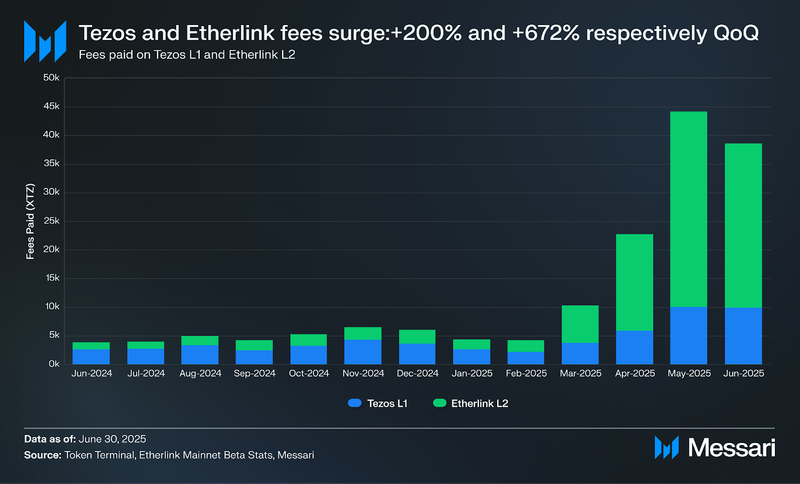
In Q2’25, total fees paid on Tezos L1 and Etherlink surged to 29,844 XTZ and 79,584 XTZ, respectively. This marked a 200% QoQ increase for Tezos L1 (up from 9,832 XTZ in Q1’25) and a 672% increase for Etherlink (up from 10,302 XTZ). The sharp uptick in Etherlink fees reflects accelerating usage of the rollup, following its mainnet beta release in March. By June, Etherlink fees made up over 74% of total network fees, reflecting a transfer of activity from L1 to L2.
Supply and Market Capitalization
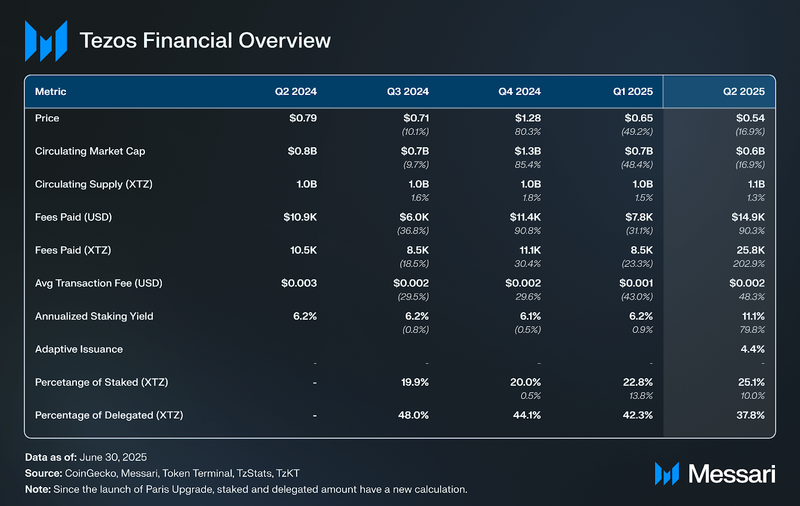
XTZ, the native token of Tezos, is used as a medium of exchange and for staking, delegating, and facilitating governance. As of the end of Q2, the circulating supply was 1.1 billion XTZ. The Paris upgrade that launched in 2024 introduced the Adaptive Issuance mechanism, which is designed to incentivize a secure network while keeping inflation at a minimum. The target for staking is 50% of the total XTZ supply, and the mechanism dynamically adjusts staking rewards to achieve this with the least possible XTZ issuance. The aim is to minimize the dilution of XTZ, improve liquidity, reduce inefficiencies, and make XTZ better suited for real-world use cases. In Q2, the annualized real yield for validators was 1.6%, with a QoQ increase of 1.3%.
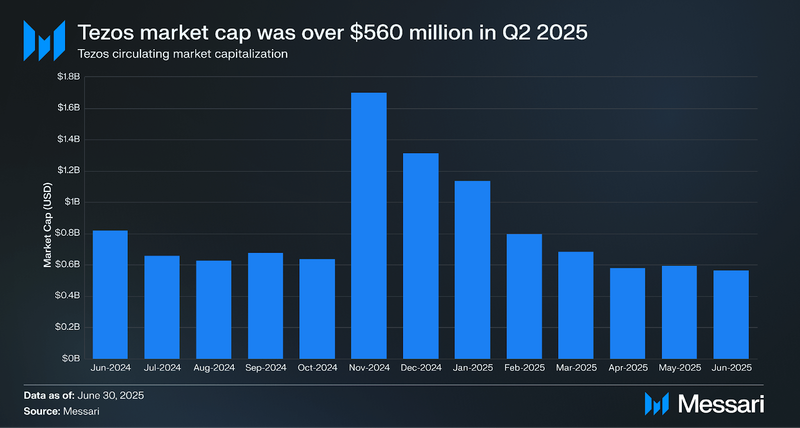
Tezos’ circulating market capitalization declined 17.8% QoQ to approximately $560 million by the end of Q2’25. The contraction follows a 48.4% drop in Q1 and reflects continued softness in the broader market, despite a sharp rebound in network usage and fees paid.
Network Overview
Usage
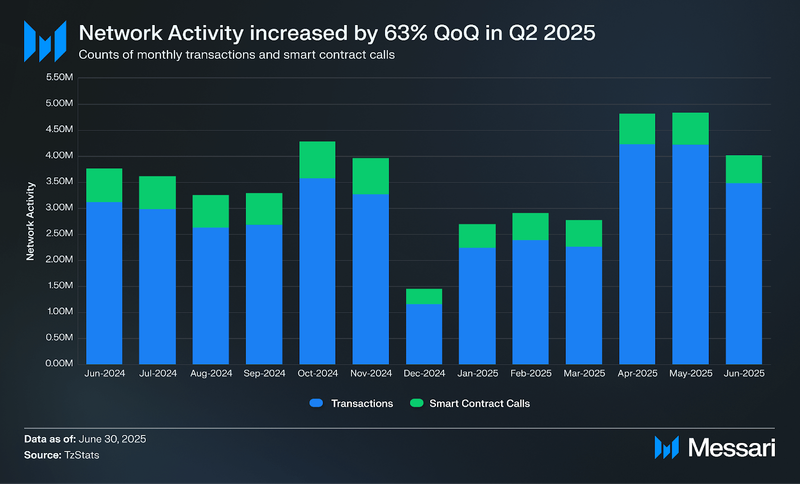
Network activity on Tezos L1 rose 63.1% QoQ in Q2’25, reaching an average of 4.0 million transactions and contract calls per month, up from 2.4 million in Q1. Activity growth was driven by a broad rebound in transaction throughput, including increases in both standard transfers and smart contract calls. The spike coincides with rising demand for blockspace on Tezos L1 and Etherlink L2, suggesting a coordinated upswing in user engagement across the ecosystem.
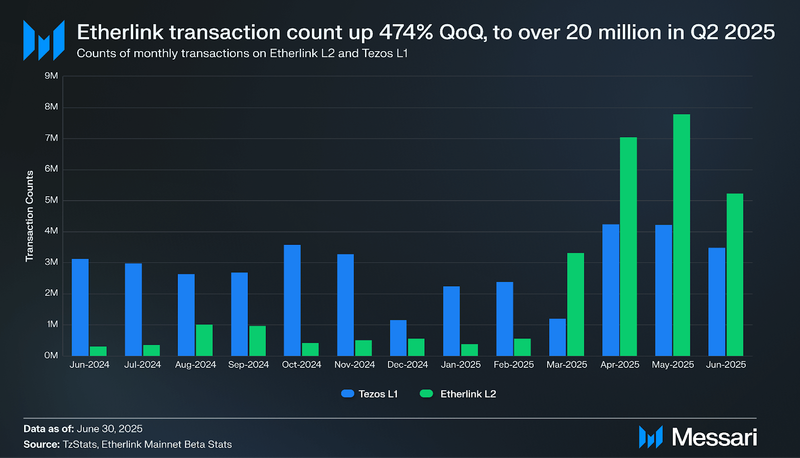
Etherlink processed 20.5 million transactions in Q2’25, a 474% QoQ increase from 3.6 million in Q1. The surge followed the launch of its Mainnet Beta in March and reflects the rollup’s rapidly expanding usage. For the quarter, Etherlink accounted for 64% of all Tezos ecosystem transactions, overtaking L1 volume and reflecting its emerging role as the primary execution layer within Tezos’ modular architecture.
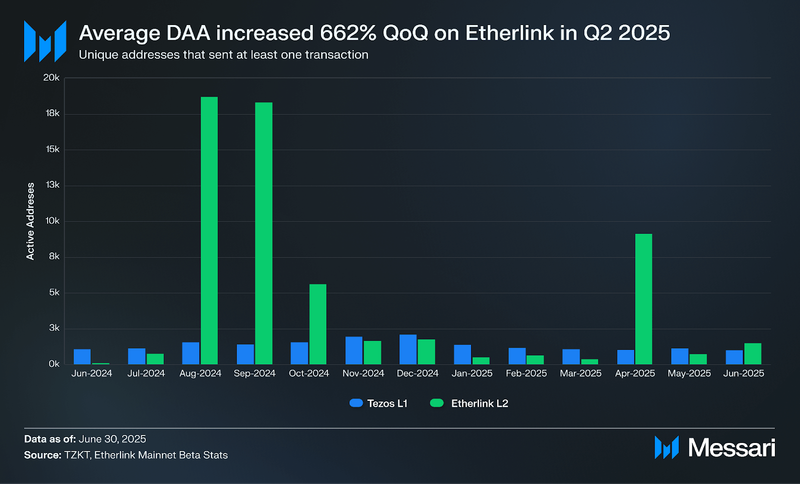
In Q2 2025, daily active addresses (DAA) on Tezos L1 fell 7% QoQ, averaging 1,040 unique addresses per day. However, on Etherlink, DAA increased 662, averaging over 1400 DAA in June, demonstrating strong user adoption of the Etherlink L2 and broader Tezos X ecosystem.
Network Upgrades
Rio Protocol Upgrade (Activated May 1, 2025)
The Rio upgrade marked Tezos’ 18th protocol upgrade and was activated following community governance approval. Developed by Nomadic Labs, Trilitech, and Functori, Rio introduced changes aimed at improving scalability, staking mechanics, and validator participation.
Key Changes Introduced:
- Data Availability Layer (DAL) Incentives: Rio adjusted the reward model by allocating 10% of participation rewards to validators operating DAL nodes. The DAL only activates when at least 66% of baking power participates. Validators who fail to participate forfeit DAL rewards. Attestations are considered valid if 64% of assigned data is covered. Dishonest attestations result in forfeiture of DAL rewards but do not trigger slashing.
- Shortened Network Cycles: The network cycle duration was reduced from approximately three days to one day. This change decreased the time required for staking-related operations to finalize:
- Unstake finalization time decreased from ten to four days.
- Consensus rights updates now occur in two days instead of six.
- Staking parameter changes apply after five days, down from 14.
- Consensus key activation and deactivation delays shortened from six to two days.
- Attestation rewards are now distributed daily.
The 14-day governance period remained unchanged.
- Baker Inactivity Rules: To improve network responsiveness, the threshold for inactivity was reduced. Bakers are now marked inactive after two days instead of eight, and can return to active status after another two days instead of 6 days. Inactive bakers lose consensus rights and must re-register to resume participation.
- Transaction Fee Adjustment: A fix to the gas model increased fees for transactions between implicit accounts by 0.0002 tez to better reflect storage usage. Smart contract transaction costs remained unchanged.
- Stakeholder Participation: The upgrade was supported by broad community involvement throughout its governance phases, with optional testing available on the ‘rionet’ testnet and a release candidate bundled in.
RISC-V Toolkit Expansion (Announced June 30, 2025)
In June 2025, Tezos announced the addition of RISC-V support to its developer toolkit. RISC-V is a low-level, open-source instruction set architecture known for its minimalism and adaptability. Unlike WebAssembly, which prioritizes portability but lacks support for advanced functionality such as runtime code generation or precise gas metering, RISC-V provides developers with greater control over execution logic.
The Tezos development teams built a RISC-V interpreter in Rust and began integrating it into the smart rollup infrastructure. This enables support for complex, performance-sensitive applications, including fraud-proof generation and just-in-time compilation. Existing WebAssembly-based rollups remain fully operational and are unaffected by the change. The introduction of RISC-V is intended to offer developers an additional, more flexible execution environment and does not require any underlying protocol modifications.
Development
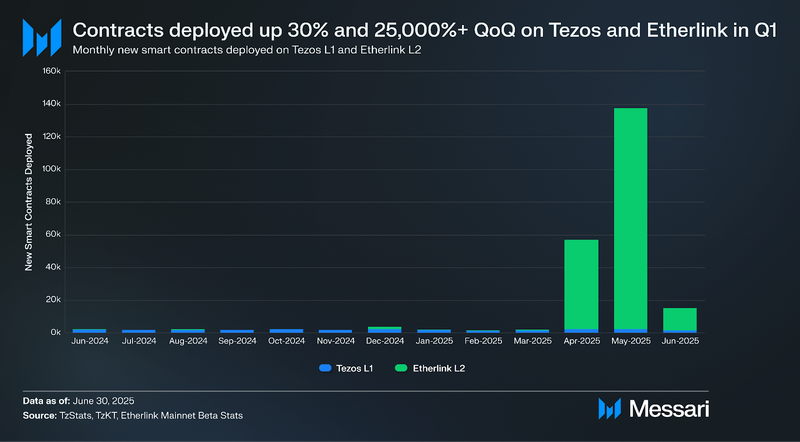
Over 209,000 smart contracts were deployed across Tezos L1 and Etherlink in Q2’25, driven almost entirely by activity on Etherlink. Contract deployments on Etherlink surged to 203,223, up 25,102% QoQ from just 806 in Q1. Tezos L1 deployments increased modestly to 5,816, a 30.6% QoQ rise. The spike on Etherlink reflects accelerated onboarding and testing activity following its Mainnet Beta launch, with deployment volume peaking in May.
As of June 2025, Tezos continues to maintain a growing base of active open‑source contributors, with 167 monthly active developers working across more than 3,700 Git repositories, up slightly from Q4 2024.
Security
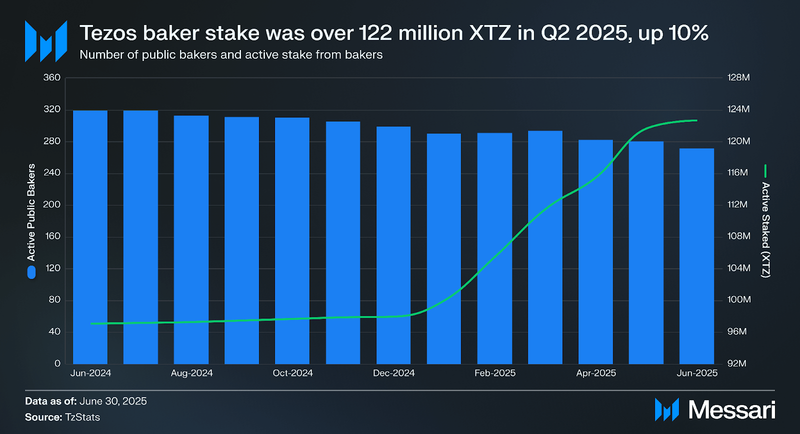
Tezos uses a Liquid Proof-of-Stake (LPoS) mechanism, which requires validators (known as “bakers” in the Tezos ecosystem) and delegators to stake XTZ as collateral to secure the network. Rewards and fees collected from transactions are paid to validators and delegators to maintain the network. In Q2’25, the number of active public validators declined 7.5% QoQ, from 293 in March to 271 in June. Public validators make a fraction of the total validator set. Active validator stake increased 10% over the same period, increased from 111.5 million XTZ to 122.7 million XTZ. Despite the ongoing downtrend in public validator participation, overall staking levels have seen significant growth, indicating continued network security and economic alignment among participants.
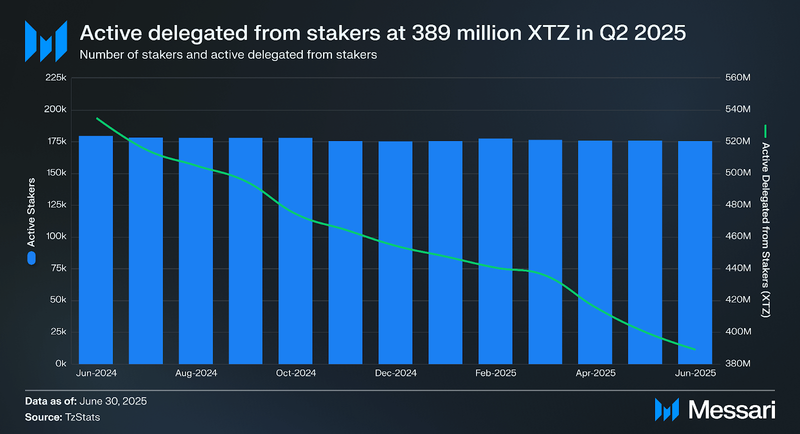
Stakers delegate XTZ on active validators and receive a portion of fees and rewards collected. In Q2’25, the number of active stakers remained steady at approximately 175,272, showing no material change QoQ. However, delegated XTZ from stakers declined by 11%, from 435.5 million XTZ at the end of Q1 to 389.0 million XTZ by the end of Q2.
Adaptive Issuance dynamically adjusts the issuance of XTZ based on the proportion of staked tokens to the total supply. At the end of each blockchain cycle, the issuance rate is modified to target a protocol-defined staking level, currently set at 50%. This mechanism incentivizes staking to provide stable security for the network.
The Tezos network has shown consistent year-over-year stability in the number of validators and delegators, as well as in staked XTZ. This stability is crucial for secure and scalable L2 growth. Validators in the ecosystem are also decentralized geographically and by host service providers, further ensuring the network’s resilience and security.
Governance
Tezos utilizes an LPoS mechanism, enabling staked XTZ to be used for both network security and governance. The network’s self-amending blockchain reduces the need for hard forks by employing onchain governance for protocol upgrades. Users delegate their XTZ to validators who participate in stake-weighted voting. The governance process is divided into five periods, spanning approximately two months and ten days.
To complement protocol governance, Tezos Commons established the Tezos Ecosystem DAO, which manages and allocates XTZ for community projects. The DAO’s initial funding came from NFT sales on Objkt and donations from ecosystem participants.
Etherlink follows an onchain governance model similar to Tezos L1, ensuring fairness and transparency. Governance for Etherlink is self-amending (meaning no hard fork), controlled by L1 bakers, and pilots both upgrades and the sequencer operator. The governance process fully happens on Tezos L1 through dedicated smart contracts, and consists of five stages: Proposal Period, Exploration Vote Period, Cooldown Period, Promotion Vote Period, and Adoption Period.. The Etherlink governance periods are synchronized with L1 governance periods.
Ecosystem Overview
Etherlink Adoption, Gaming, and NFTs
In Q2 2025, Etherlink continued to play a pivotal role in supporting the expansion of the Tezos ecosystem, facilitating growth across DeFi, gaming, and NFTs. As an EVM-compatible Layer 2 built on Tezos’ Smart Rollup technology, Etherlink delivers subsecond finality and low fees, while remaining anchored to Tezos’ secure and decentralized Layer 1 for settlement and governance. This quarter saw a surge in new activity, including incentive programs, infrastructure enhancements, and strategic partnerships. Together, these developments reinforced Etherlink’s role as a scalable execution layer that complements Tezos’ vision for a modular and layered blockchain architecture.
DeFi
Total value locked (TVL) in USD on Tezos increased 22.5% QoQ in Q2’25, rising from $30.7 million at the end of March to $37.6 million by June. In XTZ terms, TVL grew 45.8% QoQ, from 46.9 million XTZ to 68.4 million XTZ. This rebound reflects renewed inflows into Tezos-based DeFi protocols following the network’s broader usage uptick, as well as growing activity on Etherlink. The divergence between USD and XTZ-denominated TVL in prior quarters has narrowed, indicating stabilization in both asset prices and DeFi participation.
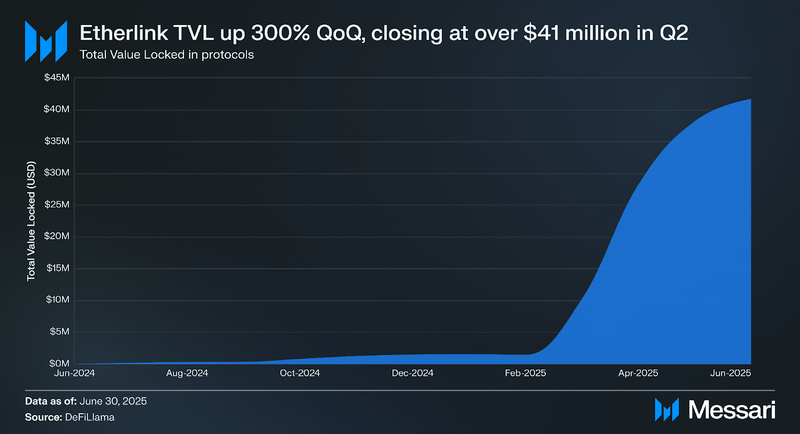
Etherlink’s total value locked (TVL) reached $41.7 million at the end of Q2’25, a 307% QoQ increase from $10.2 million at the end of Q1. Growth in TVL was consistent throughout the quarter, with TVL rising to $28.2 million in April, $38.2 million in May, and $41.7 million in June. The sharp increase reflects accelerating DeFi adoption on Etherlink as more protocols are deployed and liquidity is bridged into the network.
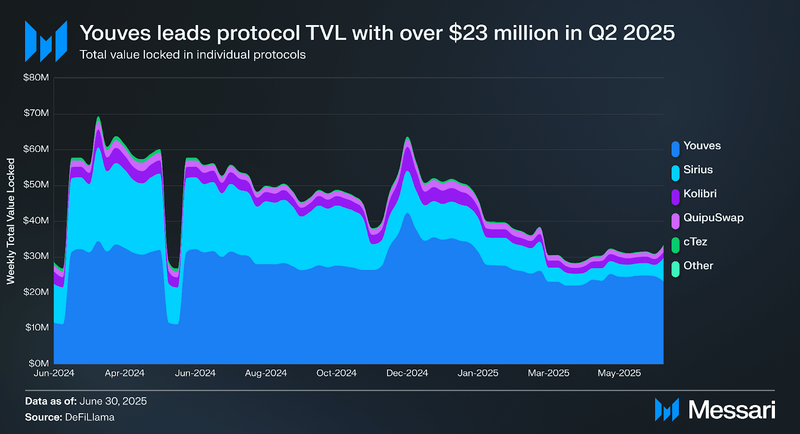
Youves remained the largest protocol by TVL in the Tezos ecosystem, with $23.1 million locked at the end of Q2’25, showing no material change from the previous quarter. Sirius recorded the largest gain, rising 65% QoQ to $6.5 million, overtaking Kolibri ($1.66 million) and QuipuSwap ($1.81 million). TVL in cTez declined to $213,000, while the Other category, which includes smaller or emerging protocols, more than doubled from $206,000 to $2.1 million.
On Etherlink, IguanaDEX remained the leading protocol with over $11 million in TVL, followed by Superlend at $5.5 million. New protocols like Uranium.io and Hanji Protocol continued gaining traction, with $6.7 million and $3.4 million in TVL, respectively. This reflects the growing diversity of DeFi use cases on Etherlink, particularly in real-world assets and financial inclusion.
Protocol Interactions
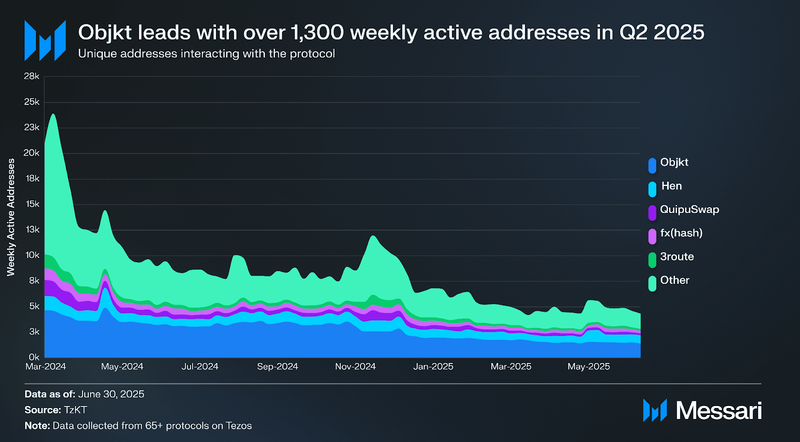
Objkt remained the leading protocol on Tezos by unique user activity, averaging over 5,560 monthly active addresses in Q2’25, though this marked a 5.1% decline QoQ from 5,860 in March. Despite the drop, Objkt continued to dominate the NFT category, maintaining the largest share of active users across the network.
Other NFT platforms like IINK saw gains in user engagement. After launching very early in Q2 2025, IINK reached 500+ collectors across 2000+ mints.
Art on Tezos was celebrated with events across the world, including several activations at NFC Lisbon with a mainstage show of Victor Doval’s collaborative project ‘Sum’ and a container gallery curated by XCOLLABZ. During NFT NYC, renowned gallery bitforms opened Zancan’s solo show, Tree_Line.
The Paintboxed Tezos World Tour culminated with a pivotal exhibition at the Digital Art Mile in Basel during Art Basel, after appearances at major art world events in Miami, Paris and New York. The exhibition was accompanied by a catalogue of works produced by legendary artists such as David Hockney and Kim Mannes-Abbott – some of the first to experiment with the tool – along with a younger generation of artists like Simon Denny, Coldie and Gretchen Andrew.
In the DeFi category, QuipuSwap and 3route also experienced modest growth. QuipuSwap rose from 183 to 198 weekly users, and 3route rose from 188 to 204. The Other category, which includes dozens of smaller or emerging protocols, saw activity rise from 1,289 to 1,486 weekly active addresses, representing sustained participation across the long tail of applications.
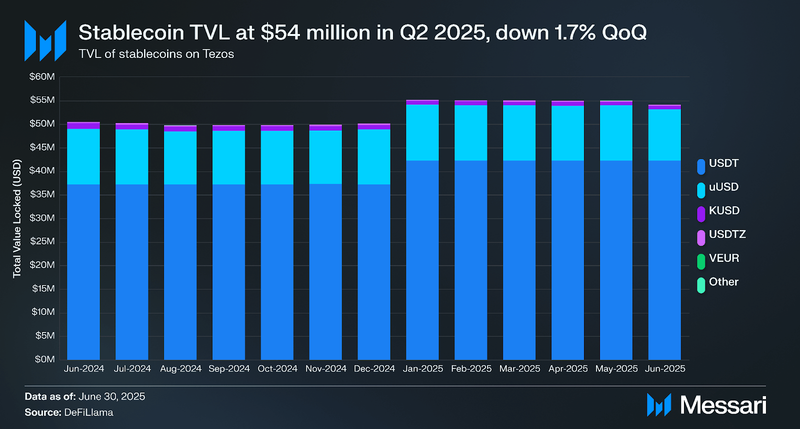
Total stablecoin TVL on Tezos stood at $54.0 million at the end of Q2’25, down 1.7% QoQ from $55.0 million in Q1. USDT remained the dominant stablecoin on the network with $42.3 million in issuance, followed by uUSD at $10.9 million. The largest Tezos-native stablecoins, kUSD and USDTez, recorded $749,000 and $254,000 in circulation, respectively. The small decline in TVL was primarily driven by reduced balances in uUSD and kUSD, while USDT remained stable across the quarter.
Closing Summary
Tezos made significant progress in Q2’25 across protocol development, network activity, and ecosystem growth. The Rio upgrade advanced the network’s scalability roadmap by integrating incentives for DAL participation, accelerating staking operations, and reducing validator latency. Meanwhile, the addition of RISC-V tooling extended Tezos’ rollup infrastructure to support more complex, high-performance applications.
Network usage rebounded across both Tezos L1 and Etherlink, with transaction volume and fee revenue reaching new highs. Etherlink solidified its role as the primary execution layer, driving sharp increases in DeFi activity, contract deployments, and TVL. While validator participation declined modestly, overall staking levels and onchain governance remained stable, supporting the network’s economic and security guarantees.
With protocol enhancements now firmly aligned to the Tezos X roadmap and Etherlink adoption accelerating, the network continues to position itself as a modular, scalable blockchain infrastructure built for long-term growth.