Key Insights
- Spheron Network is a decentralized compute network that allows anyone to access, deploy, and monetize global GPU and CPU resources. It aims to lower overhead and technical barriers so individuals and enterprises can launch and scale compute marketplaces.
- The network operates two node types: Provider Nodes and Fizz Nodes. Provider Nodes deliver enterprise-grade GPU and CPU infrastructure from data centers, while Fizz Nodes contribute consumer-grade hardware from individuals worldwide.
- Annual Recurring Revenue (ARR) exceeded $12 million by the end of August 2025. The network generated revenue before the token launch, surpassing $10 million ARR by mid-July 2025.
- SPON is the native utility token of Spheron Network. It is used to pay for compute, staking to secure the network, rewarding node operators, and participating in future governance systems. The token launched on July 25, 2025, and had a circulating market capitalization of about $17.3 million by the end of August 2025.
Introduction
The training and deployment of large AI models remains highly centralized. A handful of corporations not only control the most capable models but also dominate the compute infrastructure required to build and operate them. While this concentration brings efficiencies of scale, it also introduces systemic vulnerabilities. Decisions about infrastructure and access are made privately, user dependence deepens, and opportunities for broader participation are constrained. As experiments in distributed training prove increasingly viable, the possibility of running models across open, community-driven networks is shifting from theory to practice.
Spheron Network directly addresses these challenges by creating a decentralized marketplace for compute. Rather than relying on a few cloud incumbents, Spheron aggregates underutilized GPUs and CPUs from data centers, independent operators, and individual contributors into a global infrastructure layer. Through this network, developers can rent scalable compute for AI training, inference, and other intensive workloads, while resource providers earn from otherwise idle capacity. This approach aims to lower barriers to entry and redistribute control over access to compute for model training to build a more open and resilient AI ecosystem.
Background
Spheron Network, originally launched as ArGoApp, was founded in 2020 by Prashant Maurya and Mitrasish Mukherjee as a decentralized hosting platform for Web3 applications. Developers could use the platform to deploy static websites, dApps, and backends on decentralized storage networks like IPFS, Arweave, and Filecoin, reducing reliance on centralized providers. In 2021, the team dissolved ArGoApp and launched Spheron as part of a broader shift beyond decentralized storage. The team introduced developer-facing products such as the Site Deployer for automated workflows, a CI/CD pipeline integrated with GitHub Actions to streamline continuous deployments, and support for Web3 naming systems like ENS, along with traditional Domain Naming Services, to expand the ways developers can register and manage application endpoints.
By 2024, Spheron had established itself as a “Decentralized Compute Network (DCN)” through its permissionless peer-to-peer compute marketplace. Other notable developments in Spheron’s evolution include:
- July 2024 – Announced and publicly showcased decentralized edge container deployment to lower latency and improve resilience.
- May 2024 – Storage service retired to focus on compute/network services.
- June 2024 – Release of the whitepaper “Spheron: On-Demand by DePIN for GPUs”, articulating the vision for decentralized physical infrastructure networks (DePIN) to democratize global GPU access.
- January 2025 – Crossed 25,000 Fizz Nodes powering decentralized GPU workloads.
- January 2025 – Announced Supernoderz, a no-code node deployment platform to simplify participation in blockchain networks, lower entry barriers, and broaden involvement for enhanced decentralization and security.
- January 2025 – Launched Skynet, a no-code AI agent builder featuring a drag-and-drop interface for modules and agent deployment capabilities.
- July 2025– SPON token launches on Base as the native utility and future governance token of Spheron Network.
As of September 2025, Spheron Network has raised more than $7.1 million to develop its decentralized compute network, with backing from Tykhe Ventures, Zee Prime Capital, Protocol Labs, Consensys Mesh, and Nexus Venture Partners, among others. In addition, the project secured an undisclosed investment from Arcanum Ventures in January 2025.
Technology
The Challenge of Decentralized Compute
Building a decentralized compute network introduces several technical and economic challenges. Unlike centralized incumbents, decentralized alternatives must coordinate contributions from a wide range of participants with varying capacities, geographic locations, and reliability. Idle compute resources from personal devices, gaming rigs, and data centers need to be matched effectively with demand. Ensuring this process is fair, efficient, and transparent requires a system of rules that incentivizes participation while discouraging misconduct.
Other difficulties arise around secure payments and workload execution. Without trusted intermediaries, the system must rely on smart contracts to guarantee that providers are compensated and users receive the agreed-upon resources. At the same time, individuals offering unused capacity generally require a simple and low-overhead framework that enables them to contribute without advanced infrastructure expertise.
Why Spheron?
Spheron Network approaches these challenges by introducing a DePIN that provides a platform for transacting compute resources. It aims to lowe the overhead and technical barriers for creating marketplaces with their own governance rules and frontends. By abstracting away infrastructure complexity, Spheron allows developers, startups, and enterprises to spin up compute markets in a plug-and-play fashion rather than building from scratch.
The underlying network utilizes specialized nodes running Kubernetes to orchestrate deployments, a matchmaking engine to enable peer-to-peer compute transactions, and an onchain payment system to compensate resource providers and distribute incentives.
A distinguishing feature of Spheron’s architecture is its dual-node model. Standard Provider Nodes manage enterprise-grade data center resources, while Fizz Nodes extend participation by enabling decentralized GPU contribution at the edge for tasks such as AI inference. To connect compute demand with supply, the matchmaking engine selects providers based on parameters including price, uptime, and geographic location. This process is supported by smart contracts that formalize leases and facilitate transparent payment settlement between users and providers.
Provider Nodes and the Matchmaking Engine
Provider Nodes enable enterprises to supply GPU and CPU resources by registering their devices through the network’s smart contracts to make their hardware available for lease. Once registered, providers can participate in the resource marketplace by responding to deployment requests from users.
When a user initiates a deployment, an event is submitted to the Matchmaking Engine’s Order Smart Contract, which then emits a new order event. The order event enables providers monitoring the network to submit bids to fulfill the request by specifying their available resources and pricing. After the bidding window closes, the matchmaking engine evaluates all bids against a set of parameters designed to balance performance, cost, and fairness. The selection criteria include:
- Geographic region and availability zone – To minimize latency and comply with data residency requirements.
- Price competitiveness – Ensuring the user receives a fair market rate.
- Uptime and availability history – Rewarding reliable providers.
- Reputation – Based on prior performance within the network.
- Resource availability – Confirming capacity to meet the request.
- Stake and slashing history – Which incentivize providers to maintain good behavior.
- Randomness – Introduced to avoid deterministic selection patterns that could favor a small set of providers.
Once a provider is chosen, the system creates an onchain lease agreement, and the user sends the deployment manifest over an mTLS connection. The provider then activates the requested server configuration, and the status is updated onchain to confirm successful deployment.
Notably, users may request changes to their deployments at any time. When the workload is no longer needed, the user or provider issues a CLOSE_LEASE event, after which the provider shuts down the server and the Order Smart Contract updates the status to release any remaining funds back to the user.
Fizz Nodes
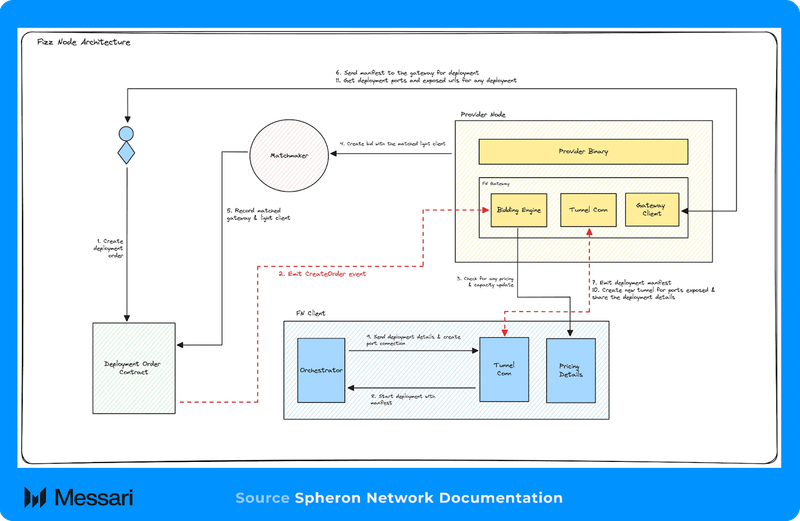
While Provider Nodes deliver larger-scale compute capacity, Spheron also supports Fizz Nodes, a lightweight alternative that allows individuals to contribute underutilized compute from personal devices like laptops and desktops. This design extends the network’s reach by enabling community participation without requiring specialized infrastructure or data center-grade hardware. Fizz Nodes operate using a Docker-based system, which reduces the overhead typically associated with Kubernetes orchestration. Each deployment request runs in a new Docker container to ensure isolation and efficient use of limited device resources.
A Fizz Node is composed of three core components:
- Pricing Configuration – Operators define how much to charge for their resources.
- Orchestrator – Manages deployment processes and coordinates container activity.
- Service Tunnel – Connects the Fizz Client on a local device to the Gateway Service so that workloads can be accessed securely.
Gateway Service
The Gateway Service is an interface that plays a critical role by facilitating communication with Fizz Clients and handling user interactions with them, monitoring pricing and capacity, and aggregating proofs of compute capacity. Through this gateway, groups of Fizz Nodes can collaborate with a Provider Node or Gateway Node and form subnets with their own micro-economies and governance systems.
Payment System
Spheron Network uses a token-based payment system for compute transactions and provider rewards. Currently, the network only supports the native SPON token, with a fee structure designed to privilege its use. Support for multiple tokens will be introduced in the future via a governance system. User payments in non-SPON tokens will incur a 5% facilitation fee, and provider utilization payments in non-SPON tokens are subject to a 5% fee. Transactions conducted in SPON are exempt from these charges.
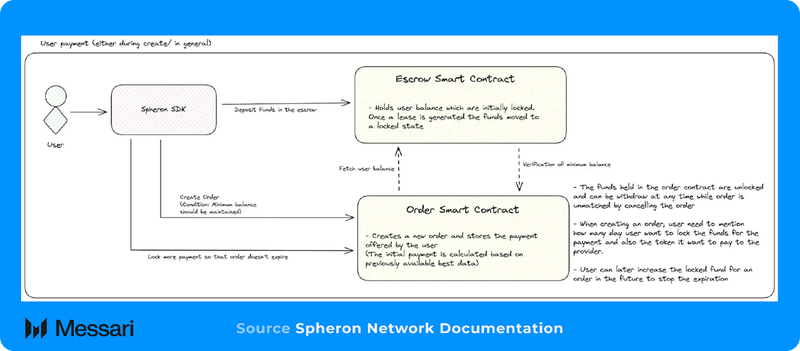
To initiate a deployment, users first deposit funds into a Compute Escrow Wallet. Deposits are divided into locked balances, which secure active leases, and unlocked balances, which remain available for future orders or withdrawal. Users then create an order specifying the lease duration and payment token. Once a provider is matched, the required funds are locked in escrow and streamed to the provider over time, with transfers calculated from block timestamps. If a lease ends early, remaining balances are reconciled and redistributed. Providers must remit 5% of deployment payments to the Spheron Foundation. Utilization payments stream into escrow and can be withdrawn as they accrue. If escrowed funds drop below requirements, the lease smart contract terminates the deployment and shuts down the server. Beyond utilization payments, providers earn SPON-denominated liveness rewards when their hardware is underutilized. These rewards are typically distributed in 24-hour cycles and may be auto-staked to improve provider reputation and future selection probability.
Tokenomics
SPON is the native utility of Spheron Network that underpins its compute marketplace. Its core functions include:
- Economic Security – Secures the network by incentivizing honest behavior among providers and participants staking tokens.
- Payments – Serves as a medium of exchange for compute transactions on the network.
- Incentives – Rewards node operators, compute providers, and contributors, ensuring efficient supply-side participation.
- Staking Rewards – Provides inflationary and revenue-driven rewards to stakers, aligning long-term commitment with network growth.
SPON is also intended to serve as Spheron’s governance token, granting holders the power to vote on critical protocol decisions such as enabling additional payment tokens and network upgrades. While the high-level intent is public, the exact governance mechanisms like proposal and DAO design have not yet been detailed as of September 2025.
SPON Token Distribution & Vesting Schedules
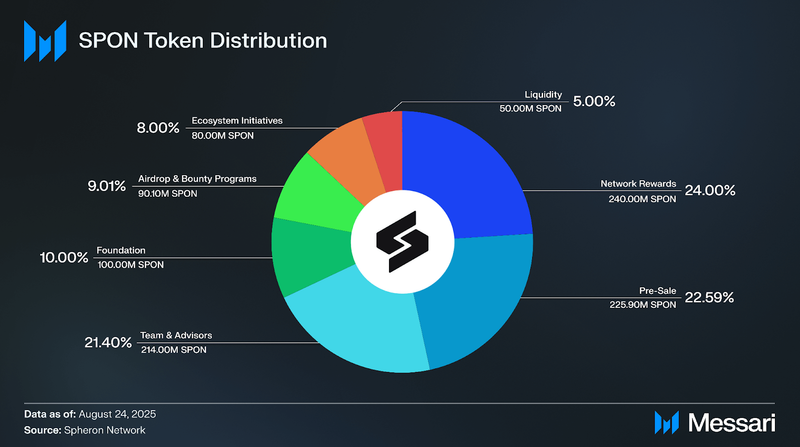
- Network Rewards (24.00%) – Released linearly over 48 months to incentivize ongoing compute contributions and maintain a reliable base of decentralized resources. This allocation is designed to ensure that providers remain active participants in the network over the long term.
- Pre-Sale Investors (21.26%) – Locked for a total of 24 months, with a 12-month cliff followed by 12 months of linear vesting.
- Strategic Investors (1.33%) – Subject to a six-month cliff and an 18-month linear vesting period.
- Team & Advisors (21.40%) – Locked with a 12-month cliff, followed by 36 months of linear vesting. This allocation reflects the commitment of the project’s contributors and advisors to sustained execution and governance.
- Foundation (10.00%) – Locked with a 12-month cliff and vesting over a four-year period. Managed by the project’s foundation treasury, these tokens are intended to support long-term development, operations, and responsible treasury management.
- Airdrop & Bounty Programs (9.01%) – Fully unlocked at the Token Generation Event, but distributed over an eight-month period. This phased approach aims to sustain contributor engagement while rewarding early adopters and community supporters.
- Ecosystem Initiatives (8.00%) – Fully unlocked at the Token Generation Event but subject to DAO-led approval for use. These tokens are earmarked for grants, ecosystem growth programs, and strategic partnerships aligned with the project’s mission.
- Liquidity (5.00%) – Fully unlocked at the Token Generation Event to provide initial market liquidity, enable trading activity, and support price discovery at launch.
Staking and Reward Mechanisms
Provider Nodes must stake SPON tokens to register and participate in the network. Staking activates their bidding engines, allowing them to compete for deployments, and serves as collateral against downtime or misconduct. This requirement ensures that providers maintain a financial commitment to the network’s integrity.
Tokenholders who do not operate nodes can delegate SPON to providers. Delegation increases a provider’s likelihood of being selected by the matchmaking system and entitles both the provider and delegators to share in rewards. This system aligns incentives across participants and broadens the base of stakeholders supporting network reliability.
Rewards are derived from multiple sources. The primary source is user payments for compute usage, ensuring providers are compensated directly for their resources. To stabilize participation during periods of low demand, the protocol issues liveness rewards, which encourage providers to remain online and available. Additional incentives include delegation rewards, bonus payouts for reaching lease-hour milestones, and foundation delegation in early phases to bootstrap provider activity. APRs for delegators are variable and depend on utilization, provider performance, and the network’s inflation schedule.
The staking system is also used to enforce accountability. Providers that fail to meet obligations face penalties through slashing. Misconduct such as falsifying resources, misusing user data, or experiencing extended downtime results in the loss of staked and delegated tokens. For active leases, downtime penalties are tied to lost fee income, while idle downtime reduces liveness rewards. Maintenance modes and cooldown periods are built in to balance fairness with operational flexibility.
Revenue Redistribution
Spheron directs a portion of network revenue back to participants through defined mechanisms. Fees generated from compute leases and related services are collected in SPON and distributed into staking reward pools. Separately, the Secure Compute mechanism introduces a buyback-and-burn process, where provider tokens are repurchased using surplus margins and permanently removed from circulation. The first execution of this process occurred in September 2025, and burned 0.65% of the total supply.
Ecosystem
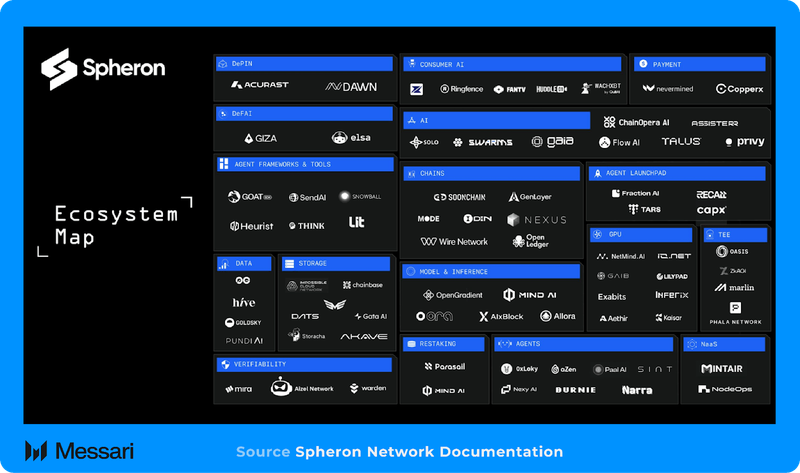
Spheron has established over 100 strategic partnerships spanning infrastructure integrations, AI model deployment, ecosystem engagement, and more. These partnerships showcase its position as a foundational layer for compute services. Several notable partnerships include:
- DAWN– Spheron’s compute layer is integrated with DAWN’s Black Box to allow consumer devices to operate Fizz nodes and supply GPU and CPU resources directly to the compute marketplace.
- Sentient– Spheron has partnered with Sentient to supply decentralized GPU resources for its Open AGI platform. The integration enables developers to train and deploy AI models using Spheron’s compute marketplace while supporting Sentient’s goal of building community-owned and monetizable AI systems.
- Wire Blockchain– Spheron and Wire Blockchain have partnered to integrate decentralized compute with Wire’s cross-chain transaction layer. The collaboration aims to provide scalable infrastructure for AI-driven dApps.
- Warden Protocol – Spheron and Warden Protocol have launched a joint campaign via Galxe to foster community engagement ahead of Warden’s beta and token launch. The partnership also integrates Warden’s AI-native tooling with Spheron’s decentralized compute layer.
Beyond these alliances, Spheron is also collaborating with several emerging AI and infrastructure entities, such as Assisterr, OpenGradient, OpenLedger, and Mira.
Roadmap
Q3 2025 (Ongoing)
Token Generation & Rewards
- V2 Reward Structure – A redesigned system will distribute provider rewards more efficiently, with higher returns for providers that supply rented machines.
Infrastructure Development
- AMD GPU Support for Fizz Nodes & Providers – Expanding support beyond NVIDIA to broaden hardware inclusion and tap into a wider provider base.
- Visualization Dashboard for GPU Stats & Utilisation – A monitoring interface will launch to allow providers to track GPU performance, capacity usage, and revenue metrics.
Platform Features for Users
- Workload Utilisation Dashboard – End users will be able to monitor live metrics for their workloads directly in the console, improving visibility and performance tracking.
- Escrow Balance Alerts – Alerts will notify users when balances approach depletion, reducing service interruptions.
- Custom Domains for Deployments – Users will gain the ability to assign custom domains to their deployments, supporting enterprise-grade use cases.
Agent Ecosystem
- Agent Marketplace Launch – A marketplace for AI agents will be introduced, enabling developers to deploy and monetize autonomous agents.
- Agent-to-Infrastructure Communication – Agents will gain the ability to dynamically request infrastructure resources.
- Open-Source LLM Endpoints – Serverless endpoints for open-source language models will be deployed, making it easier for developers to integrate LLMs into applications.
- Agent Marketplace Bootstrapping – Early-stage incentives will be implemented to attract developers and users to the new ecosystem.
Product Growth
- Demand-Side Bootstrapping – Ecosystem funds will be allocated to stimulate demand, ensuring balanced growth between supply and consumption.
- Affiliate Programs – New referral structures will provide revenue sharing and SPON rewards to create stronger retention and long-term incentives for partners.
- University & College Collaborations – Educational partnerships will be formed to drive adoption and build developer funnels at scale.
- Docker Marketplace Launch – A curated Docker marketplace will go live with revenue-sharing models to reward creators.
Q4 2025
Security & Privacy
- Secret Manager / MPC – Multi-party computation and secret management systems will be released to enhance security for sensitive data and credentials.
- Trusted Execution Environments (TEE) – The introduction of TEE providers will allow for secure transaction execution and protect workloads from malicious interference.
- Decentralized Matchmaking Engine – The Matchmaking Engine will be progressively decentralized to reduce reliance on centralized coordination.
- Slark Node Validation Network – A decentralized validation network will be introduced to strengthen reliability and trust in provider operations.
Platform Features
- Automatic Workload Replacement – Workloads will automatically migrate if a provider or node goes offline to minimize downtime.
- Automatic Price Rebalancing – Lease prices will begin adjusting dynamically and reflect market conditions for ongoing workloads.
Scaling & Optimization
- Resource Allocation Optimization – Improved scheduling will enhance efficiency in distributing workloads across the network.
- Global Infrastructure Expansion – New data center and provider regions will be onboarded to strengthen the global footprint.
- Enterprise Partnerships – Strategic collaborations with enterprise clients will be made to support large-scale adoption and integrate the platform into traditional IT ecosystems.
Closing Summary
Spheron Network provides a decentralized alternative to incumbent cloud providers by aggregating underutilized GPUs and CPUs into a global compute marketplace. Its architecture combines Provider Nodes, which supply enterprise-grade infrastructure, with Fizz Nodes that enable participation from consumer hardware. This dual model supports workloads such as AI training, inference, and other compute-intensive tasks while lowering barriers to entry for both users and resource providers.
Since launching in 2021, Spheron has grown into a revenue-generating compute platform, surpassing $12 million in annual recurring revenue by mid-2025 and launching the SPON token to support payments, staking, and incentives. The roadmap for the remainder of 2025 emphasizes new features, including staking and reward mechanisms, workload monitoring dashboards, an agent marketplace, and security enhancements such as trusted execution environments and decentralized matchmaking. These initiatives are intended to strengthen reliability, attract enterprise adoption, and advance Spheron’s role in building a more open and resilient compute infrastructure.