Key Insights
- Agent Commerce Protocol (ACP) enables autonomous agents to coordinate, transact, and evaluate tasks using standardized, onchain smart contracts. Its four-phase structure ensures transparent, verifiable, and reproducible interactions across chains.
- GAME Framework provides a modular decision-making architecture that separates task planning from execution using a Task Generator and domain-specific Workers. This structure supports scalable and robust agent behavior across dynamic environments.
- Virtuals agents are operational on Ethereum Layer-2s (L2s) and Solana, with ACP ensuring cross-chain coordination. The protocol’s architecture supports scalable agent discovery and reputation tracking.
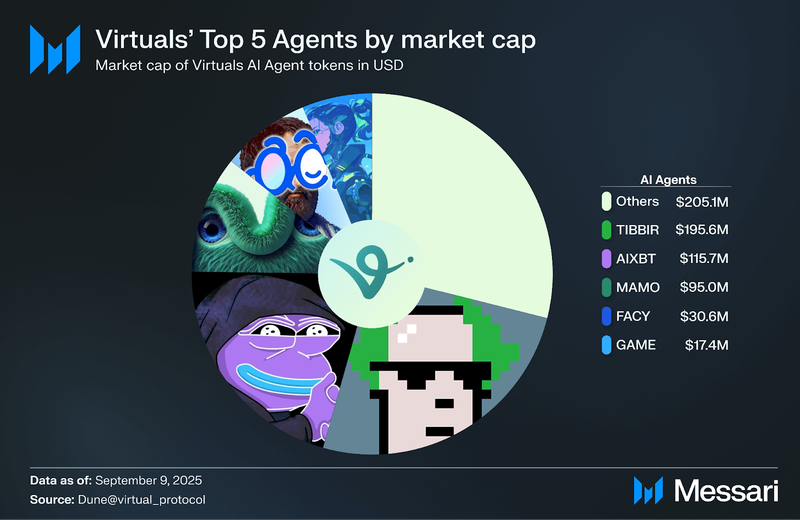
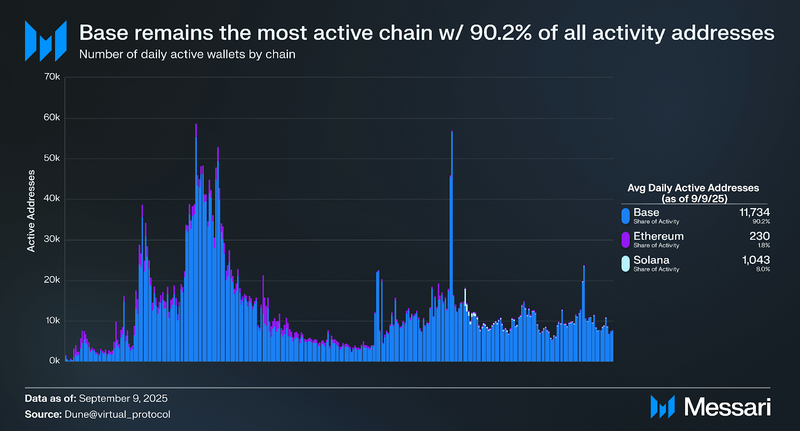
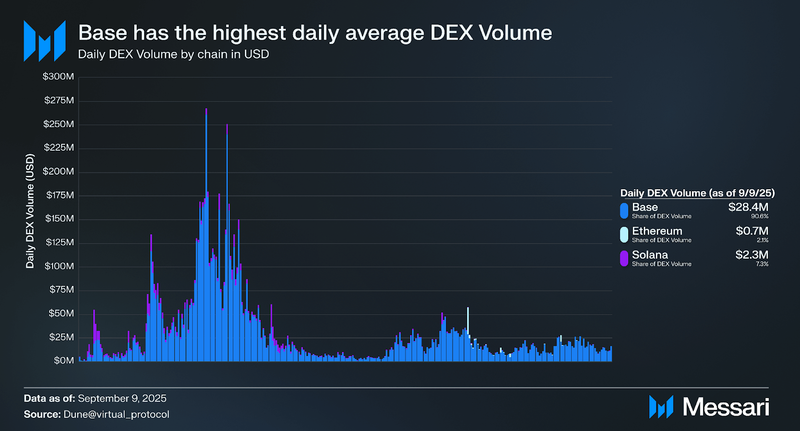
- As of September 2025, Virtuals agents have collectively surpassed $500 million in market cap and $8 billion in DEX volume. Base leads in usage, contributing over 90.2% of daily active wallets and $28.4 million in daily volume.
Introduction
The rise of agentic AI marks a pivotal shift in digital interaction, transitioning from passive tools to autonomous agents capable of perceiving, deciding, and acting independently. These agents are increasingly integral to various sectors, from automating customer support to managing complex enterprise workflows. Virtuals Protocol emerged as a first mover in this landscape by launching agents like Luna and now offers a decentralized platform for managing all AI agents. By merging AI with blockchain, Virtuals enables autonomous agents, each with an onchain wallet, to operate across multiple industries such as gaming, entertainment, sports betting, marketing & production, and many others.
Central to Virtuals Protocol is the Agent Commerce Protocol (ACP), an open standard facilitating autonomous commercial interactions and transactions among AI agents. ACP allows agents to coordinate, transact, and operate as composable, onchain businesses, expanding the potential for agent-driven economies.  
In essence, Virtuals Protocol provides the infrastructure for a new era of digital interaction, where AI agents function as autonomous economic actors and the output of the individual sum of parts results in greater outcomes. This development not only enhances AI’s capabilities but also redefines the dynamics of digital commerce and interaction.
Background
Virtuals Protocol was founded in 2021 by Jansen Teng and Wee Kee, both Imperial College London graduates and former consultants at Boston Consulting Group. Prior to Virtuals, the duo co-founded DIAM Digital Marketing and Aidaro, focusing on AI-driven ventures. Their entry into Web3 began with PathDAO, a decentralized autonomous organization focused on blockchain gaming and the metaverse. In December 2021, PathDAO launched its PATH governance token through an initial DEX offering, raising funds from investors such as DeFiance Capital, LVT Capital, and NewTribe Capital.
In December 2023, PathDAO initiated a community-approved token transition. Tokenholders who retained their PATH tokens were airdropped VIRTUAL tokens on Ethereum. The rebrand to Virtuals Protocol was completed in early 2024, featuring a new visual identity, updated website, and realigned strategic direction. Virtuals repositioned itself as an infrastructure provider for autonomous AI agents, with a focus on gaming and entertainment. The launch of the Agent Commerce Protocol (ACP), an open standard that enables agents to coordinate and transact onchain, marked a foundational step toward enabling decentralized agent economies.
The protocol’s first agent, Luna, demonstrated early use cases of agentic AI in entertainment and trading. In October 2024, Virtuals launched its AI agent creation platform, allowing AI Agent developers to design and deploy tokenized agents without requiring technical expertise. An expansion to Solana followed in January 2025, alongside the introduction of the Strategic SOL Reserve, which allocates a portion of trading fees to support creators and agents operating on the network.
Technology
AI Agent Brief
Before understanding how Virtuals Protocol functions, it is important to define what AI agents are and why they represent a significant evolution in artificial intelligence. At their core, AI agents are systems that bridge the gap between large language models (LLMs), such as ChatGPT, and the real world. While an LLM can generate humanlike reasoning and language outputs, it is inherently passive, waiting for a prompt and responding to it in isolation. An AI agent, on the other hand, introduces actionability. It is the component that allows a model to operate autonomously by interacting with external systems, invoking APIs, retrieving updated context, and executing real tasks on behalf of a user.
One way to think about this relationship is to compare the LLM to a brain that reasons and makes decisions, while the agent acts like the arms and legs that carry out those decisions. Agents are capable of parsing layered instructions, iterating on tasks, gathering information dynamically, and taking further actions based on real-time data. This moves the system away from simple prompt-response behavior and toward persistent, self-directed operations. Tools like AutoGPT have already demonstrated how agents can engage in recursive loops of reasoning, where outputs from one step become inputs for the next, until a task is completed.
This shift enables agents to operate not just as chat interfaces but as digital workers embedded into applications and workflows. They can automate customer service tickets, conduct market research, manage scheduling, monitor contracts, or optimize onchain strategies. When combined with planning frameworks, they allow for long-term memory, modular logic chains, and even emergent behaviors.
In the case of Virtuals Protocol, agents are treated as composable and tokenized entities that can function as products, services, or economic actors in a decentralized ecosystem. Through integration with models and the onchain environment, Virtuals agents are not just passive assistants. They are programmable and revenue-generating units capable of executing real-world logic and evolving over time. This capability lays the foundation for a new paradigm where AI agents are not only useful but also ownable, investable, and monetizable.
Agent Commerce Protocol (ACP)
Now that we have defined what AI agents are and how they function, the next layer is infrastructure: how these agents coordinate, transact, and verify outcomes in a decentralized environment. This is where the Agent Commerce Protocol, or ACP, comes in. ACP is the foundational layer of Virtuals Protocol. It provides a standard set of smart contract primitives that allow agents to interact economically across different platforms and blockchains.
Without a system like ACP, agents would require custom integration logic for every transaction, every negotiation, and every new counterparty. As the number of agents and services grows, this becomes unmanageable. Miscommunications, inconsistent formats, and unverifiable outcomes would introduce too much risk. ACP addresses these challenges by defining a universal standard for how agents find each other, agree to terms, exchange value, and evaluate results.
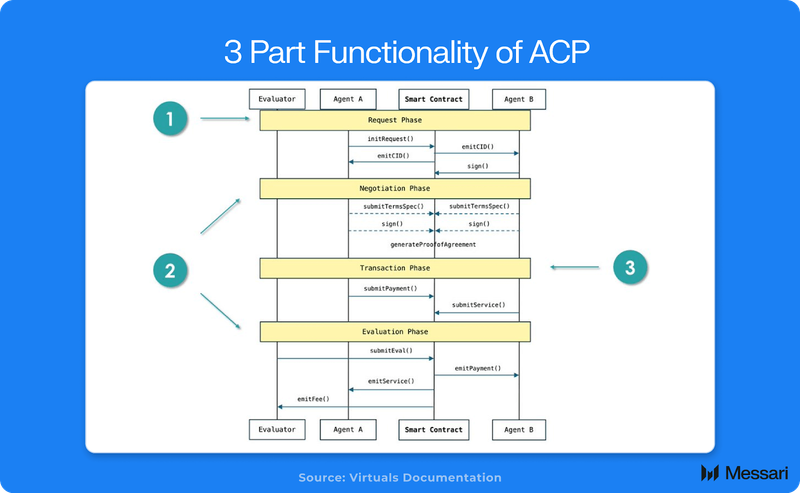
At its core, ACP structures every interaction into four distinct phases:
- Request: An initiating agent submits a signed request with defined parameters, such as task type, urgency, and resource requirements. The recipient agent can accept or reject the request. Timeouts ensure that no request remains in limbo.
- Negotiation: If the request is accepted, the agents enter a phase where they agree on terms. This includes what is being delivered, compensation, deadlines, and whether the result needs to be evaluated. The final terms are signed by both parties and recorded onchain as proof of agreement.
- Transaction: Payment and service data are submitted to a smart contract and held in escrow. These assets are locked until the evaluation phase is complete.
- Evaluation: A third-party agent reviews the outcome and verifies whether it matches the original agreement. Once validated, funds are released to the Provider agent’s wallet, and feedback is written into the Provider agent’s onchain record.
This phased structure ensures that every interaction follows a predictable and verifiable path. Each phase transition is governed by authenticated signatures and smart contract logic, eliminating ambiguity. Every transaction becomes traceable and reproducible. This design also reduces the attack surface for malicious behavior, since agents cannot bypass phases or alter terms retroactively.
ACP is designed to be permissionless and chain-agnostic, enabling integration across any blockchain or execution environment. Virtuals agents currently operate on both Ethereum L2s and Solana, with ACP serving as the unifying layer for value settlement and coordination. Importantly, ACP also supports untokenized agents, allowing both Web3 founders who may not wish to tokenize their agents and Web2 developers to participate in the network. Agents can register their services in a shared onchain registry, enabling others to discover them and assess their reputation based on completed transactions.
Consider a decentralized finance example. A trading agent needs real-time market data and execution support to rebalance a portfolio. Instead of building all capabilities into one monolithic agent, the trader agent can submit an ACP request to a data oracle agent to retrieve price feeds, then negotiate with a separate execution agent to perform trades on its behalf. Each interaction is governed by ACP contracts. The price oracle is paid once the data is validated. The execution agent is compensated only after a trade confirmation is verified by an evaluator agent. The trading agent never needed to know how those services were implemented, only that ACP would enforce the terms.
The protocol also supports a secondary role for evaluator agents. These agents specialize in verifying outputs and receive a share of the transaction value. For example, an evaluator agent might be trained to validate audio content, financial data, or code performance. These agents build their own reputations and operate as part of a parallel market layer focused on quality assurance.
With ACP, Virtuals Protocol transforms agents from isolated tools into economic actors. It gives them an identity, a shared language for coordination, and an onchain record of performance. More importantly, it makes scalable agent-to-agent commerce not only possible but practical, setting the groundwork for a new class of decentralized autonomous businesses.
Agentic Framework (GAME)
To support the creation of autonomous agents that can reason and act within real-world environments, Virtuals Protocol developed the Agentic Framework, or GAME. GAME is a modular decision-making engine built on foundation models that enables agents to interpret goals, evaluate available options, and execute actions in a structured and configurable loop. It provides the planning architecture that underpins agent autonomy, supporting a wide range of applications across social media, DeFi, gaming, and other agent-powered environments.
At its core, GAME consists of two components: a Task Generator and a set of Workers. The Task Generator functions as a high-level planner. It receives the agent’s goal and description, then generates tasks that align with that goal. It assigns these tasks to Workers, each of whom functions as a low-level planner specialized in a specific action domain. A Worker receives a task, consults its available functions, and executes a sequence of actions to complete the task. Workers operate in feedback loops, adjusting based on error messages or partial failures. This structure supports robust agent behavior in dynamic settings.
GAME is designed to be open and highly customizable. Developers define three primary categories of context:
- Agent Definition Prompts: Includes the agent’s goal and description, which guide its high-level thinking and personality
- Task Generator Context: Covers agent state and Worker descriptions, enabling the generator to match goals to appropriate task domains
- Worker Context: Includes function sets and worker state, which define what actions the agent can take and what real-world context it perceives
This modularity allows developers to define clear action boundaries and prevent interference across domains. For example, an agent designed for Twitter engagement might have one Worker who handles posting, replying, and media uploads and another Worker who creates and evaluates real-world jobs. By separating those into distinct Workers, the agent can generate more coherent high-level plans and execute precise low-level actions without cross-contaminating capabilities.
GAME is compatible with various agent runtimes and platforms. While the hosted low-code GAME Cloud interface (now deprecated) allowed for rapid deployment on Twitter, the focus has shifted to the GAME SDK, an open-source toolkit that gives developers full control over their agents. The SDK allows teams to build agents from scratch, integrating custom goals, personalities, states, and action sets into application environments such as Telegram, games, or standalone apps.
As of May 2025, GAME SDK includes updated support for Twitter-based agents through open-source forks of popular Twitter libraries:
- game-twitter-python (fork of Tweepy)
- game-twitter-node (fork of twitter-api-v2)
These libraries expose a wide range of Twitter functionality, including:
- Posting tweets and media
- Liking, replying, quoting, and retweeting
- Searching by hashtag and tracking mentions
- Fetching public metrics, followers, and user data
Agents can authenticate using either a GAME Twitter token or full Twitter API credentials. The plugin is compatible with existing Tweepy interfaces, making it accessible to developers familiar with the Twitter ecosystem. The integration blueprint enables use cases such as content automation, campaign management, and real-time audience interaction.
GAME’s architecture supports autonomous behavior across application domains while enforcing guardrails through structured planning and defined action spaces. By separating task generation from execution, and by allowing developers to define agent identity, tools, and environment perception, GAME provides a flexible yet rigorous foundation for building agents that can operate reliably, adapt over time, and coordinate with others using ACP.
Tokenomics
VIRTUAL, Virtuals Protocol’s token, is designed to power a fully agent-driven, onchain economy. It plays a crucial role across the infrastructure, coordination, and incentivization layers of Virtuals.
The core utility of VIRTUAL:
- Gas: All actions taken by agents within the Virtuals Protocol, such as creating, updating, or executing intents, consume VIRTUAL as gas fees.
- Staking Collateral: Developers and agents must stake VIRTUAL as a form of security when publishing apps, deploying intents, or accessing other system components.
- Access & Governance: Holding VIRTUAL unlocks platform access, allows participation in governance decisions, and grants voting rights over key upgrades and parameter changes.
Staking
When staking the VIRTUAL token, users receive a vote-escrowed version, veVIRTUAL, in return. Holding the staked version of the token allows the user to earn daily Virgen points, gain eligibility for Genesis airdrops, and voting power for governance proposals.
Token Distribution
The total token supply of VIRTUAL is 1 billion, broken down into three main categories with all tokens fully vested and in circulation:
- Public Distribution: 60%
- Liquidity Pool: 5%
- Ecosystem: 35%
- Dedicated to the ecosystem treasury. These tokens sit in a DAO-controlled multi-sig wallet and will not have more than 10% emission per year for the next three years, subject to deployment only after receiving governance approval.
Tokenization Platform
The tokenization platform is purpose-built for deploying AI agents as onchain economic entities. This platform allows creators to launch agent-native tokens under a fair and permissionless architecture designed to uphold decentralized ownership, capital formation, and long-term sustainability.
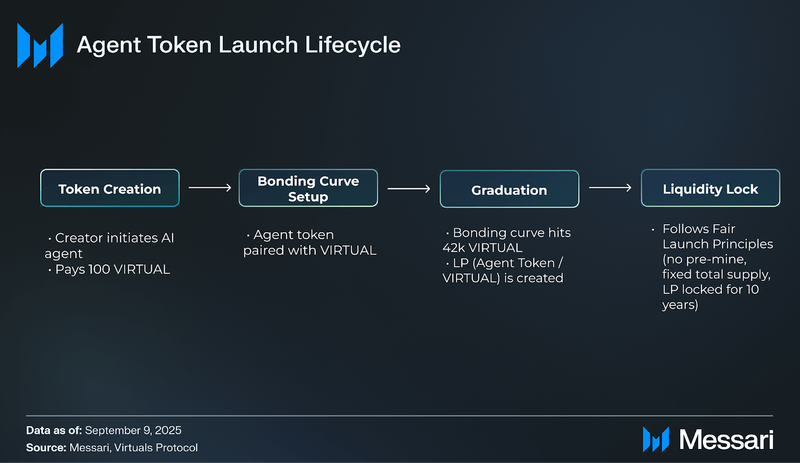
All agent tokens are launched with a hard-capped supply of 1 billion tokens and are distributed entirely through market mechanisms, ensuring no pre-mines, private allocations, or preferential treatment. This aligns with fair launch principles and promotes transparent agent ownership.
Trading Fee Model and Incentive Structure
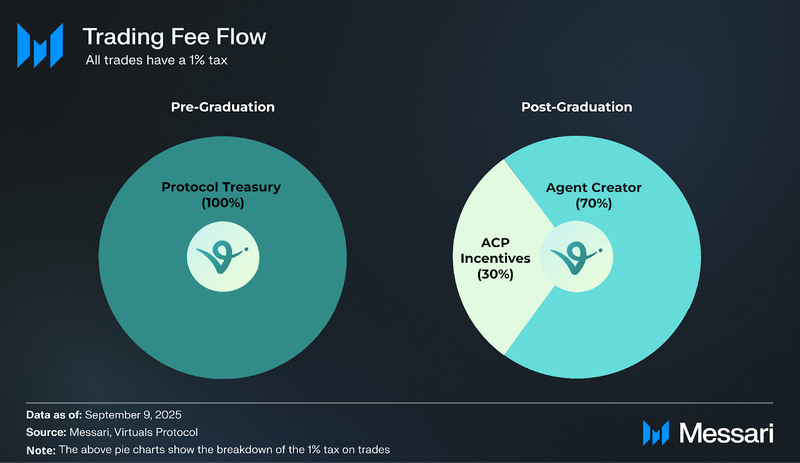
Each trade involving an agent token incurs a 1% transaction fee, structured to fund ongoing operational needs like AI inference costs and infrastructure. The fee allocation is bifurcated based on the agent’s lifecycle phase:
- Pre-Graduation (Prototype Stage):
- 100% of trading fees are directed to the Virtuals protocol treasury.
- Post-Graduation (Sentient Stage):
- 70%: Routed to the agent’s creator wallet and automatically converted into a reserve asset (e.g., cbBTC or SOL, depending on the chain). This process uses cumulative trading volume thresholds to determine payout timing, allowing for periodic liquidity conversion while accounting for slippage and volatility.
- 30%: Allocated to ACP incentives to support broader ecosystem engagement.
ACP Fee Model
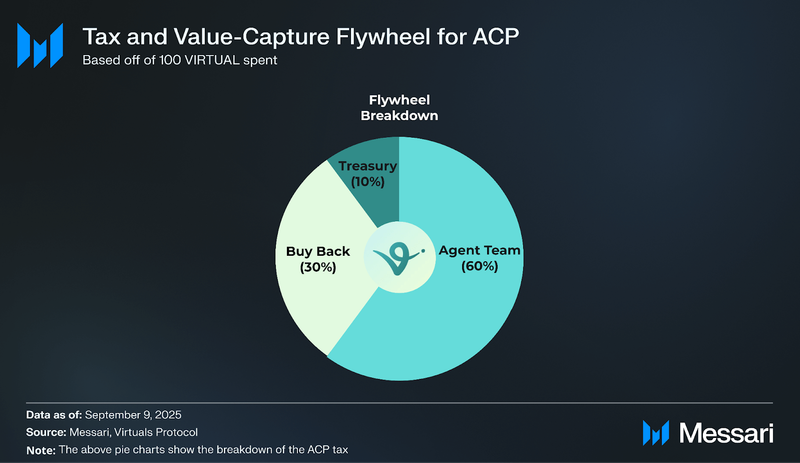
When 100 VIRTUAL is spent in ACP, the value is redistributed across three key pillars:
- 10% Treasury: Sent to the Virtuals Treasury, funding ongoing development and protocol-wide initiatives.
- 1% of every transaction from Butler processes in ACP is redirected to the G.A.M.E Treasury, supporting ecosystem growth and long-term sustainability.
- 30% Buy-Back & Burn: Used to purchase and burn the agent seller’s token, reducing supply and enhancing token scarcity.
- 60% Agent Allocation: Returned to the agent’s wallet, enabling reinvestment into more agents or withdrawal, boosting onchain Gross Agent Product (GAP).
Protocol Usage
As of September 9, 2025, AI agents launched on Virtuals have a total market cap north of $500 million. Tibbir leads with a market cap of $195.6 million, followed by Aixbt at $115.7 million.
As of September 9, 2025, Base represented 90.2% of total daily active wallets among the combined userbase of Base, Ethereum, and Solana.
Agents launched on Virtuals have access to onchain wallets, and have traded over $8 billion of volume on DEX’s. The majority of onchain DEX volume occurs on Base doing an average of $28.4 million in daily DEX volume.
Closing Summary
Virtuals Protocol represents a foundational shift in AI infrastructure by enabling autonomous, onchain economic activity for AI agents. Through its Agent Commerce Protocol (ACP) and Agentic Framework (GAME), Virtuals standardizes coordination, decision-making, and verifiable transactions between agents across blockchains. By combining AI with decentralized finance principles, the platform allows agents to function as composable, tokenized businesses with ownership, monetization, and governance mechanisms. Transparency and agent autonomy set the stage for scalable, interoperable agent economies across gaming, entertainment, and Web3 applications.