Key Insights
- KiteAI is a Layer-1 blockchain building infrastructure for Agentic payments. Its primary focus is enabling secure, high-throughput agentic payments using stablecoins, aiming to become a foundational financial rail for the machine-to-machine economy.
- KiteAI closed an $18 million Series A funding round led by PayPal Ventures and General Catalyst on Sept. 2nd, 2025, and has now secured $33 million in total funding. This funding is essential for KiteAI to realize its ambition to bridge established Web2 platforms with blockchain infrastructure.
- Core Technologies for Trust and Attribution: KiteAI is built on two key innovations: the Kite Passport, which provides cryptographically verifiable identity and permissioning for agents, and Proof of Artificial Intelligence (PoAI), a mechanism designed to attribute and reward valuable contributions across agent actions.
- E-Commerce Entry Point: Targeting the e-commerce vertical as its initial entry market, KiteAI’s Agent App Store allows AI agents to discover and transact with PayPal and Shopify merchants, providing an immediate and practical application for its technology.
Background
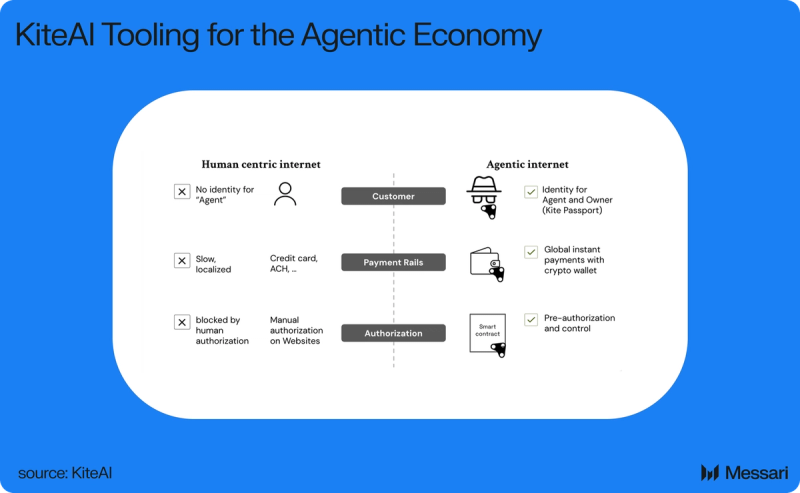
Following the advent of ChatGPT just a few years ago, the internet is entering what many describe as the “agentic era,” where autonomous AI software agents increasingly execute complex, multi-step tasks on behalf of human users. However, the foundational infrastructure of the current web was designed for direct human interaction and is ill-equipped to support a scalable, secure, and trustworthy machine-to-machine economy. This structural mismatch creates several critical gaps, such as the lack of verifiable identity for non-human actors, the absence of native payment rails for autonomous transactions, and insufficient frameworks for programmable trust and governance.
Web2 solutions for identity (e.g., OAuth) and payments (e.g., credit card APIs) are centralized and permissioned, requiring human oversight and creating friction that hinders full agent autonomy. These systems ultimately lack the necessary auditability and composability for complex agent-to-agent (A2A) interactions, where multiple agents collaborate to achieve a goal. As agents become more integrated into e-commerce, supply chain management, and data analysis, the need for a dedicated infrastructure layer to manage these agents becomes paramount.
Blockchain technology offers a potential solution by providing a neutral, programmable, and censorship-resistant foundation. A dedicated agentic blockchain can establish a system of digital scarcity, verifiable identity, and immutable transaction records. Such a system enables the creation of a trust layer where agents can interact based on computationally enforced rules, settle transactions instantly and transparently, and build a verifiable reputation over time, paving the way for a truly scalable agentic economy.
Introduction
KiteAI is a Layer-1 blockchain project designed to serve as the foundational base layer for the agentic internet. The protocol’s core objective is to provide the needed infrastructure for autonomous AI agents to coordinate through verifiable identity, programmable governance, and onchain financial settlement. By focusing specifically on agentic payments with stablecoins, KiteAI seeks to create a crucial bridge between the merchant networks of Web2 platforms and the efficiency and transparency of Web3 financial rails.
In Sept. 2025, KiteAI confirmed the close of its Series A funding round, increasing KiteAI’s total raised capital to $33 million. The round was co-led by PayPal Ventures, the venture arm of the global payments giant, and General Catalyst, a prominent TradFi venture capital firm.
The protocol’s architecture is built around its two main technological pillars: the Kite Passport, a decentralized identifier (DID) based identity and access management system for agents, and Proof of Artificial Intelligence (PoAI), a novel consensus and reward mechanism designed to measure, verify, and compensate valuable AI-driven work. Together, these components aim to create a high-trust environment where developers can confidently deploy agents and users can delegate tasks with predefined security parameters. Early integrations with platforms like PayPal and Shopify, available through the Kite Agent App Store, serve as an initial proof of concept, focusing on the tangible use case of AI-powered e-commerce.
Core Technology
Kite Passport
The Kite Passport is the identity and permissions layer of the KiteAI network. It moves beyond traditional identity systems by providing each AI agent with a unique, cryptographically secure Decentralized Identifier (DID). This Passport is effectively a programmable smart contract that governs an agent’s capabilities. A user or organization can provision a Kite Passport with specific rules. For example, a travel agent could be authorized to spend up to $500 in PYUSD on flights, but only with approved airlines and after cross-referencing prices on at least three platforms. This architecture effectively sandboxes agent operations, mitigating risk and limiting the “blast radius” if an agent is compromised or behaves unexpectedly. The protocol has already developed integrations for Kite Passport with major AI platforms, including Anthropic’s Claude, OpenAI’s ChatGPT, and Perplexity, allowing agents operating on these platforms to execute e-commerce tasks with Shopify merchants autonomously.
Decentralized Identifier (DID)
The DID provides each AI agent on the KiteAI network with a unique and verifiable digital identity, functioning much like a secure, onchain passport. By cryptographically binding an agent to its identity and permissions, DIDs make impersonation or “spoofing” impossible and allow agents to build a verifiable reputation over time. This solves a critical security flaw in traditional systems, anchoring accountability (“who did what”) and authorization (“who is allowed to do what”) directly onto the blockchain, which is essential for enabling a secure and trustworthy economy of autonomous agents.
Proof of Artificial Intelligence
Proof of Artificial Intelligence (PoAI) is a proposed mechanism designed to solve the complex problem of attribution within the AI value chain. In a typical AI workflow, value is created by multiple contributors ranging from the data provider all the way to the agent orchestrating the task. PoAI aims to create a transparent, onchain ledger that tracks these contributions and rewards each participant proportionally, functioning as a verifiable system for measuring “useful AI work.” By doing so, PoAI creates a powerful economic incentive for developers and infrastructure providers to contribute high-quality components to the KiteAI ecosystem, ultimately fostering a marketplace for AI resources.
Kite Chain (Layer 1)
KiteAI is built as an EVM-compatible Layer-1 blockchain, with its mainnet planned as a dedicated Avalanche C-chain. Rather than a Layer-2 solution, KiteAI has developed its own sovereign L1 architecture to meet agentic workloads’ unique performance and customization needs. The stated advantages of this approach include:
- Fast Finality: Agent-to-agent interactions, such as automated negotiations or time-sensitive data purchases, require near-instantaneous and irreversible settlement. A sovereign L1 can offer faster finality guarantees than an L2, ensuring that agentic transactions are secure and final.
- Custom Transaction Lanes: The L1 architecture allows for implementing custom transaction types and specialized fee markets. For instance, KiteAI can create dedicated, low-cost state channels for high-frequency Application to Application (A2A) communication, separating messaging traffic from higher-value financial settlements on the main chain.
- Predictable Fee Market: Predictable operational costs are essential for enterprise adoption. KiteAI is designed to offer low and stable transaction fees by allowing gas to be paid in various stablecoins (e.g., PYUSD). This abstracts away the need for users and agents to hold a volatile native gas token, removing a significant point of friction for Web2 developers and enabling more precise business forecasting.
- Agent-Native Wallet Infrastructure: The chain will natively support account abstraction, a critical feature for agentic systems. This enables functionalities like social logins for users, multi-signature wallets for enterprise governance, and, most importantly, session keys. Session keys allow users to grant an agent temporary, task-specific permissions without handing over complete control of their wallet, dramatically improving security and usability.
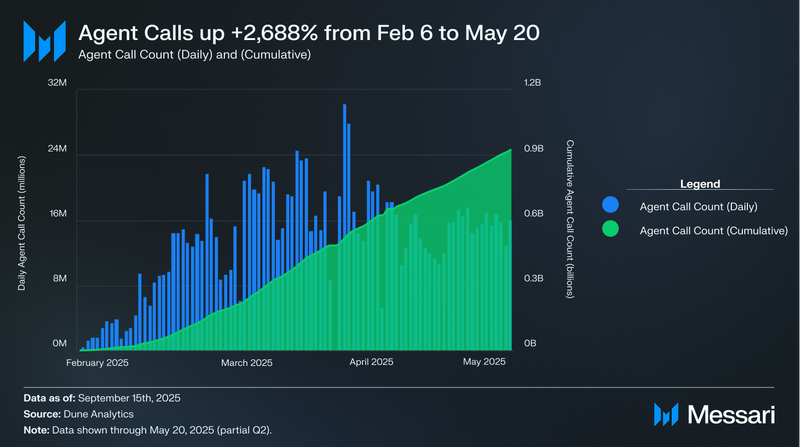
Between Feb. 6 and May 20, 2025, daily agent calls increased by over 2,688%, rising from just 6,000 per day at launch to nearly 16 million per day, with a peak of 30 million+ calls on April 9. Even with rate limiting in place, KiteAI’s infrastructure has already processed over 1.9 billion total agent interactions, demonstrating enterprise-scale capacity despite controlled access. On the community-facing side, testnet adoption has reached 20 million total users across Ozone and Aero, with Ozone alone attracting over 15 million participants. This engagement translated into more than 51 million blockchain addresses, 7.8 million actively transacting accounts, and over 300 million total transactions, peaking at 5.6 million on June 14.
Developer participation has been equally strong, with more than 50,000 tokens deployed and over 16 million smart contracts created on the Kite testnet blockchain. The dataset reflects a transitional period for the testnet, making direct QoQ comparisons complex; a slight dip (–8.5% QoQ) is observed only because activity post-Ozone V2’s May 22 upgrade was not fully captured in addition to the implementation of rate limits to restrict spam calls. In aggregate, these adoption trends highlight both the demand for scalable, agent-native infrastructure and KiteAI’s positioning to serve as the transactional backbone of the emerging agentic internet.
Kite Agent App Store
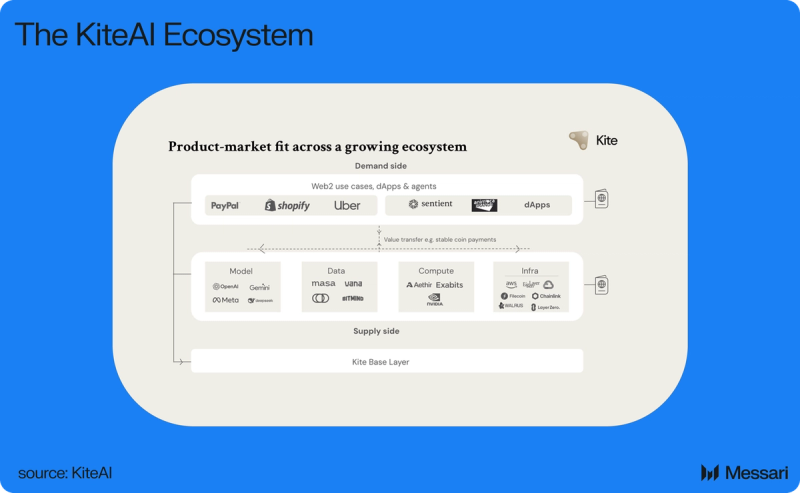
The Kite Agent App Store serves as the central marketplace and discovery hub for the KiteAI ecosystem. It is a two-sided platform where the “supply side” (developers) can list their AI agents, models, data sources, and other services for monetization, and the “demand side” (other agents, users, and applications) can discover and consume these services.
This store is instrumental to the protocol’s go-to-market strategy. The initial integration allows PayPal and Shopify merchants to register their product catalogs, making them discoverable to AI shopping agents. This creates a tangible use case where an agent, acting on behalf of a user, can query the network, find a product, and execute a purchase onchain using stablecoins, with the entire process being auditable and transparent.
Example Use Case
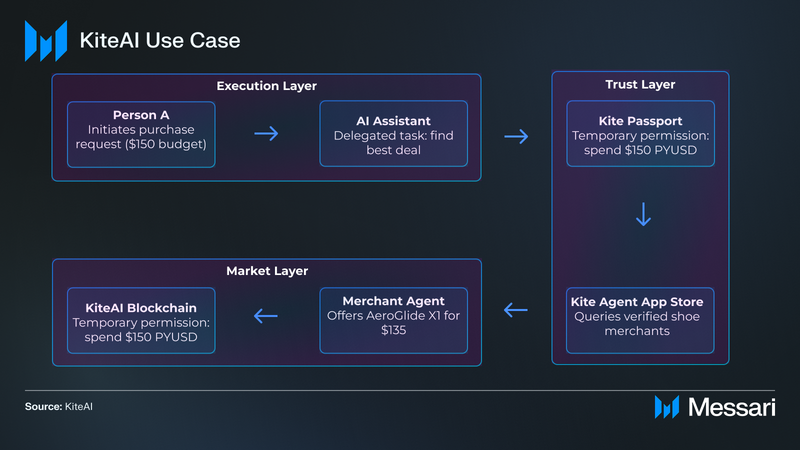
Person A initiates an automated purchase by telling his AI assistant to find the best deal on ‘AeroGlide X1’ running shoes with a $150 budget. Instantly, the assistant’s Kite Passport is activated with a temporary, task-specific permission to spend up to $150 in PYUSD. The agent then queries the Kite Agent App Store, discovering several verified shoe merchants and communicating directly with their respective agents on the KiteAI network to find the best price in real-time. After identifying a deal for $135 including shipping, the agent autonomously executes the transaction, which the KiteAI blockchain validates against the Passport’s rules before instantly settling the payment in PYUSD from Person A’s wallet to the merchant’s. The entire process, from delegation to secure onchain payment and confirmation, occurs within moments without further human intervention.
Ecosystem Overview
Key Partnerships and Integrations:
Commerce and Payments:
KiteAI’s partnerships with PayPal and Shopify are central to its go-to-market strategy, providing an immediate and scalable entry point into the real-world economy. By integrating with these two giants, KiteAI accesses a massive, pre-existing network of millions of merchants and consumers. This approach bypasses the difficult task of building a two-sided marketplace from scratch. Instead, it creates a tangible use case for agent-driven commerce where AI agents can autonomously discover products on Shopify and execute payments using PayPal’s stablecoin infrastructure. This allows KiteAI to bootstrap real-world economic activity and demonstrate immediate utility, providing a powerful incentive for developers to build agents and consumers to use them.
AI & Data Protocols:
To build a robust and decentralized AI ecosystem, KiteAI is actively collaborating with a range of specialized AI and data projects to populate the supply side of its network. These partnerships are crucial for providing agents with high-quality resources to function effectively. Key partners include Masa, a decentralized data network that offers verifiable data sources for agents, and AI Veronica, an Animoca Brands project focused on digital identity and experiences. Collaborations with protocols like Codatta, Vishwa, and Bitmind further enrich the ecosystem with diverse models and capabilities. Furthermore, KiteAI plans to attract subnets from Bittensor by offering a dedicated, high-performance environment for execution and onchain settlement. The goal is not to replace a subnet’s core AI function but to offload its most significant pain points: economic coordination and settlement. Currently, a subnet’s mining, validation, and the resulting high volume of micropayments all rely on Bittensor’s native blockchain, which can be slow and expensive. By handling these economic activities, KiteAI’s architecture is designed to act as a specialized financial and logistical backbone, allowing the subnets to focus on their core AI competition while benefiting from faster and cheaper settlement
Crosschain Interoperability:
Recognizing that the future of blockchain is multichain, KiteAI is integrating with crosschain interoperability protocol LayerZero as its primary bridging provider to ensure seamless interoperability from the outset. This integration prevents the KiteAI ecosystem from becoming a siloed environment, enabling the seamless transfer of assets and data between KiteAI and other major blockchain networks like Ethereum, Solana, and Avalanche. Users and agents can easily move value and leverage assets from other ecosystems within KiteAI’s agentic framework. For the protocol, it also ensures composability, allowing it to serve as a foundational layer that can interact with and draw value from the entire Web3 space.
DeFi Primitives
To create a self-sustaining onchain economy, KiteAI is developing a suite of native DeFi applications. This goes beyond simple payments, enabling agents to become autonomous economic actors. The planned infrastructure includes liquid staking protocols for capital efficiency, a perpetuals DEX for advanced financial strategies, and a borrow/lend protocol. This economic infrastructure will allow agents to manage capital, earn yield on idle assets, hedge against risk, and access leverage autonomously, unlocking more sophisticated use cases.
Roadmap
KiteAI is progressing through a multi-phased testnet program, methodically building and testing its infrastructure, leading to a mainnet launch scheduled for Q4 2025.
- Testnet V1 (aero): Completed. This initial phase was an incentivized, retail-focused testnet that provided a no-code environment for users to experience agent interactions. It successfully validated user interest, attracting over 53 million testnet wallets and processing nearly 1 billion agent interactions.
- Testnet V2 (ozone): Completed. This phase expanded on the first by introducing core infrastructure like Universal Accounts via account abstraction, social logins, and initial staking mechanisms. It also began onboarding ecosystem partners to deploy their agents on the network, testing the two-sided marketplace dynamics.
- “Fly the Kite” NFT Collection: An initiative to reward early adopters and community contributors with a PFP NFT collection, fostering strong community engagement and cultural identity before the mainnet launch.
- Testnet V3 (Upcoming – September 2025): This is the final primary testnet phase before mainnet. It will focus on hardening the network and introducing critical, production-ready features such as multisig wallet support for enterprise users, a cross-chain bridge via LayerZero, expanded staking and delegation options, airdrop functionality for community distribution, and initial on/off-ramp integrations.
- Mainnet Launch (Upcoming – Q4 2025): The public launch of the KiteAI L1 blockchain as an Avalanche C-chain will bring the protocol’s full functionality to the public and mark the beginning of its onchain economy.
Conclusion
KiteAI is developing a highly specialized Layer-1 blockchain to address the burgeoning agentic economy’s unique and demanding infrastructure requirements. By combining a programmable, DID-based identity system (Kite Passport) with a novel contribution-based incentive mechanism (Proof of Artificial Intelligence), the project is building a foundational trust layer for autonomous AI agents. The protocol’s strategic focus on stablecoin-based payments, underpinned by significant backing from industry leaders like PayPal Ventures and General Catalyst, provides a clear and pragmatic path to adoption, starting with the tangible and expansive use case of e-commerce.
The choice to engineer a custom L1 architecture is an acknowledgment of the technical challenges ahead, while prioritizing fast finality, economic predictability, and customizability to support real-time, machine-to-machine coordination at scale. As KiteAI approaches its mainnet launch with a growing ecosystem of AI, data, and DeFi partners, it is strongly positioned to become critical infrastructure for the future of automated commerce and decentralized AI. The project’s ultimate success will hinge on its ability to cultivate a vibrant two-sided marketplace, attract a critical mass of developers to build innovative agents, and deliver on its ambitious promise of a secure and scalable economic layer for artificial intelligence.