Key Insights
- Yield Guild Games (YGG) is evolving beyond its original guild model, expanding into game publishing and game development.
- YGG debuted as a publisher with LOL Land, a browser-based casual board game that initially offered a $10.0 million YGG token rewards pool.
- YGG launched YGG Play, its publishing arm, to rebalance the publisher–developer relationship through smart contract–enforced, real-time revenue sharing that improves transparency and aligns incentives
- LOL Land attracted over 630,000 monthly users on Abstract in July and generated $3.1 million in revenue.
- YGG conducted token buybacks, repurchasing 135 ETH (~$518,000) worth of YGG on July 31, 2025 and did another subsequent buyback on August 22, 2025 for $1.0 million USD with revenue generated from LOL Land.
Introduction
Yield Guild Games (YGG) emerged in 2020 as a decentralized network of gaming guilds with a mission to democratize access to play-to-earn opportunities in virtual worlds. By organizing a global network of players, creators, and builders, YGG enabled participants to earn real income from blockchain games and helped shape the foundational narrative of Web3 gaming.
Over the following years, YGG grew into the largest Web3 gaming community by pioneering the scholarship model that gave players access to NFTs from guild-owned treasuries, most famously during the Axie Infinity boom. YGG also launched the Guild Advancement Program (GAP), a series of structured quests that rewarded player participation and became one of the most successful questing initiatives in the space. To scale globally, YGG established partnerships with regional guilds worldwide such as YGG Pilipinas, OLA GG in Latin America, and KGEN (formerly IndiGG) in India, building localized entry points into Web3. Alongside community growth, YGG invested in and partnered with dozens of blockchain games, including Axie Infinity, The Sandbox, and Illuvium, creating a wide network of opportunities for its members.
As the market matured, YGG recognized that the traditional play-to-earn model struggled to sustain engagement. Crypto-native users wanted fast, fun, and rewarding experiences, a gap that guild programs alone could not fill. This recognition catalyzed YGG’s expansion from being solely a guild platform to becoming a full-stack game publisher and ecosystem operator. Through its new publishing arm, YGG Play, YGG now focuses on creating and distributing games tailored to the emerging “casual degen” market segment.
YGG Play: LOL Land
On May 23, 2025, YGG launched its publishing arm, YGG Play, and with it, its first title: LOL Land. LOL Land is a browser-based casual board game built on Abstract. Designed as a “casual degen” experience, it combines approachable gameplay with Web3 features. It allows players to move through Monopoly-style themed boards, earn points, unlock NFTs, and compete for rewards from a $10.0 million YGG token pool. The game integrates community-driven characters, including Pudgy Penguins, to bring a playful twist to the traditional board game format. Early reception on LOL Land has been positive, with LOL Land having over 25,000 players join in on its opening weekend. While still early, LOL Land has attracted a foundation of active users on Abstract that it can build upon.
Since launch, LOL Land has generated over $3.1 million in revenue, averaging $27,361 daily. While still in its early stages, the game has established a solid foundation for growth with promising initial traction. By targeting the “casual degen” audience, LOL Land benefits from a steady flow of players who can quickly enter the game, spend modest amounts of time and money, and engage in light, rewarding gameplay.
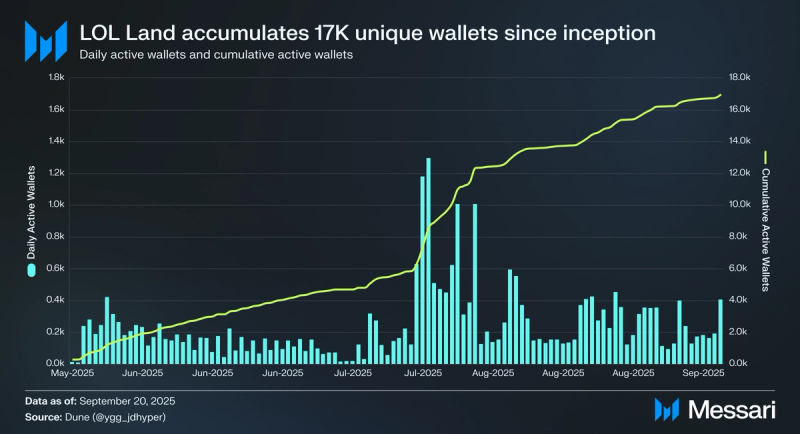
LOL Land attracted 16,979 unique wallets since launch, averaging 243 daily active players. YGG’s efforts to drive adoption had a direct impact, with activity spiking on July 21, 2025, during Malaysia Blockchain Week, where the game was featured alongside Cambria, Planet Hares, and Spekter in the Gaming Cave booth. The surge demonstrated YGG’s efforts to actively grow the player base with event-led activations.
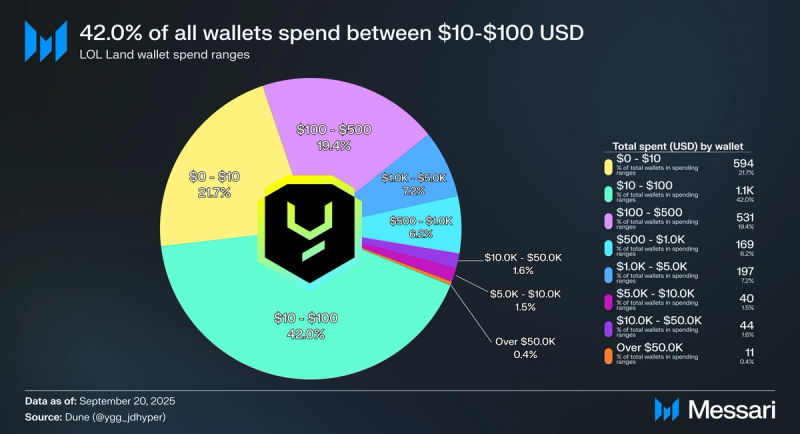
Over 42.0% of spenders on LOL Land spent between $10 and $100, aligning with YGG’s intent to design a “casual degen” game where players could jump in easily, spend a small amount, and play for the chance at points that can be exchanged for NFTs and YGG tokens. At the same time, the game attracted high-value spenders, with more than 55 wallets contributing over $10.0K and 11 wallets spending above $50.0K. This barbell distribution showed that LOL Land appeals across the spectrum, engaging a broad base of casual users while capturing significant value from whales. Reflecting this mix, YGG’s average revenue per user (ARPU) reached $1,020, a figure higher than traditional gaming titles, highlighting how YGG Play’s design combines accessibility for casuals with spending from whales.
Third Party Publishing
In addition to launching its first game, YGG partnered with other titles to expand its third-party publishing service through YGG Play. A key motivation for building this arm was to address long-standing tensions in the traditional publisher–developer relationship. In the Web2 model, publishers collect revenue and distribute it to studios on delayed schedules, often leaving developers with little visibility into their earnings and limited influence over key decisions. YGG Play aims to rebalance this dynamic by embedding revenue sharing directly into smart contracts. This model ensures that revenues are split automatically between publisher and developer, payments are onchain, and neither side has to rely on the other’s reporting or discretion. The result is greater transparency, trustless enforcement of agreements, and better alignment of incentives. YGG Play’s first third party publisher partner, Gigaverse, highlights this approach not only through cross-game activations such as a Gigaverse-themed board in LOL Land and LOL Land skins in Gigaverse, but also through the adoption of YGG Play’s smart contract-enforced, revenue sharing. GIGACHADBAT, a new title from South Korean Web3 game development studio Delabs Games, has also joined the YGG Play ecosystem as a third-party publishing partner.
YGG Treasury
YGG’s financial strategy has matured alongside its business model. Following the successful launch of LOL Land, YGG completed a 135 ETH buyback of YGG in July 2025 as well as a $1.0 million buyback in August, funded directly from the game’s revenues after covering development and deployment costs. The $518,000 and $1.0 million transactions represented YGG’s long-term commitment to ecosystem success by cycling new revenues back into its token economy. The move aligned with its treasury strategy, which was to generate sustainable, reinvestable cash flows that support operational growth.
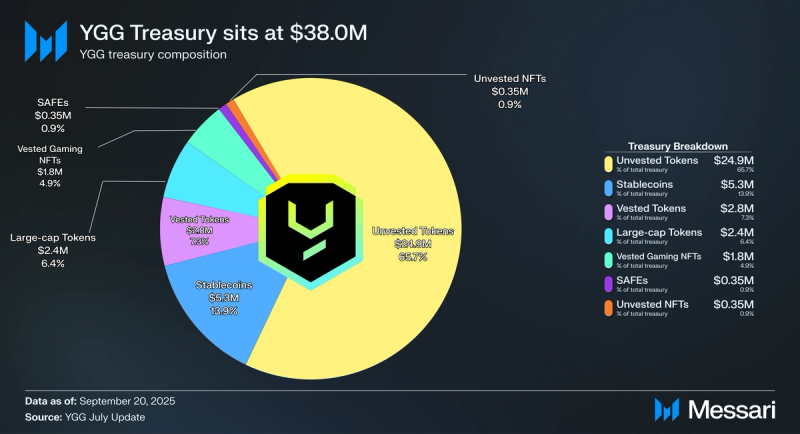
The YGG treasury remains robust, with a reported value of $38.0 million as of July 2025, including $7.7 million held in stablecoins, T-bills, and large-cap tokens. With this treasury, YGG has stated that it has enough runway to continue operating well into 2027. The launch of LOL Land has also boosted the Treasury, as now YGG has a revenue-generating product.
Closing Summary
YGG’s expansion into publishing through YGG Play marks a significant evolution of its business model. The launch of LOL Land demonstrated early success, generating millions in revenue, attracting a solid player base, and establishing a repeatable framework for engaging the “casual degen” audience. These results highlight the viability of YGG Play as both a revenue engine and a community growth tool, validating YGG’s decision to expand beyond its original model. With LOL Land providing proof of concept and titles such as Gigaverse and GIGACHADBAT already joining as partners, YGG Play is positioned to scale its publishing footprint and further integrate its success into its ecosystem.