Key Insights
- Plume Genesis launched on June 5, 2025, with $150 million in utilized RWAs and support from institutions like Blackstone, Invesco, and Galaxy. Within weeks, it became the top-ranked network by number of RWA holders.
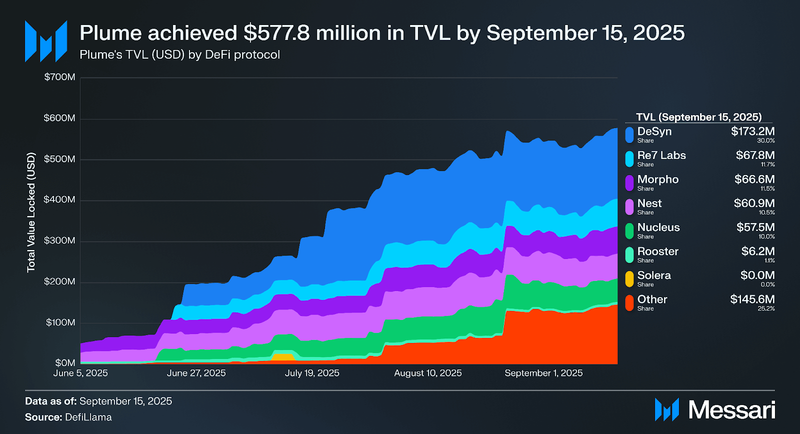
- Plume reached $577.8 million in TVL by mid-September, led by Nest’s RWA vaults and a growing ecosystem of DeFi protocols like DeSyn, Nucleus, Morpho, Solera, and Rooster.
- Plume’s tokenized asset market grew to $170 million by mid-September, spanning 144 assets across more than 200,000 wallets. Top issuers include Superstate, Nest, and Mercado Bitcoin.
- Plume’s Season 2 incentive program allocates 150 million PLUME tokens to reward long-term participation across protocols like Nest and Rooster.
Introduction
On June 5, 2025, Plume (PLUME) officially launched Plume Genesis, the public mainnet designed for real-world asset finance (RWAfi). Plume is a full-stack Layer-1 network and ecosystem purpose-built to enable the interaction between tokenized real-world assets (RWAs) and DeFi protocols. At launch, Plume had already integrated with traditional financial titans (e.g., Blackstone and Invesco) and DeFi mainstays (e.g., Curve and Morpho), onboarding over $150 million in utilized RWAs. Plume’s Series A was backed by major investors (Brevan Howard, Apollo, Galaxy, etc.), and the network went live with more than 70 projects live or in development.
Since launch, Plume has surpassed Ethereum to become the highest-ranked network by the total number of RWA holders. According to rwa.xyz, the count of addresses holding RWAs on Plume jumped to over 103,000 within weeks of launch, which is roughly 50% of all RWA holders across public networks. It currently stands at over 200,000. Through the Plume Portal, users can bridge assets into Plume, swap tokens, and explore protocols like Nest, Rooster, and Solera. By abstracting away complexity, the portal helps make RWAs feel like native crypto by making them instantly swappable, composable, and accessible.
Early Mainnet Performance
TVL
DeFi activity on Plume has been strong since its mainnet launch in June 2025. By September 15, total value locked (TVL) reached $577.8 million in USD terms and 4.9 billion in PLUME. Desyn accounted for the largest share at $173.2 million, or 30% of TVL.
Nest is Plume’s flagship RWA staking protocol. It allows users to deposit stablecoins into various RWA vaults and receive liquid ERC-20 tokens called nTOKENS. These tokens are composable across Plume’s DeFi ecosystem. For instance, a user can deposit pUSD into the Nest Treasury Vault to receive nTBILL, then deposit nTBILL into a lending market like Solera to borrow against it.
Other notable protocols contributing to Plume’s TVL include:
- DeSyn Protocol: A platform for creating and managing onchain portfolios like ETFs and structured funds. It supports open-end, closed-end, and custom strategies, which enable flexible asset management via smart contracts. One month after launch, DeSyn pools held $58.8 million in TVL (22.2% share).
- Nucleus: Nucleus is a yield infrastructure protocol that embeds default yield at the network layer for bridged assets. Plume uses Nucleus’s BoringVault to back its stablecoin pUSD 1:1 with USDC, ensuring liquidity and price stability without protocol fees. Nucleus launched with Plume mainnet and reached $57.5 million in TVL (10% share).
- Morpho: Morpho is a lending protocol for creating isolated, overcollateralized markets onchain. On Morpho Lite, users can borrow against Nest vault tokens and other assets curated by Re7 Labs. As of mid-September, Morpho had $66.6 million in TVL (11.5% share).
- Rooster Protocol: Rooster is a DEX on Plume specifically designed for trading tokenized RWAs. It utilizes Maverick Protocol’s AMM and a ve(3,3) flywheel incentive model to improve liquidity and price discovery for a wide range of RWA tokens. Rooster supports over 20 RWA assets, including those from Nest. Rooster holds $6.2 million in TVL (1.1% share).
Tokenized Assets on Plume
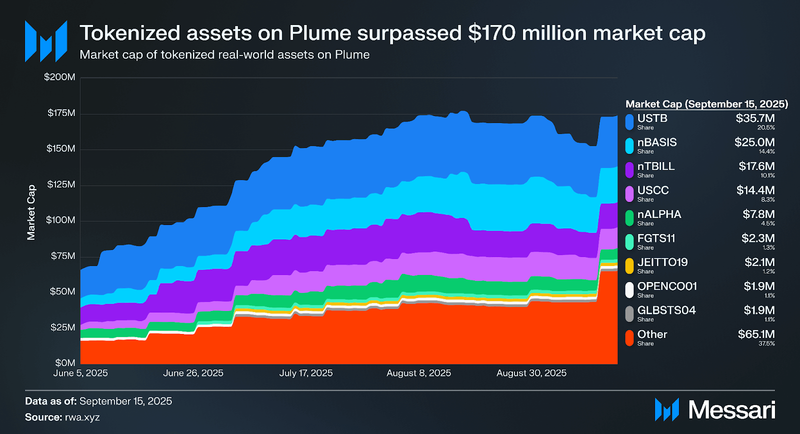
Plume launched with $65.8 million in tokenized assets, which grew to $170 million by September 15, 2025. According to rwa.xyz, there are currently 144 tokenized assets on the network, distributed across more than 202,000 addresses. The largest assets by market share were deployed by Superstate, Nest, and Mercado Bitcoin.
Superstate allows qualified investors to mint and redeem ERC-20 fund shares using USDC, with real-time pricing and onchain settlement. Its leading assets on Plume are USTB ($35.7 million market cap) and USCC ($14.4 million market cap). USTB represents the Short Duration U.S. Government Securities Fund, which provides exposure to short-term Treasury Bills. USCC is the Crypto Carry Fund, a strategy that captures yield from the spread between spot and futures markets for Bitcoin and Ethereum. These assets are restricted to qualified investors but become composable within DeFi when held by Nest.
Nest’s top assets include nTBILL ($17.6 million market cap) and nBASIS ($25 million market cap). nTBILL aggregates short-duration yield products, such as USTB and M0’s M, into a single token. nBASIS provides exposure to delta-neutral basis strategies, including USCC’s carry trade and Mida’s mBASIS, which targets crypto funding rates.
Mercado Bitcoin (MB), one of the largest issuers of tokenized private credit, has deployed 132 assets on Plume with a combined market cap of $71.7 million. Top tickers include FGTS11 ($2.2 million) and JEITTO19 ($2 million). FGTS11, created in partnership with Prata Digital, is backed by Brazilian payroll receivables and offers a CDI+1.5% annual yield to retail investors. JEITTO19 is backed by a portfolio of microloans and offers fixed yields above the CDI benchmark in exchange for exposure to Brazilian consumer credit.
Stablecoins on Plume
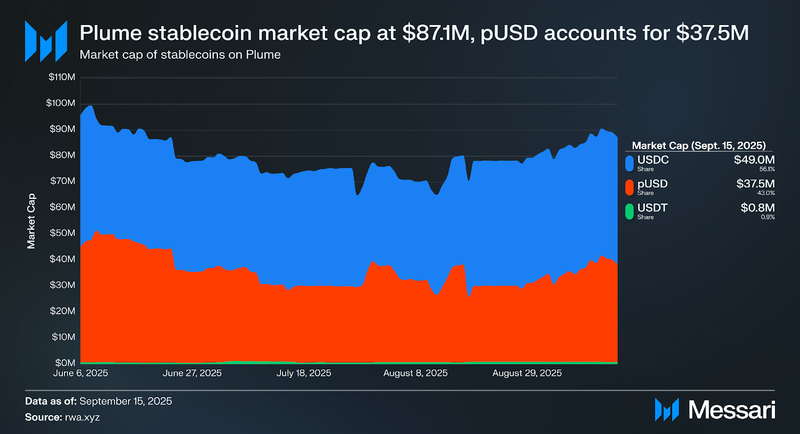
As of September 15, 2025, the total stablecoin market cap on Plume is $87.1 million. The largest share belongs to bridged USDC, which accounts for $49 million. Plume’s native stablecoin, pUSD, holds a market cap of $37.5 million. Bridged USDT makes up the remainder with $800,000 in circulating supply.
Plume USD (pUSD) is the network’s flagship stablecoin. Users can mint pUSD by depositing USDC or USDT into BoringVaults, which are operated by Nucleus. These vaults rebalance reserves to maintain liquidity and preserve the 1:1 dollar peg. Redemptions are available at parity with no protocol fees. pUSD is deployed on both Ethereum and Plume, enabling interoperability and streamlined integration across DeFi protocols. While pUSD itself is non-yielding, the Plume team is developing opt-in staking wrappers that will allow users to earn real-world yields.
Plume also announced plans to integrate Agora’s AUSD. AUSD will serve two roles on the network: as eligible collateral within Nest and as a reserve asset for pUSD. This integration is expected to enhance liquidity and provide additional backing for pUSD. AUSD is backed by a mix of short-duration U.S. Treasuries, cash, and overnight reverse repos. Reserves are managed by VanEck and held with State Street, which aligns with Plume’s emphasis on institutional-grade design and transparent reserve management.
Plume is integrating native USDC and Circle’s Cross-Chain Transfer Protocol (CCTP) V2, giving its ecosystem direct access to the largest regulated stablecoin. This upgrade replaces reliance on bridged USDC and allows users to mint and redeem Plume’s pUSD stablecoin directly against USDC. The addition of CCTP V2 also enables faster, cost-efficient crosschain transfers.
Plume Airdrop and Incentives
A key driver of Plume’s early traction has been its airdrop and incentive campaigns. Before mainnet, Plume launched a “Season 1” airdrop on testnet that recorded over 18 million wallets and 280 million transactions. This initiative distributed initial PLUME tokens to early adopters and testers. Following its mainnet launch, Plume introduced “Season 2” to sustain momentum and grow network usage. The Plume Foundation committed up to 150 million PLUME tokens for rewards distributed over time across various onchain activities.. Distribution is coordinated through Royco Markets, a partnered liquidity mining platform.
Users can earn PLUME by depositing assets or providing liquidity to designated Plume protocols, including Nest vaults and Rooster liquidity pools. To qualify, assets must remain in place for at least 90 days. This time lock discourages short-term farming and incentivizes long-term engagement. Plume has also launched PLUME staking for validator participation, which introduces a new stream of rewards and may serve as a future eligibility criterion for additional airdrops.
Overall, these programs have been effective in attracting crypto-native users to the Plume ecosystem. By linking rewards to actions that build protocol liquidity and adoption, such as bridging assets, interacting with RWA applications, or contributing to security, Plume has translated early interest into durable growth. The community, known as “Plume Goons,” continues to expand, with many participants now aligned with the network’s long-term success.
Closing Summary
In its first month of mainnet operation, Plume has established itself as a serious contender in the emerging RWAfi sector. With over $577 million in TVL, more than 200,000 wallet addresses interacting with tokenized assets, and a growing catalog of integrated DeFi protocols, Plume has achieved both early traction and strong infrastructure alignment. The network’s native stablecoin, pUSD, alongside major tokenized products from Superstate, Nest, and Mercado Bitcoin, has created a base for onchain RWAfi.
As Plume continues to expand its ecosystem and deepen its integrations with both crypto-native and traditional finance players, it positions itself as a scalable solution for institutional and retail RWA adoption. By abstracting away technical hurdles and aligning token design with meaningful usage, Plume has turned early curiosity into measurable activity. If momentum holds, the network may become a blueprint for how RWA protocols bridge liquidity, composability, and trust in a multichain future.