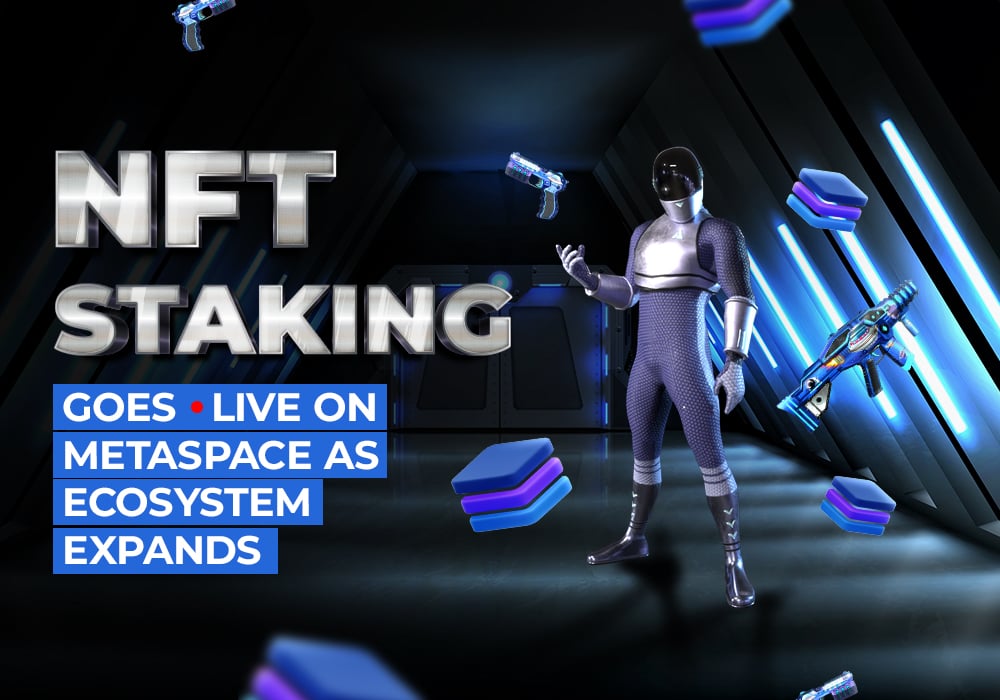
MetaSpace has rolled out NFT staking as part of its latest platform update, adding a new layer of functionality to its growing Web3 gaming ecosystem. The launch enables players to put their in-game NFTs to work, moving beyond static ownership and into an active participation model that is increasingly shaping how value is created in decentralized games.
With staking now live, early participants are beginning to explore a system designed to reward long-term involvement rather than short-term activity. As MetaSpace continues to expand its on-chain economy, access during this initial phase may play a meaningful role for users looking to position themselves ahead of broader adoption.
Data Shows NFT Markets Maturing, Holders Gain by 2026
Recent market data suggests the global NFT market is moving into a more mature growth phase rather than decline. According to industry research, the NFT market is projected to reach $45–46 billion by 2026, driven largely by gaming, utility-based NFTs, and long-term ecosystem adoption rather than speculative trading alone.
Within this broader shift, projects like MetaSpace reflect how NFTs are evolving into functional digital assets. By integrating gameplay performance, staking rewards, and ecosystem access, MetaSpace aligns closely with the market trend toward utility-first NFTs—positioning holders to benefit as NFT marketplaces continue to expand through 2026.
MetaSpace Offers a Direct Whitelist Path for NFT Collectors
Within the MetaSpace project, NFTs are organized into a clear progression system that directly connects rarity with power and earning potential. Each NFT tier represents a step forward in value, performance, and long-term utility, making it easier for players and collectors to understand how their assets contribute to staking outcomes.
MetaSpace NFT structure and staking logic:
-
NFT tiers: Common → Rare → Epic (coming soon) → Legendary (coming soon)
-
Higher-tier NFTs offer more in-game power and higher value
-
Hash rate increases as NFT rarity increases
-
Staking yield depends on the combined hash rate of staked NFTs
-
Higher hash rate results in higher potential earnings
To support collectors preparing for the next phase of the ecosystem, MetaSpace is also introducing a direct whitelist path for its upcoming Epic NFT collection. Players who hold at least one Common NFT and one Rare NFT are automatically eligible for whitelist access, creating a straightforward and accessible route for early participation in the project’s next NFT release.
NFTs Utilities in MetaSpace
NFTs within the MetaSpace project are designed to play an active role across gameplay, rewards, and community participation. Rather than serving as static collectibles, each NFT tier unlocks practical utilities that influence how players perform in-game, earn through staking, and participate in the wider ecosystem.
Key utilities unlocked by MetaSpace NFTs include:
-
Gameplay utility: Higher NFT tiers provide better in-game performance.
-
NFT staking: Stake NFTs to earn $MLD through the platform’s staking system.
-
Airdrops & rewards: Eligibility for $MLD airdrops and priority access to ecosystem rewards.
-
Esports access: Priority entry into MetaSpace esports events and pathways toward the official team.
-
Community perks: Exclusive Discord roles, tags, and early access to announcements.
-
DAO & co-builder rights: Participation in the MetaSpace DAO with recognition as a project co-builder.
Together, these utilities reflect MetaSpace’s approach to building a utility-driven NFT economy, where ownership connects gameplay, rewards, governance, and community involvement into a single, evolving ecosystem.
Conclusion
Web3 gaming is reaching a point where surface-level ownership is no longer enough. Players are beginning to value systems that reward time, strategy, and contribution—where NFTs influence outcomes, generate yield, and create real stakes in how a game evolves. This shift is separating short-lived experiments from ecosystems built to last.
Within this broader movement, the MetaSpace project offers a practical example of how staking, NFT tiers, and community access can be integrated into a single framework. By aligning gameplay performance, rewards, and governance under one system, MetaSpace contributes to the ongoing conversation around sustainable Web3 game design and player-owned economies.
Disclaimer: This article is provided for informational purposes only. It is not offered or intended to be used as legal, tax, investment, financial, or other advice.