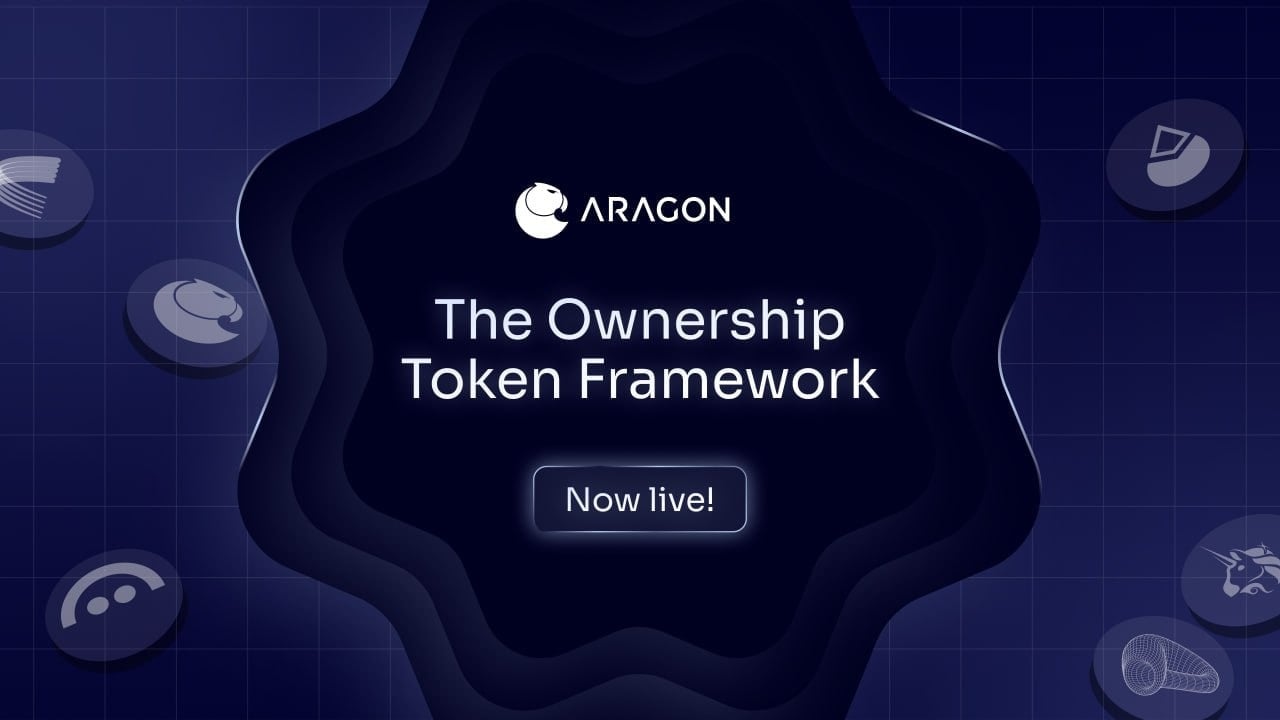
Aragon debuts a new framework and live dashboard that make token ownership verifiable, launching with Uniswap, Curve, Lido, Aerodrome, and other leading protocols as the first cohort to set a new standard for onchain transparency and accountability.
Tuesday 04 February, Zug, Switzerland — Aragon today announced the public launch of the Ownership Token Framework, a new evidence-based standard for evaluating crypto tokens on fundamentals rather than narrative. Alongside the framework, Aragon launched the Ownership Token Dashboard, a public product designed to make token ownership auditable in practice.
The launch addresses one of the crypto industry’s most persistent problems: tokens are widely traded and invested in, yet there is no shared standard for assessing what a token actually owns or can credibly claim. As a result, many tokens trade on assumptions about governance influence, future fee capture, or alignment with a protocol’s success, without clear evidence that tokenholders have enforceable rights over the assets and value flows that determine economic outcomes. Where those rights are weak, discretionary, or bypassable, markets typically discount tokens accordingly. According to a recent CoinGecko study, 11.6 million crypto tokens failed in 2025 alone, accounting for roughly 86 % of all recorded project failures between 2021 and 2025, a clear signal that many tokens in the market aren’t sustaining long-term viability.
The Ownership Token Framework is designed to make those realities transparent.Rather than treating “governance” as a proxy for ownership, the framework evaluates whether tokenholders have programmatic, enforceable control over economically material decisions and value flows. It relies on primary evidence, including deployed contracts, execution and upgrade paths, value routing mechanisms, and verifiable offchain dependencies that may reinforce or undermine tokenholder rights.
“Smart contracts make it possible to encode and enforce economic rights directly in code, but those rights only exist where systems actually implement that control plane,” said Anthony Leutenegger, CEO at Aragon. “When ownership is discretionary or unverifiable, tokenholder exposure becomes a matter of trust. The framework is built to educate market participants on the hard power a token has, and furthermore, point out offchain dependencies that may create misaligned incentives that could negatively impact a token’s value. ”
The framework evaluates tokens across four core dimensions and provides hard evidence to back up the evaluation:
-
Onchain Control: Whether tokenholders are the ultimate authority over economically material actions, including upgrades, parameter changes, emergency controls, and supply modification.
-
Value Accrual: Whether a live, rule-based mechanism produces observable value flows or token-scarcity effects that accrue to tokenholders.
-
Verifiability: Whether economically material code and deployments can be independently verified from primary onchain evidence.
-
Token Distribution: Whether ownership and effective voting power are meaningfully distributed rather than concentrated in common-control blocs.
-
Offchain dependencies: whether incentives are aligned or misaligned offchain to ensure value and security isn’t leaked away from the token
Alongside the framework, Aragon launched the Ownership Token Dashboard, a live product that operationalizes the methodology and presents structured ownership profiles for real protocols. The dashboard applies the framework using continuously updated, publicly verifiable onchain and offchain data, allowing users to inspect how ownership claims map to deployed systems in practice.
The initial launch includes profiles for UNI, CRV, LDO, AERO, and AAVE, with more tokens set to be released soon. These profiles were developed in collaboration with the listed token’s respective protocols, with each project engaging directly on scope, evidence, and accuracy of representation. This collaborative process ensures that listings reflect validated deployments and governance structures rather than third-party interpretation or speculation.
Each dashboard profile links directly to the underlying evidence supporting its assessment, including deployed contracts, governance execution paths, and relevant offchain structures where applicable. New token listings will be added on a rolling basis, with the dashboard designed to evolve into a living reference for token fundamentals as the standard expands.
The Ownership Token Framework and dashboard were developed in collaboration with participating protocol teams and reviewed by governance, legal, and policy experts focused on onchain systems and digital asset structures. The review process was designed to surface how ownership and control actually function after a token launches, including the risks introduced by discretionary or opaque dependencies. “Aragon’s framework provides much needed transparency for network tokens. It shows who still has power over a token after it launches, what that means for users and investors, and what risks come with those hidden dependencies,” said Miles Jennings, General Counsel at a16z crypto.
The Ownership Token Framework and dashboard do not constitute legal, financial, or investment advice.
About Aragon
Aragon creates the systems that help networks run securely at scale, from how they allocate capital to how they make decisions and manage ownership.
Founded in 2017, Aragon is a leading onchain infrastructure provider powering governance, capital allocation, and protocol ownership for some of the largest networks in crypto. Its modular frameworks are used to manage tens of billions of dollars in assets and support high-profile implementations including Lido, Curve, Polygon, Taiko, Morpho, Katana, and others.
At the core of the Aragon stack is Aragon OSx, a modular execution and permissions layer that separates decision-making from execution, allowing governance and ownership systems to evolve without risky migrations. On top of this foundation, Aragon provides products and services for tokenomics design, incentive and capital distribution, treasury management, and secure, upgradeable governance.
Aragon emphasizes security, modularity, and long-term resilience. Its infrastructure has operated for more than eight years without security incidents and is designed to help networks coordinate value, adapt over time, and build systems worth owning.
Learn more at aragon.org.
Media Contact:Amy Wilkinsonamy@aragon.org
Disclaimer: This article is provided for informational purposes only. It is not offered or intended to be used as legal, tax, investment, financial, or other advice.